6 Months Later: Is Vanguard’s Overlooked Monthly Income ETF Still Worth It?
Roughly six months ago, our December 2025 piece flagged Vanguard Emerging Markets Government Bond Index Fund ETF Shares (NASDAQ: VWOB) as an overlooked monthly-income play for retirees, highlighting a roughly 5.7% yield, monthly distributions near $0.32 per share, and a…


Roughly six months ago, our December 2025 piece flagged Vanguard Emerging Markets Government Bond Index Fund ETF Shares (NASDAQ: VWOB) as an overlooked monthly-income play for retirees, highlighting a roughly 5.7% yield, monthly distributions near $0.32 per share, and a surprise 13.5% capital gain in 2025. The thesis was simple: emerging-market sovereign debt was quietly paying retirees a check every month while also delivering price appreciation. Half a year later, the VWOB story has split in two. The income leg has held up cleanly. The capital-gain tailwind has gone flat.
What VWOB Is Built to Do
VWOB tracks the Bloomberg USD Emerging Markets Government RIC Capped Index, holding U.S. dollar-denominated bonds issued by emerging-market governments. Because the bonds are dollar-denominated, holders sidestep direct local-currency risk. However, they still carry sovereign credit risk from issuers like Mexico, Brazil, Saudi Arabia, and Turkey. The return engine is straightforward: coupon income from a diversified basket of EM sovereigns, passed through monthly. The fund manages $6.1 billion in assets at a 0.15% expense ratio, making it one of the cheapest ways to access this corner of fixed income.
The Income Leg Is Doing Its Job
VWOB’s monthly distributions have been steady. From December 2025 through June 2026, payouts ranged from $0.3180 to $0.3396 per share, with the June 2026 distribution at $0.3189. That is a tighter band than the $0.3137 to $0.3855 range seen in the prior six months, which included an August 2025 catch-up payment.
The Price Story Has Cooled
This is where expectations need a reset. VWOB closed at $66.65 on June 10, 2026, up just 1.3% year to date. The trailing one-year return of 3.3% looks a little healthier. However, almost all of that was earned in 2025. The catalyst for the flat line is no mystery: the Federal Reserve has held the federal funds rate at a range of 3.50% to 3.75% since mid-December 2025. With Treasuries paying more, emerging markets bond prices have less room to run. For holders, this means the 2026 return is now essentially the coupon, full stop.
VWOB Versus EMB After Six Months
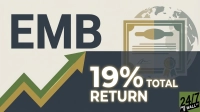
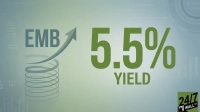
The pricier alternative we floated in December, iShares J.P. Morgan USD Emerging Markets Bond ETF (NASDAQ: EMB), has tracked a similar path. EMB charges 0.39%, holds $14.1 billion, and carries a 5.9% dividend yield. Over the same six-month window, EMB returned 2% and is up 10% over one year. The trade is the usual one: EMB offers deeper liquidity and broader benchmark coverage, while VWOB charges 24 basis points less. EMB also carries notable concentration in distressed credit, with four Argentina positions totaling 3% of net assets, a risk VWOB’s broader, capped methodology dilutes.
The Tradeoffs to Weigh
Three issues matter for anyone holding VWOB today:
- Distributions are taxed as ordinary income, so the fund works best inside an IRA or 401(k).
- Sovereign credit risk in places like Argentina, Ghana, and Turkey is genuine.
- Duration risk cuts both ways: another leg up in Treasury yields would pressure the net asset value (NAV) before any coupon offset.
Who It Fits Now
VWOB still earns a place as a 5% to 10% income sleeve for retirees in tax-deferred accounts who have accepted that the next twelve months will likely look like coupon-only returns rather than the 2025 windfall. Investors needing capital preservation, taxable-account efficiency, or any meaningful upside should look elsewhere. The income promise survived six months of rate volatility. The growth bonus did not.
Contact [email protected] for any questions or corrections.
Trey has been an editor and author at 24/7 Wall St. for more than a decade, where he has published thousands of articles analyzing corporate earnings, dividend stocks, short interest, insider buying, private equity, and market trends. His comprehensive coverage spans the full spectrum of financial markets, from blue-chip stalwarts to emerging growth companies.
Beyond 24/7 Wall St., Trey has created and edited financial content for Benzinga and AOL's BloggingStocks, contributing additional hundreds of articles to the investment community.
Trey's editorial expertise extends across multiple publishing environments. He served as production editor at Dearborn Financial Publishing and development editor at Kaplan, where he helped shape financial education materials. Earlier in his career, he worked as a writer-producer at SVE. His freelance editing portfolio includes work for prestigious clients such as Sage Publications, Rand McNally, the Institute for Supply Management, the American Library Association, Eggplant Literary Productions, and Spiegel.
Outside of financial journalism, Trey writes fiction and has been an active member of the writing community for years, moderating workshop sessions at regional conventions.