Prediction: Elon Musk Will Target 2 Trillion-Dollar Acquisitions After the SpaceX IPO
The market is already treating tomorrow’s SpaceX IPO as one of the most important public offerings in decades. Investors are focused on valuation, demand, and whether the company can justify the excitement surrounding a business that spans launch services, Starlink…

The market is already treating tomorrow’s SpaceX IPO as one of the most important public offerings in decades. Investors are focused on valuation, demand, and whether the company can justify the excitement surrounding a business that spans launch services, Starlink internet, artificial intelligence, robotics, and advanced manufacturing.
Yet the bigger story may be what happens after the IPO.
Elon Musk has never viewed companies as standalone entities. Instead, he tends to assemble ecosystems. Tesla (NASDAQ:TSLA | TSLA Price Prediction), SpaceX, Neuralink, X, and xAI all serve pieces of a broader vision centered on energy, transportation, communications, manufacturing, and artificial intelligence. If history is any guide, the SpaceX IPO may not mark the end of Musk’s expansion plans. It could be the beginning of an acquisition spree unlike anything Wall Street has seen.
Intel May Be the Most Logical Target
The first acquisition target sounds improbable until you examine the numbers. Musk recently described chip production as an “existential struggle.” During SpaceX’s IPO roadshow, he also noted that he doesn’t think in five-year timelines.
“My timelines go one year, two year, and at year three it goes to infinity.”
That statement matters because building a state-of-the-art semiconductor fabrication facility typically requires four to six years and tens of billions of dollars. According to Intel‘s (NASDAQ:INTC) filings, the company spent more than $17 billion on capital expenditures in 2025 alone while operating one of the world’s largest semiconductor manufacturing networks.
Here’s what the numbers tell us:
| Company | Key Asset | Annual Revenue |
| Intel | Semiconductor fabs and manufacturing expertise | $52.9 billion |
| Nvidia (NASDAQ:NVDA) | AI chip design leadership | $215.9 billion |
| SpaceX | Launch, Starlink, and space infrastructure | $18.7 billion |
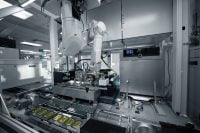
Intel’s value isn’t just its revenue. It already possesses decades of manufacturing expertise, thousands of chip engineers, and fabrication facilities spread across the United States and Europe.
As I argued previously, if Musk believes AI infrastructure is the defining challenge of the next decade, buying manufacturing capability may be faster than building it from scratch. Acquiring Intel would instantly give SpaceX access to one of the few organizations on Earth capable of producing advanced chips at scale.
Granted, integrating a legacy semiconductor giant would be difficult. Intel’s manufacturing technology still trails the industry leader, Taiwan Semiconductor Manufacturing (NYSE:TSM). That said, Musk has repeatedly shown a willingness to tackle complex industrial turnarounds that others considered impossible.
Why Tesla Could Be Next
The second acquisition candidate is hiding in plain sight. Musk has openly discussed the possibility of combining Tesla and his other ventures in the past. The blueprint already exists.
First, Musk acquired Twitter. Then Twitter was absorbed into X. Earlier this year, xAI merged with X, combining AI models, data, distribution, and computing infrastructure under a single corporate structure. A future merger between SpaceX and Tesla would follow that same pattern.
Consider what Tesla brings to the table:
- Some $94.8 billion in annual revenue.
- Energy storage operations growing faster than vehicle sales.
- Manufacturing expertise across multiple continents.
- Humanoid robotics through Optimus.
- Massive AI training requirements through autonomous driving efforts.
Surprisingly, Tesla and SpaceX increasingly rely on many of the same strategic resources: AI chips, manufacturing capacity, robotics, batteries, and computing infrastructure. The overlap is growing rather than shrinking.
A combined organization could potentially streamline capital allocation while giving investors exposure to electric vehicles, energy storage, artificial intelligence, robotics, satellite communications, and space transportation through a single entity.
Key Takeaway
In short, investors may be underestimating how aggressively Musk could move after the SpaceX IPO.
Intel offers something Musk repeatedly says he needs immediately: semiconductor manufacturing expertise and existing fabrication capacity. Tesla offers something equally valuable: a business already intertwined with Musk’s broader AI and automation ambitions.
Whether either deal actually happens is impossible to predict. Regulatory hurdles alone would be enormous. Regardless, the pattern is becoming difficult to ignore. Musk has spent the last several years consolidating capabilities rather than operating separate empires.
If that strategy continues, Intel and Tesla look like the two most logical trillion-dollar acquisition targets waiting on the other side of the SpaceX IPO.
Contact [email protected] for any questions or corrections.
After two decades of patrolling the dark corners of suburbia as a police officer, Rich Duprey hung up his badge and gun to begin writing full time about stocks and investing. For the past 20 years, he’s been cruising the markets looking for companies to lock up as long-term holdings in a portfolio while writing extensively on the broad sectors of consumer goods, technology, and industrials. Because his experience isn’t from the typical financial analyst track, Rich is able to break down complex topics into understandable and useful action points for the average investor. His writings have appeared on The Motley Fool, InvestorPlace, Yahoo! Finance, Money Morning, and, of course, 24/7 Wall St. He has been featured in both U.S. and international publications, including MarketWatch, Financial Times, Forbes, Fast Company, and USA Today.