Wall Street Analyst: SpaceX IPO Could Unleash Billions in New Public Offerings
Citizens’ JMP Devin Ryan, Head of Financial Technology Research, argued on CNBC’s Squawk Box on June 12 that the real story of the SpaceX listing is the message it sends to every other private company sitting on the sidelines. “It’s…

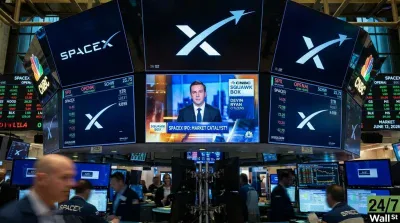
Citizens’ JMP Devin Ryan, Head of Financial Technology Research, argued on CNBC’s Squawk Box on June 12 that the real story of the SpaceX listing is the message it sends to every other private company sitting on the sidelines. “It’s good to be an investment banker, largest deal ever,” Ryan said, before pivoting to the bigger question around the second-order effects this move could bring: “What does this imply for more deals coming and just kind of reopening the capital markets, which I think everyone’s been waiting for.”
A 4-5 Year IPO Drought
Ryan bluntly quantified the slump the market’s seen for new IPOs: “We haven’t had a functioning IPO market for 4 or 5 years. And we’re still at roughly half of where we were in 2021, which was a prior peak,” he said. Capital that would normally flow through public listings has instead pooled into private rounds. He pointed to OpenAI raising $120 billion in private fundraising in February as evidence that demand for growth companies exists.
The pent-up supply is visible in filings. SpaceX’s own S-1 confirms that it is required to apply the net proceeds of a qualified initial public offering to repay amounts outstanding under the SpaceX Bridge Loan within six months of receipt, illustrating how closely linked the listing is to debt markets.
The Second-Order Trade: Brokers and Banks
Ryan was direct about what he feels is coming next. “This deal has to perform well. Everyone’s watching that. And then if it does, the rest of the pipeline I think starts to move forward.” Demand signals are encouraging so far. BlackRock placed an order for at least $5 billion in shares, and Goldman Sachs and Morgan Stanley are co-leading the underwriting at fees reportedly negotiated below 0.75%, which would still produce one of the largest paydays in banking history, given the deal size.
The most important point for investors may be Ryan’s view on downstream revenue. “The second-order impact, I think, is actually going to be much bigger for retail brokers and even the investment banks than what this actual deal is for the P&L on day one. There’s a lot more that’s going to come off of this,” he said. Trading commissions, securities lending, options activity, and derivative products built around a newly public mega-cap can persist for years and drive meaningful revenue for brokerages and banks.
Retail platforms cited in the discussion include Charles Schwab (NYSE:SCHW | SCHW Price Prediction) and Robinhood Markets (NASDAQ:HOOD). Both have lagged this year, with Schwab down 10.6% year-to-date through June 11, while Robinhood is off 18.45% year-to-date despite a 17.84% rally over the past month.
What to Watch Next
The biggest question is whether SpaceX’s strong debut encourages other private companies to move forward with public listings. Ryan argued that many firms have been waiting on the sidelines for a successful IPO to reopen the market, and SpaceX could provide that catalyst.
If SpaceX performs well in its first few weeks of trading, expect more companies to test investor demand. For investors, the broader opportunity is the potential impact on investment banks, brokers, and other financial firms that benefit when IPO activity accelerates.
Contact [email protected] for any questions or corrections.
Thomas Richmond is a financial writer and content strategist with 5+ years of experience covering stocks and financial markets. He has published over 500 articles focused on individual stock analysis, helping investors better understand business fundamentals, stock valuations, and long-term opportunities.
Thomas previously served as a Content Lead at TIKR, a stock research platform, where he helped scale the company’s blog to hundreds of articles per month and contributed to a weekly newsletter reaching more than 100,000 investors.
Outside of work, Thomas enjoys weight lifting and soccer.