Should You Look for the “Next Nvidia” or Just Buy the Real Thing?
The artificial intelligence boom has created a familiar pattern on Wall Street. Investors spend years chasing the market's biggest winner, then spend the next few years hunting for whatever comes next. That search is happening right now with Nvidia. After…


The artificial intelligence boom has created a familiar pattern on Wall Street. Investors spend years chasing the market’s biggest winner, then spend the next few years hunting for whatever comes next.
That search is happening right now with NVIDIA (NASDAQ:NVDA | NVDA Price Prediction). After becoming one of the most successful investments in stock market history, Nvidia’s more recent price action has left some investors wondering whether the easy money has already been made. Financial websites routinely anoint one company or another as the “next Nvidia,” while retail and institutional investors alike scan the market for the next explosive AI winner.
The numbers, though, suggest this debate may be focused on the wrong question entirely.
The Market Has Fallen Back in Love With AMD
If stock performance alone is the measuring stick, Advanced Micro Devices (NASDAQ:AMD) has become Wall Street’s favorite AI story in 2026. The stock has surged roughly 160% year-to-date, while Nvidia has gained approximately 13%. The S&P 500, meanwhile, is up about 11% over the same stretch.
Here’s how the two stack up:
| Metric | Nvidia | AMD |
| YTD Stock Performance | +13% | +160% |
| Forward P/E Ratio | ~23x | ~74x |
| Position in AI Infrastructure | Dominant GPU Supplier | Rising challenger |
The performance gap tells a clear story: investors are increasingly rewarding future possibilities over current market leadership. AMD has real momentum behind that optimism. The company locked in a 6-gigawatt GPU supply agreement with Meta Platforms and secured an expanded relationship with OpenAI, cementing its position as a credible second-source supplier of AI accelerators. Its Q1 2026 Data Center revenue jumped 57% year-over-year to $5.78 billion, and CEO Lisa Su has guided server CPU revenue growth of more than 70% for the second quarter.
But Nvidia remains the essential compute engine powering the largest AI infrastructure buildout in history. The company’s GPUs sit at the center of spending plans from hyperscalers including Amazon (NASDAQ:AMZN), Microsoft (NASDAQ:MSFT), and Alphabet (NASDAQ:GOOG), which continue committing hundreds of billions of dollars toward AI infrastructure. Meta Platforms is part of that same spending wave.
The AI race reshapes many things. Demand for compute is not one of them.
Nvidia Looks Cheap, But There Is a Catch
The most surprising number surrounding Nvidia today is not revenue growth or market share. It is valuation.
At a forward P/E ratio of approximately 23, Nvidia trades near its lowest valuation since 2019. The stock briefly dipped toward a forward multiple in the high teens earlier this year before recovering, but it still trades well below the levels investors grew accustomed to during the peak AI frenzy of 2023 and 2024. Behind that compression is a powerful business reality: earnings exploded even as the stock stayed near historical highs, so the multiple contracted sharply.
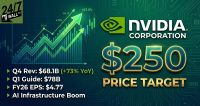
The numbers are striking. In its most recent fiscal year (FY2026), Nvidia posted revenue of $215.9 billion, up 65% from the prior year. Then, in Q1 FY2027, it reported another record: $81.6 billion in quarterly revenue, up 85% year-over-year, with Data Center revenue of $75.2 billion up 92%. Alongside those results, Nvidia announced an $80 billion additional share repurchase authorization and raised its quarterly cash dividend from $0.01 to $0.25 per share. Profits, in short, are growing faster than the stock price. That is how a valuation compresses without the stock actually falling.
Many investors spent years hoping for a meaningful pullback before buying Nvidia. Now that the valuation has fallen toward a multi-year low, many of those same investors are waiting for yet another pullback.
That is not necessarily irrational. Markets rarely hand out bargains without a reason.
What the Market May Be Telling Investors
A low valuation can signal opportunity. It can also signal skepticism. The market may be pricing in the possibility that Nvidia’s earnings growth is approaching a natural ceiling. Most AI projects still struggle to generate the kind of revenue that would justify the scale of infrastructure being built. Chip capacity is expanding, and while demand remains robust, competition for that demand is also growing.
What’s scarce today is not hardware. It is the proven ability to build AI products that customers pay for consistently and at scale. If AI monetization disappoints broadly, future earnings estimates across the sector could move lower. In that scenario, today’s seemingly modest forward P/E would become less compelling in a hurry.
That is why anchoring on a single valuation metric can mislead. A more complete picture includes Nvidia’s dominant CUDA software ecosystem, its deep relationships with hyperscale customers, gross margins above 74%, record free cash flow, and a product roadmap that extends from current Blackwell systems to the upcoming Vera Rubin architecture. Viewed together, Nvidia remains better positioned than almost any other company in the AI infrastructure value chain.
Key Takeaway
Investors searching for the “next Nvidia” may be overlooking the fact that Nvidia itself is trading at one of its lowest forward multiples in years, even as it prints record quarterly revenues and expands its capital return program.
Risks remain real. If AI spending cycles down or earnings estimates fall short, the low valuation may be low for good reason. AMD’s forward P/E of approximately 74 implies that investors are already pricing in substantial future growth there, leaving little room for disappointment.
The gap between Nvidia’s sub-25x forward multiple and its underlying earnings trajectory represents a disconnect worth examining carefully. Historically, such gaps have tended to resolve in favor of earnings growth rather than pessimism. Ultimately, following the business rather than the narrative tends to produce better outcomes. The market is rewarding AMD today, but Nvidia remains at the center of the AI economy. Until that changes, the real thing may still be the better bet.
Editor’s note: This article has been updated to reflect current figures as of mid-July 2026, including AMD’s year-to-date gain rising to approximately 160%, Nvidia’s YTD gain revised to approximately 13%, updated forward P/E ratios for both companies, and Nvidia’s Q1 FY2027 results showing record revenue of $81.6 billion (up 85% year-over-year) alongside an $80 billion share buyback authorization and a dividend increase.
Contact [email protected] for any questions or corrections.
After two decades of patrolling the dark corners of suburbia as a police officer, Rich Duprey hung up his badge and gun to begin writing full time about stocks and investing. For the past 20 years, he’s been cruising the markets looking for companies to lock up as long-term holdings in a portfolio while writing extensively on the broad sectors of consumer goods, technology, and industrials. Because his experience isn’t from the typical financial analyst track, Rich is able to break down complex topics into understandable and useful action points for the average investor. His writings have appeared on The Motley Fool, InvestorPlace, Yahoo! Finance, Money Morning, and, of course, 24/7 Wall St. He has been featured in both U.S. and international publications, including MarketWatch, Financial Times, Forbes, Fast Company, and USA Today.