The Top AI ETFs That Let You Invest In The Whole Trend At Once
AI spending has moved well past the hype phase. Consensus estimates now put 2026 hyperscaler capital expenditures at $611 billion, and the global AI market is projected to reach $4.8 trillion by 2033 from $189 billion in 2023. For investors…

This post may contain links from our sponsors and affiliates, and Flywheel Publishing may receive compensation for actions taken through them.

AI spending has moved well past the hype phase. Consensus estimates now put 2026 hyperscaler capital expenditures at $611 billion, and the global AI market is projected to reach $4.8 trillion by 2033 from $189 billion in 2023.
For investors who want exposure to that trajectory without betting on a single company, three ETFs cover the space from meaningfully different angles: a broad global index fund, a semiconductor-weighted infrastructure play, and an actively managed generative AI pure-play. 🤖🏗️
AIQ: The Widest Net in the AI ETF Space
Global X Artificial Intelligence & Technology ETF (NYSEARCA:AIQ) tracks the Indxx Artificial Intelligence & Big Data Index, which targets companies positioned to benefit from AI development and implementation, including hardware providers. The result is one of the broadest AI mandates available in a single fund.
With $7.8 billion in total net assets and an expense ratio of 0.68%, AIQ is both the largest and least expensive of the three funds covered here. It has been trading since May 2018, giving it a track record that spans multiple market cycles in the AI era. Over the past year, the fund returned 28%, though it is down 7% year to date.
The geographic mix is a distinguishing feature. About 71% of the portfolio is in U.S. companies, but the fund carries meaningful positions in South Korea (6%), Taiwan (4%), China (8%), and Japan (3%). That international exposure brings in SK Hynix, Samsung Electronics, TSMC, Tencent, and Alibaba alongside U.S. names like Nvidia, Palantir, and Meta. The fund holds 86 diversified stocks and rebalances semiannually to prevent over-concentration.
Information technology represents about 71% of the portfolio, with communication services adding another 10%. The top individual positions are capped in the low single digits: SK Hynix at 4.5%, Samsung at 4.5%, Cisco at 4%, Netflix at 4%, and TSMC at 3%. The key point here is that no single name dominates the return profile.
The trade-off is diffusion: AIQ’s breadth means it will hold companies with only indirect AI exposure alongside pure-plays, and its international positions introduce currency and geopolitical risks that narrower U.S.-focused funds avoid.
IGPT: Built Around the AI Hardware Supply Chain
Invesco AI and Next Gen Software ETF (NYSEARCA:IGPT) tracks the STOXX World AC NexGen Software Development Index, which requires constituent companies to derive significant revenue from technologies that contribute to future software development. In practice, the portfolio tilts heavily toward the semiconductor and memory chip companies that make AI computing possible.
The fund carries $711 million in assets and an expense ratio of 0.56%, making it the least expensive of the three. It has operated under various mandates since June 2005, before being modernized to its current focus on AI and next-gen software. Over the past year, it returned 44%, the strongest one-year number among the three funds, and is essentially flat year to date.
The portfolio construction explains a lot of that outperformance. Micron Technology is the largest holding at 11%, followed by SK Hynix at 9% and Nvidia at 7%. That concentration in high-bandwidth memory and GPU manufacturers reflects a specific thesis: AI model training and inference require enormous amounts of specialized compute, and the chip companies supplying that infrastructure benefit regardless of which AI application or platform ultimately wins.
IGPT also includes data center REITs. Equinix sits at about 2% and Digital Realty Trust at 1%, giving the fund some exposure to the physical infrastructure layer where AI workloads actually run. Information technology accounts for 70% of the portfolio, with communication services at 17%.
The concentration in memory and semiconductors is both the thesis and the risk. When AI chip demand is strong, IGPT captures that leverage directly. When memory prices cycle down or chip stocks correct, the fund has limited diversification to cushion the drawdown. Rene Reyna of Invesco has described the fund as suited for a “satellite strategy” representing 5-10% of a portfolio rather than a core position.
CHAT: Active Management Targeting Generative AI Specifically
Roundhill Generative AI & Technology ETF (NYSEARCA:CHAT) is the only actively managed fund among the three and the only one built specifically around generative AI. Roundhill launched it in May 2023 as what the company described as the “first ETF globally to focus on generative artificial intelligence technology.”
The fund requires constituent companies to derive at least 50% of revenue from generative AI industries, a revenue-purity screen that the passive funds do not apply. That filter pushes the portfolio toward companies where generative AI is the business, not just a product line. The fund holds roughly 44 stocks and carries $1.06 billion in assets with an expense ratio of 0.75%.
The top positions reflect the generative AI infrastructure stack: Alphabet at 6%, Nvidia at 6%, Microsoft at 4%, Amazon at 4%, and SK Hynix at 4%. The fund also holds positions in companies such as Arista Networks, Nebius Group, ARM Holdings, Palantir, and Cloudflare, names that appear less frequently in broader AI index funds. The portfolio includes about 30% international exposure, including Chinese AI companies, a meaningful geopolitical variable.
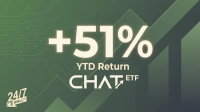
CHAT’s performance record is the sharpest of the three over available periods. It returned 82% over the past year and is up 7% year to date, the only one of the three in positive territory in 2026. Since its May 2023 inception, it has returned 151%.
Active management allows the portfolio to rotate toward new generative AI entrants and away from companies losing revenue relevance, but it also means the return profile depends on Roundhill’s stock selection rather than a rules-based index. The 0.75% expense ratio is the highest of the three, and the fund’s limited track record of roughly three years means there is less historical data to evaluate its performance across different market conditions.
How the Three Funds Differ in Scope, Cost, and Risk
AIQ offers broad, low-cost exposure to the global AI ecosystem, including hardware, software, and international players, without a concentrated bet on any single segment. IGPT tilts heavily toward the AI infrastructure buildout, particularly memory and semiconductors, and carries the cyclicality that comes with chip-heavy concentration. CHAT applies active management and a revenue-purity screen to target generative AI specifically, with a modestly higher fee and a shorter track record than the index-based alternatives.
Contact [email protected] for any questions or corrections.
David Beren has been a Flywheel Publishing contributor since 2022. Writing for 24/7 Wall St. since 2023, David loves to write about topics of all shapes and sizes. As a technology expert, David focuses heavily on consumer electronics brands, automobiles, and general technology. He has previously written for LifeWire, formerly About.com. As a part-time freelance writer, David’s “day job” has been working on and leading social media for multiple Fortune 100 brands. David loves the flexibility of this field and its ability to reach customers exactly where they like to spend their time. Additionally, David previously published his own blog, TmoNews.com, which reached 3 million readers in its first year. In addition to freelance and social media work, David loves to spend time with his family and children and relive the glory days of video game consoles by playing any retro game console he can get his hands on.