Intel’s Up 5x Since Government Invested, Here’s What’s Next On Uncle Sam’s Buying List
The U.S. government’s roughly 10% stake in Intel, acquired in 2025 at about $20.47 per share, has turned into one of the most lucrative trades on Uncle Sam’s books. Intel (NASDAQ:INTC | INTC Price Prediction) shares now trade near $121.09,…


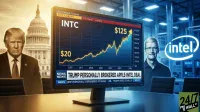
The U.S. government’s roughly 10% stake in Intel, acquired in 2025 at about $20.47 per share, has turned into one of the most lucrative trades on Uncle Sam’s books. Intel (NASDAQ:INTC | INTC Price Prediction) shares now trade near $121.09, with the stock up 217.21% year to date and 464.37% over the past year. That is roughly a 5x return on the taxpayer’s cost basis, and it is reshaping how Washington thinks about industrial policy.
Emil Michael, the Under Secretary of Defense for Research and Engineering, used a CNBC appearance to argue that the Intel model should travel. His pitch: equity stakes in strategically critical companies give taxpayers exposure to the upside they are already funding through tax credits, grants, and procurement. “Look at Intel with the Commerce Department invested in them and the stock’s gone up, and we’re now trying to make them an American chip champion and not be reliant on all foreign chip champions. And that’s important for our national security,” Michael said.
Michael’s Framework: Public Markets as a Guardrail
Michael’s argument leans heavily on the discipline imposed by public listings. “A company being public has to answer to its shareholders a little bit more than a private company,” he said, calling that “a good limiting factor.” On the equity question itself, his framing was direct: “Having them have some of the upside is fine. Congress does the regulating. I don’t think it’s a problem so long as the taxpayer is benefiting.”
That logic creates a filter. Companies sitting on $1 trillion-plus private valuations with public-benefit-corporation structures and unclear fiduciary duties (Anthropic and others have confidentially filed) sit outside the easy-equity zone. SpaceX, which just completed its IPO, would qualify as public, though its dual-class structure gives Class B shares ten votes per share and entitles Class B holders, voting separately, to elect 51% of the board, leaving Elon Musk in operational control. Michael’s framework would still apply, but governance concentration matters.
Who’s Next on the Buying List?
Three names dominate the conversation, and the strategic logic for each is different.
NVIDIA
NVIDIA (NASDAQ:NVDA) is the cleanest national-security play. Its Vera CPU business could reach $200 billion per Jensen Huang, and the company sits at the center of every AI export-control debate. Q1 FY27 revenue hit $81.62 billion (+85.2% YoY), with Data Center alone at $75.25 billion. NVIDIA already purchased $5.0 billion of Intel common stock, effectively a private-sector echo of the government’s bet. The biggest drawback would be NVIDIA’s size with the company already at a $5 trillion valuation.
AMD
Advanced Micro Devices (NASDAQ:AMD) is up 136.87% YTD and just landed a Meta partnership for up to 6 GW of Instinct GPUs. Export-control exposure on MI308 to China gives it the same national-security flavor as NVIDIA, with a smaller market cap making any stake more impactful per dollar.
Micron
Micron Technology (NASDAQ:MU) may be the most direct analog to Intel. It is the only U.S.-based memory manufacturer, it already received $878 million in government incentive proceeds in fiscal Q1 2026, and fiscal Q2 revenue exploded to $23.86 billion (196.3% YoY) with gross margin at 74.4%. Shares are up 257.81% YTD. CEO Sanjay Mehrotra has called memory “a strategic asset” for AI customers, language that aligns neatly with Michael’s framework.
The Broader Pattern
Intel’s turnaround gives the DoD a reference point. Lip-Bu Tan’s first full quarter at the helm produced $13.577 billion in revenue with Data Center and AI growing 22% YoY and Intel Foundry up 16% YoY (see the Q1 2026 8-K). Pair that with the $500 million loan commitment to Phoenix Tailings as the fifth critical-minerals deal, and the policy direction is unmistakable: equity, debt, and offtake commitments are now standard tools.

Investors watching this space should track three signals: Treasury and Commerce statements after any new chip funding round, Defense Production Act invocations, and the IPO governance choices made by any private AI champion the government might want a seat at. Michael has laid out the rationale. The market is already pricing the implications.
Contact [email protected] for any questions or corrections.
I've spent more than 15 years inside enterprise software, working alongside the finance, sales operations, and HR leaders who run the revenue engines at some of the largest tech companies in the country.
My day job is helping enterprise executives make smarter decisions about retention, compensation, and growth. These are the same operational levers that show up in every earnings report investors actually read. That perspective shapes my writing for 24/7 Wall St.
The headline numbers are easy. The interesting stuff is underneath: how companies make money, what executives are worried about, and what any of it means for the person checking their 401(k) on a Sunday afternoon. I write about personal finance and business as someone who has spent her career inside the rooms where these decisions get made.