Wall Street Just Supersized Its Price Target on AMD. Is the Stock Still Too Cheap?
Shares of Advanced Micro Devices (NASDAQ:AMD | AMD Price Prediction) traded near $521 midmorning Wednesday, roughly flat on the session after a prior close near $520. The quiet tape masks a loud catalyst: UBS just supersized its price target on…

Shares of Advanced Micro Devices (NASDAQ:AMD | AMD Price Prediction) traded near $521 midmorning Wednesday, roughly flat on the session after a prior close near $520. The quiet tape masks a loud catalyst: UBS just supersized its price target on AMD stock to $670 from $455, one of the more aggressive upward revisions on the Street this month.
The hike landed shortly after AMD stock stabilized from a 5% drop tied to a broad, Korean-led chip selloff on Tuesday. AMD stock now sits below its 52-week high of $562.99 (versus a 52-week low of $132.93).
That backdrop frames the question in the headline. UBS’s $670 mark sits well above today’s print, implying meaningful upside without doing the arithmetic. However, AMD stock has already run hard, so the real debate is whether the multiple still has slack or whether the bar is now set too high.
UBS Bets on Standalone CPU Racks and Agentic AI
UBS analyst Timothy Arcuri maintained a Buy rating alongside the supersized target. His thesis leans on a workload shift that plays directly into AMD’s structural strengths rather than the obvious GPU narrative.
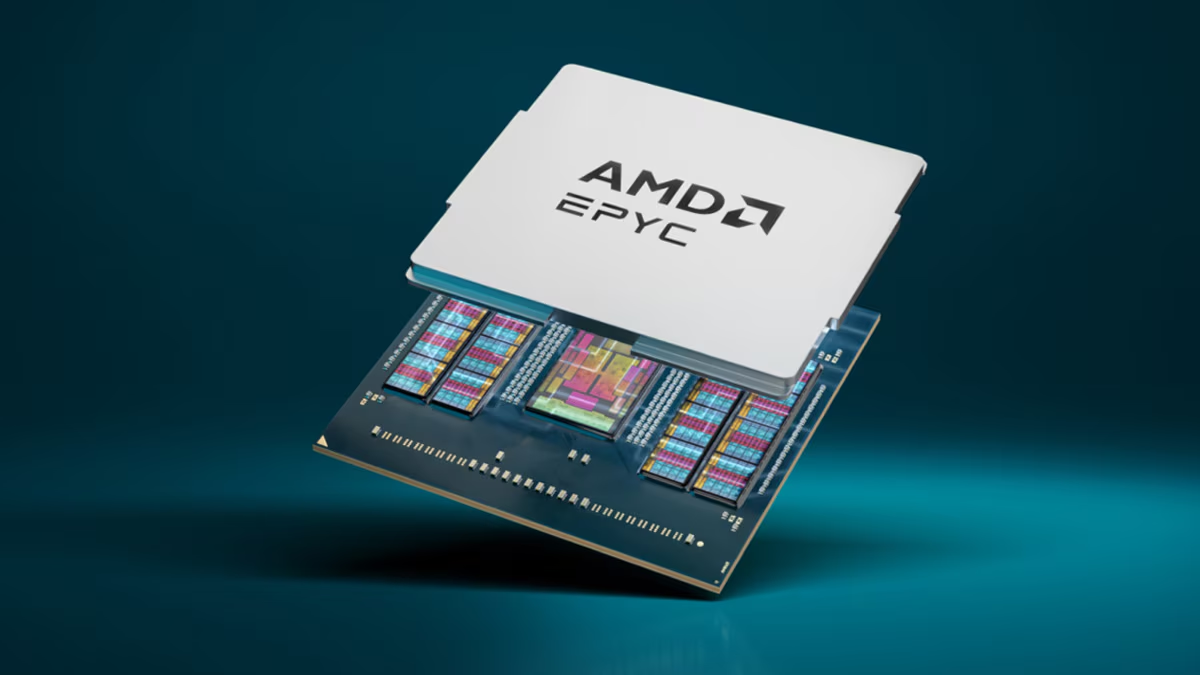
Arcuri argues that standalone CPU racks are gaining adoption, supported by AMD’s lead in core density, multithreading, and the established x86 software ecosystem. Traditional workloads being folded into agentic AI pipelines, in his view, still favor x86 silicon. That positions AMD’s EPYC franchise as more than a sidecar to the Instinct GPU story.
The Bull Case: An 80% Buy Wall and a Loaded Order Book
The Wall Street consensus on AMD stock remains overwhelmingly positive. Of 51 analysts, 5 rate it Strong Buy, 36 Buy, 10 Hold, and zero Sell. UBS’s $670 mark now ranks among the higher targets in that group, alongside a fundamentals story that has been compounding fast.
AMD’s Q1 FY2026 revenue hit $10.25 billion, up 38% year over year (YoY), with Data Center revenue jumping 57% to $5.78 billion. Management’s Q2 FY2026 guidance points to about $11.2 billion in revenue (46% YoY growth) with non-GAAP gross margin expanding toward 56%.
The AI customer book is unusually deep for AMD. CEO Lisa Su has secured an OpenAI agreement covering 6 gigawatts of GPU deployment, a Meta Platforms (NASDAQ:META) commitment of up to 6 gigawatts of Instinct GPUs with AMD named lead supplier for 6th Gen EPYC, and an Oracle (NYSE:ORCL) Helios supercluster of 50,000 GPUs. Momentum behind the MI450 series rounds out a pipeline that bulls argue underwrites the new UBS number.
The Bear Case: Elevated Multiples and Policy Risk
The valuation is where bulls and bears actually collide on AMD. Yahoo Finance lists AMD’s trailing-12-month P/E ratio near 172x, while other estimates have cited roughly 179x trailing and about 77x forward. Those levels leave little room for execution missteps and are part of why some commentators describe AMD as priced for flawless execution.
Export controls remain a live risk for AMD, as well. U.S. restrictions previously forced the company to absorb an $800 million inventory charge, and any tightening of China rules could repeat that hit. One linked valuation model also suggests AMD could be modestly overvalued at current levels, a counterpoint to UBS’s bullish stance.
Insider activity has drawn attention, too. AMD insider transactions over the last 90 days exceeded $161 million in selling, including disposals by CEO Lisa Su. That headline looks heavy in isolation, though much of it appears to reflect routine diversification after a huge run in AMD stock, not a clean thesis-change signal.
What to Watch Now
The open question is whether AMD’s accelerating data-center growth can outrun a multiple stretched into triple-digit P/E ratio territory. UBS’s $670 target implies the answer is yes, but with a P/E ratio of 172x already baked in, even a small guidance wobble could reset sentiment quickly.
Investors can watch for whether AMD stock holds above $520 in the coming sessions; they could also take note of how MI450 ramp commentary evolves through the summer, and look for any movement on U.S. China export policy. Those signals may decide whether UBS’s new target becomes the consensus base case or remains an outlier on the high side.
Contact [email protected] for any questions or corrections.
David Moadel is financial writer specializing in stocks, ETFs, options, precious metals, and Bitcoin. David has written well over 1,000 articles for leading online publications, helping investors understand markets, income strategies, and risk.His work has appeared in The Motley Fool, InvestorPlace, U.S. News & World Report, TipRanks, ValueWalk, Benzinga, Market Realist, TalkMarkets, Finmasters, 24/7 Wall St., and others.With a master’s degree in education, David has taught at the elementary, high school, and college levels. That teaching background shapes his writing style: clear, educational, and practical. David has also built a loyal social-media audience by providing trustworthy financial content on YouTube, X/Twitter, and StockTwits.