Wells Fargo’s Scott Wren to Retail Investors: Don’t Chase the Rally, Be Ready to Pounce on Dips
Scott Wren, senior global market strategist at Wells Fargo Investment Institute, went on CNBC this morning with a message for retail investors. The Federal Reserve has flipped from an easing bias to a tightening bias, and Wren wants investors to…

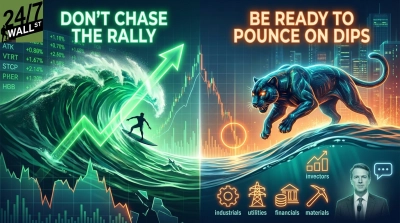
Scott Wren, senior global market strategist at Wells Fargo Investment Institute, went on CNBC this morning with a message for retail investors. The Federal Reserve has flipped from an easing bias to a tightening bias, and Wren wants investors to treat the resulting wobble as an invitation rather than a warning shot.
“You don’t want to overthink this thing,” Wren said. “Any time there’s a change like that with the federal reserve, it’s going to cause some downside volatility in the market, especially after we’ve had a hell of a run here in the last three and a half years.”
The run he is talking about
The numbers behind that “hell of a run” matter. The SPDR S&P 500 ETF (NYSEARCA:SPY) is up 24% over the past year and 87% over five years. Since April 2025 alone, SPY has climbed 31%, and Wren points out that there has not been a 10%+ pullback since April 2025. Real drawdowns have been extinct for more than a year, which is when people forget they exist.
The very recent action has cooled. SPY is down 2.23% in the past week and 1.62% over the past month, with the index sitting at $735.02. That qualifies as a wobble, and it is what a Fed pivot tends to produce before anyone has had time to recalibrate a forward earnings model.
Why the fundamentals still work for him
Wren’s constructive case rests on three legs. The first is growth. He sees 2 to 2.5% GDP growth this year and next, which would imply some acceleration from 2026Q1’s 1.6% reading. The recent run has been choppy, with quarterly GDP swinging from -0.6% in 2025Q1 to 4.4% in 2025Q3 and back down to 0.5% in 2025Q4. Smoothing that out into Wren’s 2 to 2.5% lane requires faith that the volatility was noise rather than a regime change.
The second leg is inflation. Core PCE has held near 3.29% year-over-year in April 2026, hovering in the 3.2 to 3.3% range for four months running. Headline PCE has drifted up to 3.77%, but that is largely an energy story, with energy prices up 18.26% year-over-year. Strip that out and the trend is stickier than the Fed wants but not accelerating.
The third leg is earnings. Wren said “We’ll get out of this year with probably 25% earnings growth next year. We’ve got 15% penciled in.” Even the lower figure would extend the streak of double-digit S&P 500 profit growth that has carried valuations through restrictive monetary policy.
The sector pivot beneath the headline
The more actionable part of the segment was where Wren wants to put new money. “Do we like technology? Sure… We like AI as a more secular type of trade. But we’re trying to look at some other sectors: industrials, utilities, materials, financials. They all have some tie to AI. Their valuations are a lot lower.”
This echoes a theme running through several 2026 outlooks from large allocators. J.P. Morgan Asset Management has been pushing the same idea, splitting AI exposure between “the enablers (industrials, utilities) and the adopters (financials, health care)”, and flagging that 2026 Mag 7 earnings growth is penciled at roughly 20% versus 11% for the rest of the index. You can find the full piece on J.P. Morgan Asset Management’s outlook page. The pitch is that the utility powering the data center and the bank financing the build trade at multiples that do not require heroic assumptions to work.
The playbook
Wren’s closing instruction was the part worth writing down. “We want to buy on pullbacks which of course we haven’t had a good 10% plus one since April of 2025… Don’t get sucked in to the headlines of the day all the time. Think ahead… don’t chase, be ready to step in.” Wren’s framework amounts to keeping a shopping list and some dry powder, letting the Fed’s pivot do the work of creating better entry points than the ones available today.
Contact [email protected] for any questions or corrections.
Omor Ibne Ehsan is a writer at 24/7 Wall St. He is a self-taught investor with a focus on growth, cyclical, and dividend equities that have strong fundamentals, value, and long-term potential. He also has an interest in high-risk, high-reward investments such as penny stocks.