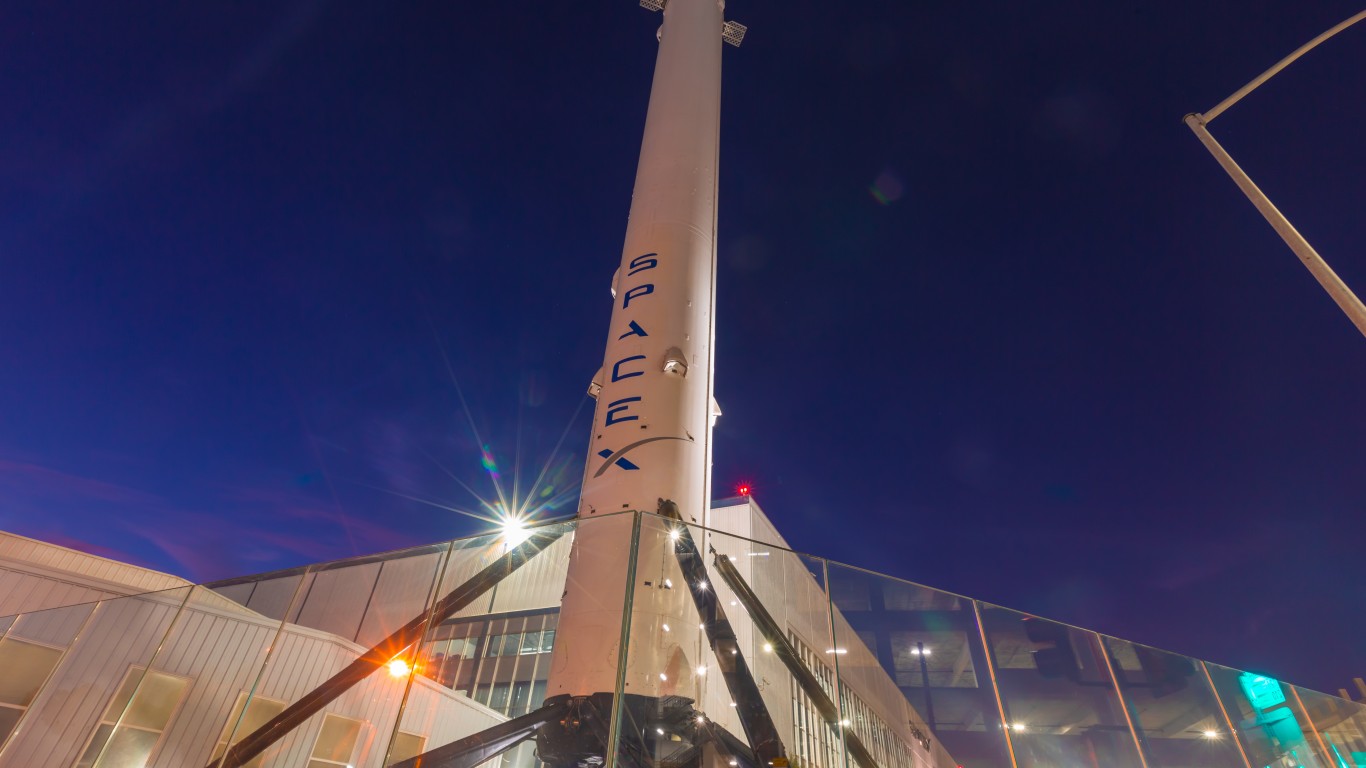
Could SpaceX Buy T-Mobile? A TD Cowen Analyst Floats the Idea
Today’s widely discussed smart-money signal on a SpaceX (NASDAQ:SPCX | SPCX Price Prediction)-T-Mobile (NASDAQ:TMUS) tie-up comes from a single TD Cowen analyst, not consensus. Meanwhile, Wall Street’s broader view on T-Mobile remains bullish on fundamentals rather than takeover speculation. A…

This post may contain links from our sponsors and affiliates, and Flywheel Publishing may receive compensation for actions taken through them.
Today’s widely discussed smart-money signal on a SpaceX (NASDAQ:SPCX | SPCX Price Prediction)-T-Mobile (NASDAQ:TMUS) tie-up comes from a single TD Cowen analyst, not consensus. Meanwhile, Wall Street’s broader view on T-Mobile remains bullish on fundamentals rather than takeover speculation. A TD Cowen analyst, as reported via TheFly and StockTwits, floated the scenario that SpaceX’s Starlink unit could need to acquire a major U.S. wireless carrier and T-Mobile “seems to us the clear choice.”
This remains speculation at the analyst level. SpaceX hasn’t announced or been reported to be pursuing T-Mobile, and the market reflects that. SPCX stock traded near $153 in Thursday’s afternoon session, down 1%, while T-Mobile stock rose 1% to $182 and change; neither move was consistent with a real bid catalyst.
For institutional investors, the operative read is straightforward: treat the TD Cowen note as a strategic thought experiment about Starlink’s terrestrial network gap, not a deal in progress. The note explores a hypothetical path rather than signaling imminent corporate action.
What the TD Cowen Analyst Actually Argued
The analyst’s reasoning rests on SpaceX’s prospectus filings, which point to explicit ambitions for Starlink to compete directly in high-density urban and suburban markets, segments demanding a far larger terrestrial footprint than the rural and isolated areas Starlink has historically served. Next-generation Starlink Mobile satellites would require a massive terrestrial footprint to deliver on those ambitions.
The analyst noted that the “Big Three” U.S. wireless carriers have reportedly refused to lease network capacity to SpaceX via mobile virtual network operator (MVNO) agreements, leaving acquisition as the apparent strategic path. T-Mobile’s momentum, “maverick” culture, position as a pure-play wireless provider, and existing Starlink partnership made it the analyst’s preferred candidate, with AT&T (NYSE:T) floated as “another thought.”
What the Data Says About TMUS and SPCX
On T-Mobile, consensus is decisively bullish independent of M&A talk. Alpha Vantage shows an analyst target price of $259.08, with 9 Strong Buy, 15 Buy, 4 Hold, and zero Sell or Strong Sell ratings against T-Mobile stock’s current $182.76. T-Mobile’s trailing P/E ratio is 20x, the forward P/E ratio is 18x, and the beta sits at 0.3.
Operationally, T-Mobile posted Q4 2025 revenue of $24.33 billion, up 11% year over year (YoY), free cash flow of $4.19 billion, and 962,000 postpaid phone net adds in the quarter. Management guided FY2026 core adjusted EBITDA of $37 billion to $37.5 billion and authorized a $14.6 billion stockholder return program through December.
SpaceX has no public analyst coverage, no consensus price target, and no institutional positioning data. SPCX carries a market cap of roughly $1.16 trillion. SpaceX stock IPO’d June 15 at $135, surged to a peak around $225 before sharp volatility, and has dropped in five of its first eight sessions, with a one-week change of around -20%.
The Gap Between the Story and the Tape
Wall Street’s consensus target of $259.08 on T-Mobile stock sits well above the current share price, a gap unrelated to SpaceX speculation. TMUS stock is down 10% year to date, even as analysts maintain their constructive stance on fundamentals.
For SpaceX, the absence of any prediction market on a wireless-carrier acquisition signals skepticism. Polymarket hosted active SpaceX M&A markets, with the Cursor/Anysphere acquisition question settling at a last trade price of 0.999, yet no carrier-acquisition contracts exist on the platform. So far, traders generally aren’t pricing in the T-Mobile scenario.
Retail sentiment on Stocktwits was reportedly bearish on both SPCX and TMUS this week, a notable divergence from the institutional bull case. That split is a useful indicator of speculative-versus-fundamental cross-currents in both names.
Is the Smart Money Right, and Should You Act on It?
On T-Mobile, institutional consensus rests on documented cash-flow growth, broadband subscriber leadership, and a multi-billion-dollar capital return program, not takeover speculation. The TD Cowen scenario is internally logical given SpaceX’s stated urban broadband ambitions, but it remains one analyst’s hypothetical without corporate confirmation from either company.
A SpaceX acquisition of T-Mobile would face significant regulatory, antitrust, financing, and integration hurdles. Besides, SpaceX is already digesting its $60 billion Anysphere acquisition announced June 16.
Investors can monitor Starlink’s terrestrial buildout disclosures and any official carrier commentary from SpaceX as real signals worth tracking. It makes sense to keep one’s position sizes modest given how speculative the M&A premise remains. For now, the smart money’s verifiable view rests on T-Mobile’s fundamentals, not takeover talk.
Contact [email protected] for any questions or corrections.
David Moadel is financial writer specializing in stocks, ETFs, options, precious metals, and Bitcoin. David has written well over 1,000 articles for leading online publications, helping investors understand markets, income strategies, and risk.His work has appeared in The Motley Fool, InvestorPlace, U.S. News & World Report, TipRanks, ValueWalk, Benzinga, Market Realist, TalkMarkets, Finmasters, 24/7 Wall St., and others.With a master’s degree in education, David has taught at the elementary, high school, and college levels. That teaching background shapes his writing style: clear, educational, and practical. David has also built a loyal social-media audience by providing trustworthy financial content on YouTube, X/Twitter, and StockTwits.