“Big Short” Legend Michael Burry Just Bet Big on Microsoft
Last week, Michael Burry disclosed via Substack that he had bought December 2028 LEAP call options on Microsoft with strikes near $700 struck well above the roughly $356 to $360 level the stock was trading at. The actual trade is…

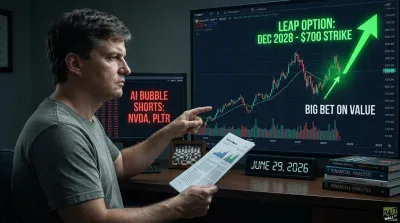
Last week, Michael Burry disclosed via Substack that he had bought December 2028 LEAP call options on Microsoft with strikes near $700 struck well above the roughly $356 to $360 level the stock was trading at. The actual trade is more interesting, and considerably more constrained, than “Big Short guy goes long Microsoft (NASDAQ:MSFT | MSFT Price Prediction).”
Burry bought a deeply out-of-the-money, long-dated option on Microsoft shares, which is a very different animal from owning the equity outright.
What the LEAP position actually is
A LEAP is a listed call option with an unusually distant expiration, in this case December 2028. Burry paid a premium for the right, not the obligation, to buy MSFT at roughly $700 per share by then. With the stock recently at $370 after a 22% year-to-date decline and a 25% drop over the past year, that strike is far above current levels. The position size is genuinely unknown. Scion no longer files 13Fs, the Substack disclosure does not include contract counts, and any dollar figure floating around is a guess.
The structure tells you something the headline does not. LEAPs offer convex, capped-downside exposure. If MSFT never crosses roughly $700 plus the premium paid, the options expire worthless. If it overshoots, the payoff is leveraged. Burry is renting upside on a clock.
The contrarian bull logic, and where the Street agrees
Microsoft is down meaningfully from 2025 highs while the underlying business has accelerated. Q3 FY2026 revenue grew 18.3% to $82.89 billion, EPS of $4.27 beat the $4.07 consensus, Azure grew 40%, and the AI business surpassed a $37 billion annualized run rate, up 123% year over year. Commercial remaining performance obligations nearly doubled to $627 billion, which is contracted future revenue, not a sentiment metric.
Sell-side opinion lines up with the direction, if not Burry’s specific strike. Forty analysts rate the stock Buy and twelve rate it Strong Buy against three Holds and zero Sells, with an average price target of $561.11. The restructured OpenAI partnership, with a roughly 27% stake valued near $135 billion and IP rights extended through 2032, plus an incremental $250 billion Azure commitment, underwrites the platform story.
The risk, and what it says about Burry’s broader 2026 playbook
For these LEAPs to pay, Microsoft has to clear $700 plus premium by December 2028. From today, that is a substantial move. Anything less, including a perfectly fine 30% rally back to old highs, leaves the options worthless at expiration. This is the asymmetry Burry is buying, and the asymmetry retail should understand before mimicking it.
The trade fits a pattern. Burry has been going long beaten-down names like Microsoft, Adobe, and PayPal while shorting crowded AI favorites including Nvidia and Palantir. So the trade is a pair. He is long the franchise the market has cooled on, and short the names the market has overheated on.
A measured takeaway
If you are a retirement-focused investor, the readable signal is the thesis itself. Burry is saying Microsoft’s drawdown looks overdone relative to 23% net income growth and a doubling RPO. Buying MSFT shares expresses that view with no expiration.
Buying 2028 LEAPs at a $700 strike expresses a much narrower view, on a clock, with a binary outcome. Copying the instrument without copying the conviction, or the position-sizing discipline you cannot see, is the part that gets retail investors hurt.
Contact [email protected] for any questions or corrections.
Omor Ibne Ehsan is a writer at 24/7 Wall St. He is a self-taught investor with a focus on growth, cyclical, and dividend equities that have strong fundamentals, value, and long-term potential. He also has an interest in high-risk, high-reward investments such as penny stocks.