Magic Formula Showdown: Why CVS Beats Qualcomm and Valero for Retirees
Joel Greenblatt's Magic Formula ranks stocks on earnings yield and return on capital, but for retirees those two numbers can point straight toward disaster. Three stocks cleared the screen, and only one survives when income reliability and volatility enter the…

This post may contain links from our sponsors and affiliates, and Flywheel Publishing may receive compensation for actions taken through them.
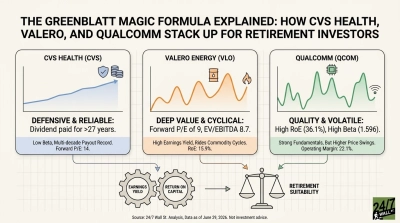
Joel Greenblatt’s Magic Formula, popularized in The Little Book That Beats the Market, ranks stocks on two factors: earnings yield (operating earnings divided by enterprise value) and return on capital (how efficiently a business converts invested dollars into profits). For retirement investors, Magic Formula scores are only the starting point. Income reliability, business durability, and volatility matter equally. A bargain-screened name can still be wrong for a retiree if cash flows swing with commodity cycles or if its multiple assumes growth that may not arrive.
Below is a countdown of three candidates, ranked from least to most appropriate for a retirement-focused portfolio.
3. Qualcomm: Quality at a Quality Price
Qualcomm (NASDAQ: QCOM | QCOM Price Prediction) is the classic Magic Formula quality stock: high gross margins, high returns on equity, and a fortress licensing business. Trailing return on equity is near 36.1%, operating margin around 22.1%, and EV/EBITDA at 14.7. Q2 FY26 delivered non-GAAP EPS of $2.65 on revenue of $10.599 billion, with record Automotive revenue of $1.326 billion, up 38% year over year.
The retirement problem is volatility and yield. Shares fell 16.2% in the past week and 23.9% in the past month, with a beta of 1.596. The dividend yield is just 1.9%, and handset revenue contracted 13% last quarter on memory supply constraints and China exposure. A great business, but not a retiree’s anchor holding.


2. Valero Energy: Cash Machine, Cyclical Risk
Valero Energy (NYSE: VLO) is where the Magic Formula screen lights up brightest. A forward P/E of 9, EV/EBITDA of 8.7, and return on equity of 15.9% combine to signal strong earnings yield and respectable capital efficiency. Q1 2026 EPS hit $4.22 against a $3.16 consensus, refining margins expanded to $14.90 per barrel, and management returned $938 million to shareholders while raising the quarterly dividend 6% to $1.20.
Shares are up 89.4% over the past year. That run is the catch. Refiner earnings swing with crack spreads, the Brent-WTI differential expanded to $5.94 per barrel from $3.43 per barrel, and California exposure produced a $123 million West Coast loss last quarter. The 1.9% yield is well covered, but earnings are not predictable enough for a retiree’s largest position.


1. CVS Health: The Retiree’s Magic Formula Pick
CVS Health (NYSE: CVS) combines Aetna insurance, the Caremark PBM, and roughly 9,000 retail pharmacies into a defensive, recession-resistant cash-generating enterprise. Forward P/E is just 14, beta is 0.623, and the dividend yields 2.6% on an annualized payout of $2.66. The dividend has been paid quarterly for more than 27 years without interruption.
The turnaround is showing in the numbers. Q1 2026 adjusted EPS came in at $2.57 against a $2.21 estimate, the fourth straight beat, with operating income up 38.71% year over year and Aetna’s adjusted operating income surging 52.6% to $3.04 billion as the medical benefit ratio improved to 84.6%. Management raised full-year adjusted EPS guidance to $7.30 to $7.50 and operating cash flow guidance to at least $9.5 billion. CEO David Joyner described the company as serving “nearly 185 million people” with strong enterprise execution. Shares have climbed 53.1% over the past year to $104.34.

Risks remain: pharmacy reimbursement pressure, elevated medical cost trends, lingering legacy litigation, and a goodwill-heavy balance sheet from the Aetna deal that drags reported return on capital. Even with those headwinds, the combination of a defensive healthcare footprint, low-beta shares, a multi-decade dividend record, and a forward earnings yield in the low-to-mid teens is the cleanest fit for someone funding retirement withdrawals.


What This Means for Retirement Portfolios
The Magic Formula is a starting point, not a verdict. Qualcomm offers the best business quality but the thinnest yield and highest volatility. Valero offers the loudest cheapness signal and a generous, growing payout, yet its earnings ride the refining cycle. CVS Health pairs a reasonable multiple with a defensive franchise, an improving Aetna margin story, and a dividend that has weathered every market cycle since the late 1990s. For a retirement investor weighing these three through a Greenblatt lens, CVS best balances cheapness, quality, and the income reliability that funds a withdrawal plan.
Contact [email protected] for any questions or corrections.
Trey has been an editor and author at 24/7 Wall St. for more than a decade, where he has published thousands of articles analyzing corporate earnings, dividend stocks, short interest, insider buying, private equity, and market trends. His comprehensive coverage spans the full spectrum of financial markets, from blue-chip stalwarts to emerging growth companies.
Beyond 24/7 Wall St., Trey has created and edited financial content for Benzinga and AOL's BloggingStocks, contributing additional hundreds of articles to the investment community.
Trey's editorial expertise extends across multiple publishing environments. He served as production editor at Dearborn Financial Publishing and development editor at Kaplan, where he helped shape financial education materials. Earlier in his career, he worked as a writer-producer at SVE. His freelance editing portfolio includes work for prestigious clients such as Sage Publications, Rand McNally, the Institute for Supply Management, the American Library Association, Eggplant Literary Productions, and Spiegel.
Outside of financial journalism, Trey writes fiction and has been an active member of the writing community for years, moderating workshop sessions at regional conventions.