The Greenblatt Magic Formula: How H&R Block, Molina, and Peabody Stack Up for Retirement Investors
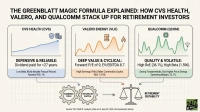
Joel Greenblatt's Magic Formula flags Peabody Energy, Molina Healthcare, and H&R Block as cheap businesses worth owning, but cheap and high-quality still fails retirement investors if the income dries up when markets turn ugly.


Joel Greenblatt’s Magic Formula ranks stocks on two factors: earnings yield (EBIT divided by enterprise value) and return on capital. It surfaces good companies trading at cheap prices.
For retirees, “cheap and high-quality” is only the starting point. Income reliability, drawdown control, and earnings predictability matter as much as a low multiple. Here is a look at how three Magic Formula candidates stack up, ranked from least to most appropriate for a retirement portfolio.
3. Peabody Energy
Peabody Energy (NYSE: BTU | BTU Price Prediction) screens as the deep-value, optionality-rich name Greenblatt enthusiasts love. Shares closed most recently at $23.69, with a price-to-book ratio of 0.85 and a forward P/E near 22x. The one-year return of 83.8% reflects renewed enthusiasm for coal tied to AI data-center power demand.
The retirement case breaks down on consistency. Q1 FY26 produced an EPS of −$0.26 versus a $0.22 estimate, a −218% earnings surprise, after Centurion mine commissioning issues caused roughly $80 million of damage to the Seaborne Met segment. CEO Jim Grech cited “temporary equipment and roof control challenges.” The $0.075 quarterly dividend has held since Q3 2023. However, the historical record shows cuts from $0.145 to $0.115 during the 2018 downturn and losses from 2015 through 2020. Cyclical coal is a trade, rarely a retirement holding.
2. Molina Healthcare
Molina Healthcare (NYSE: MOH) is the classic Magic Formula recovery setup. The managed-care operator trades at a forward P/E of 38x against trailing revenue of $43.1 billion. Shares rebounded 24.5% year to date to $216.04, though that still is 26.6% below year-ago levels.
Q4 2025 delivered an ugly adjusted EPS of −$2.75 against a $0.50 estimate, but Q1 2026 turned with reported EPS of $2.35 versus $1.91 expected, a 23.04% beat. CEO Joseph Zubretsky stated: “We believe that the imbalance between rates and trend marks 2026 as a trough year for Medicaid industry margins.” Management guides to at least $5.00 in adjusted EPS for 2026, burdened by Florida contract costs and MAPD underperformance, with embedded earnings above $11.00 by 2027 to 2029.

For retirees, the problem is income. Molina pays no dividend, regulatory risk on Medicaid rates is real, and operating cash flow turned negative $535 million in FY2025. It is a value bet on a regulated turnaround that offers no income while investors wait..
1. H&R Block
H&R Block (NYSE: HRB) is the cleanest fit for the Magic Formula and retirement portfolios. The tax-prep franchise trades at a trailing P/E of 6x and forward P/E of 6x, with a return on equity of 67.9% and an operating margin of 43.2%. That combination of a low multiple and high capital returns is precisely what Greenblatt targets.
Q3 FY26 results were strong: adjusted diluted EPS of $6.02 beat the $5.77 estimate, revenue of $2.40 billion grew 5.31% year over year, and net income rose 17.51%. Management raised FY2026 guidance to adjusted EPS of $5.10 to $5.20 on roughly $3.91 billion to $3.92 billion in revenue. CEO Curtis Campbell called the quarter “an important inflection point” as the assisted channel gained share for a third consecutive year.

Capital return crystallizes the retirement thesis. The quarterly dividend stepped up to $0.42 from $0.375, extending a 60-year streak of consecutive quarterly dividends. The board added an additional $100 million buyback authorization on top of the roughly $700 million remaining under the existing $1.5 billion program. Year-to-date capital returns reached $560.9 million. The dividend held flat through both the 2008 crisis and the 2020 pandemic. With a beta of 0.37 and a 4.7% yield, the volatility profile matches what an income-focused investor needs, though seasonal revenue concentration and AI-native tax competition remain genuine risks.
Bringing the Formula Back to Retirement
Greenblatt’s framework surfaces all three names as cheap businesses generating real returns on capital. The retirement filter separates them. Peabody is a commodity play masquerading as a value stock. Molina is a regulated turnaround with no income to collect during the wait. H&R Block pairs a high-margin, cash-generative franchise with the longest dividend history in this group and a management team that is actively shrinking the share count. For a retiree using the Magic Formula as a starting point, H&R Block stock survives the second screen.
Contact [email protected] for any questions or corrections.
Trey has been an editor and author at 24/7 Wall St. for more than a decade, where he has published thousands of articles analyzing corporate earnings, dividend stocks, short interest, insider buying, private equity, and market trends. His comprehensive coverage spans the full spectrum of financial markets, from blue-chip stalwarts to emerging growth companies.
Beyond 24/7 Wall St., Trey has created and edited financial content for Benzinga and AOL's BloggingStocks, contributing additional hundreds of articles to the investment community.
Trey's editorial expertise extends across multiple publishing environments. He served as production editor at Dearborn Financial Publishing and development editor at Kaplan, where he helped shape financial education materials. Earlier in his career, he worked as a writer-producer at SVE. His freelance editing portfolio includes work for prestigious clients such as Sage Publications, Rand McNally, the Institute for Supply Management, the American Library Association, Eggplant Literary Productions, and Spiegel.
Outside of financial journalism, Trey writes fiction and has been an active member of the writing community for years, moderating workshop sessions at regional conventions.