$500 a Month in These Stocks Will Generate $6,700 in Passive Annual Income
Passive income is the paycheck that arrives whether you show up or not. Wages depend on a functioning employer, a healthy economy, and the continued willingness of both to keep the seat warm. Dividend income depends on a company writing…


Passive income is the paycheck that arrives whether you show up or not. Wages depend on a functioning employer, a healthy economy, and the continued willingness of both to keep the seat warm. Dividend income depends on a company writing a check every 90 days, and for a handful of blue chips, that check has arrived without interruption for more than half a century.
Real estate can deliver similar cash flow, but it comes with tenants, repairs, and closing costs measured in weeks. High-yield dividend stocks settle in seconds, can be sold in any size, and require no phone calls at midnight. For an income-focused investor, that liquidity premium is often worth more than the last basis point of yield.
We screened our 24/7 Wall St. dividend equity research database, looking for stocks that pay massive dividends, and we found a collection of companies that, combined, can generate over $6,700 a year in passive annual income if you invest just $50,000 in each stock at the time of this writing.
Johnson & Johnson
- Yield: 2.11%
- Shares for $50,000: 196.87
- Annual Passive Income: $1,055
Johnson & Johnson (NYSE:JNJ | JNJ Price Prediction) is a $611 billion diversified healthcare business split across Innovative Medicine (oncology franchises like DARZALEX, TREMFYA, and CARVYKTI) and MedTech (Cardiovascular, Orthopaedics, Surgery, and Vision).
The company generated $24.06 billion in Q1 2026 revenue, up 9.9% year over year, and raised full-year guidance to $100.3 billion to $101.3 billion in sales.
The yield sits on the lower end of this list because the underlying business is a triple-A cash machine. That said, JNJ raised its quarterly payout 3.1% to $1.34 per share in Q1, extending its streak to 64 consecutive years of dividend increases, the longest track record in big pharma. Institutions own 76.83% of the float, led by Vanguard, BlackRock, and State Street.
PepsiCo
- Yield: 4.19%
- Shares for $50,000: 354.21
- Annual Passive Income: $2,097
PepsiCo (NASDAQ:PEP) is the global snacks-and-beverages operator behind Pepsi, Lay’s, Doritos, Gatorade, Mountain Dew, Quaker, Cheetos, Tropicana, and poppi, split across six reporting segments. Q1 2026 revenue came in at $19.44 billion with core EPS of $1.61, beating consensus by 4.26%.
The yield has drifted higher on multi-quarter share-price weakness. Management just pushed the annualized dividend 4% higher to $5.92 per share starting with the June 2026 payment, the 54th consecutive annual increase, and authorized a new $10 billion share repurchase program through February 28, 2030.
FY26 cash returns are guided to $8.9 billion. Institutions hold 80.92% of shares, with Vanguard and BlackRock again the largest holders.
Pfizer
- Yield: 7.20%
- Shares for $50,000: 2,093.80
- Annual Passive Income: $3,601
Pfizer (NYSE:PFE) is a global biopharma running three commercial engines: Primary Care (Eliquis, Prevnar, Nurtec ODT, Abrysvo), Oncology (Ibrance, Padcev, Xtandi, Lorbrena, plus the Seagen assets), and Specialty Care (the Vyndaqel family). Q1 2026 revenue reached $14.45 billion, up 5.4% year over year, with adjusted EPS of $0.75 topping estimates.
The elevated yield reflects the post-COVID revenue reset from Comirnaty and Paxlovid. Management is prioritizing the payout and deleveraging over buybacks: $3.3 billion in repurchase authorization remains untouched with none planned for 2026.
The quarterly is $0.43 per share, held steady across 8 consecutive quarters, and the Vyndamax patent settlement extends U.S. exclusivity to June 2031.
The bottom line
Combined, these 3 positions generate $6,753 in annual passive income on a $150,000 investment, a blended yield of 4.50%. Pfizer contributes $3,601, PepsiCo adds $2,097, and Johnson & Johnson rounds out the portfolio with $1,055.
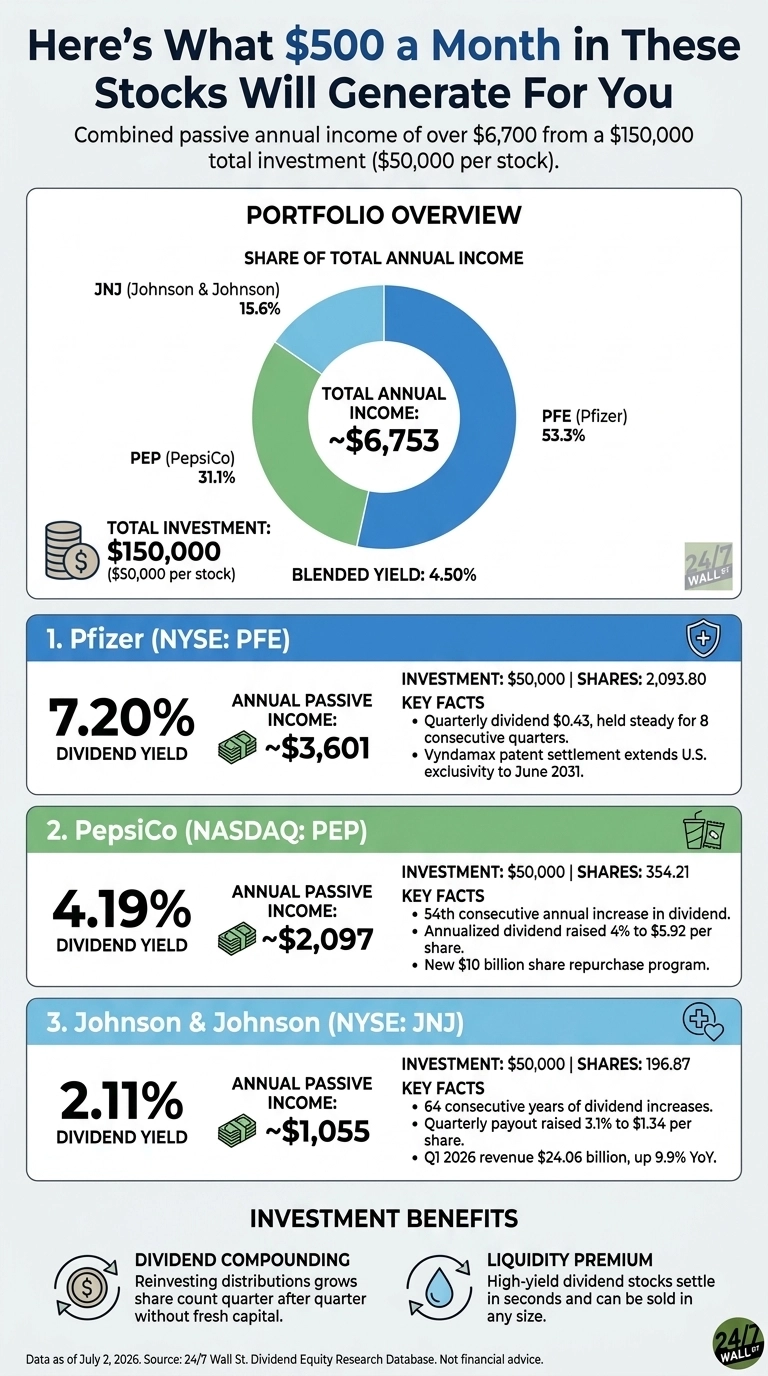
| Ticker | Annual Income | Share of Total |
|---|---|---|
| PFE | $3,601 | 53.3% |
| PEP | $2,097 | 31.1% |
| JNJ | $1,055 | 15.6% |
| Total | $6,753 | 100% |
Reinvest every distribution rather than spending it, and the share count grows quarter after quarter without a single additional dollar of fresh capital. That compounding is what separates a dividend portfolio from a bond ladder: the coupon size expands on its own. For investors building toward a future income floor, three checks a year from three separate industries is a durable place to start.
Contact [email protected] for any questions or corrections.
Vandita Jadeja is a financial publisher with over a decade of experience writing about financial topics, including investment, savings, retirement, insurance and banking. Vandita is a Chartered Accountant who loves to debunk financial concepts for readers.
Her work has appeared on sites that include The Motley Fool, InvestorPlace, and Benzinga. She covers investing and focuses on stock picks and price prediction for 24/7 Wall St.
When not looking for the next stock investment opportunity, she can be found traveling, reading, chasing sunsets and enjoying her iced latte.