The Dow Just Had Its Best First Half Since 2021, but This Jobs Number Is Flashing Yellow
The Dow just closed out its best first half since 2021, up 8.7% year-to-date, yet Wednesday’s open felt like a nervous glance at the door. CNBC’s Dominic Chu kicked off July with mixed earnings, one big M&A shrug, and a…


The Dow just closed out its best first half since 2021, up 8.7% year-to-date, yet Wednesday’s open felt like a nervous glance at the door. CNBC’s Dominic Chu kicked off July with mixed earnings, one big M&A shrug, and a jobs report that gave the bulls something to chew on.
Chu flagged the labor data. “ADP this morning reported that 98,000 jobs were added last month, that was below the consensus for economists of 110,000,” A miss of that size lands on top of a labor market quietly softening for a year. The Bureau of Labor Statistics has unemployment at 4.3% for three straight months, up from 3.9% in May 2024.
The Sahm Rule currently reads 0.10, well below the 0.50 recession trigger, though it spiked to 0.43 in November 2025 before easing back. Consumer sentiment tells a scarier story. The University of Michigan index just printed 44.8, down 5.0 points month-over-month and closing in on recessionary territory below 60. Kalshi traders are pricing a 21% probability that rates stay above 4.25% by the January 27, 2027 FOMC meeting, which means the crowd expects cuts.
Software’s redemption tour with Salesforce and ServiceNow
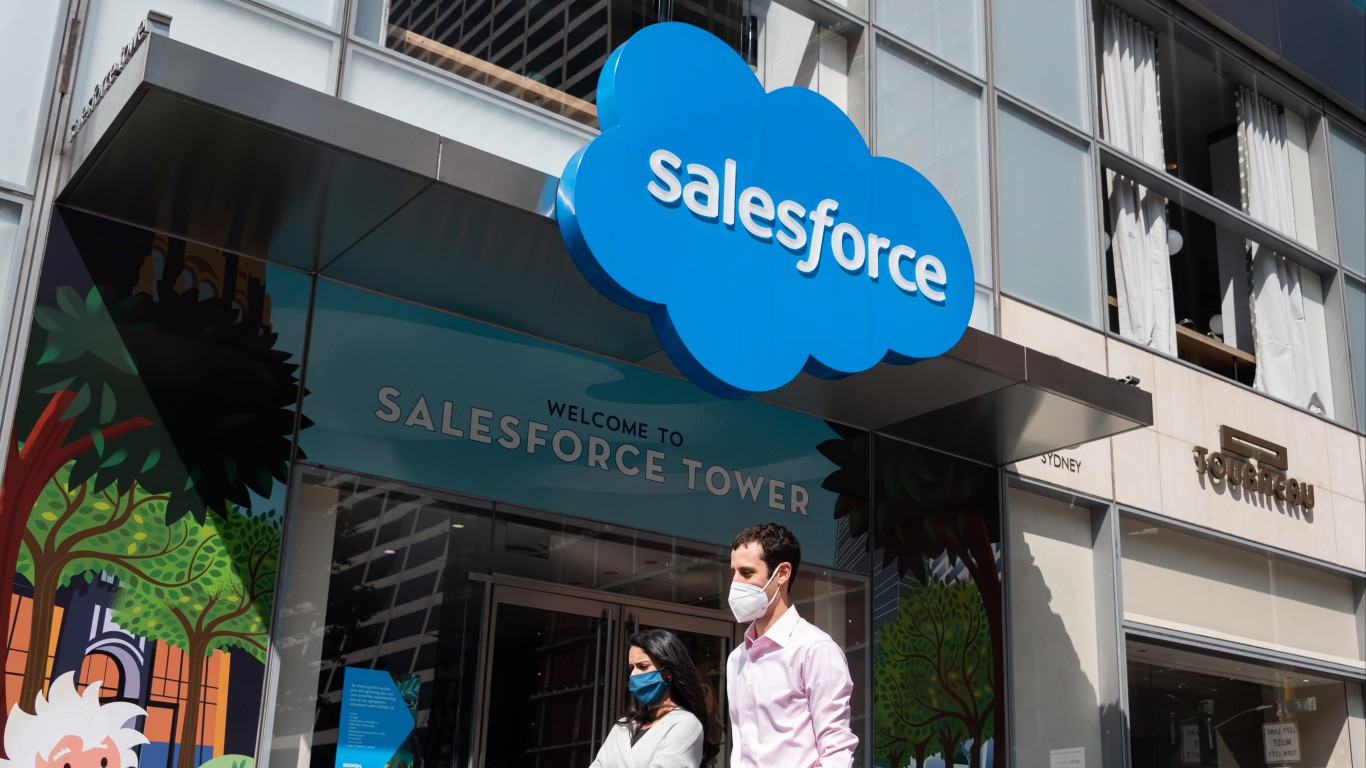
“Software giants Salesforce and ServiceNow are both up around 4%… after Guggenheim upgraded both stocks to a buy rating,” Chu noted, citing attractive valuations and the argument that both companies can weather AI disruption. Salesforce (NYSE:CRM | CRM Price Prediction) needed the boost. The stock is down 35% year-to-date at $163, a brutal contrast to the underlying business, which delivered Q1 FY27 EPS of $3.88 versus the $3.13 consensus and Agentforce ARR of $1.2 billion, up 205% year-over-year. Marc Benioff announced a $25 billion accelerated share repurchase, which is management speak for “we think this is silly.”
ServiceNow (NYSE:NOW) sits in the same penalty box, down 28% YTD despite Q4 revenue growing 20.7% year-over-year to $3.57 billion. Bill McDermott bought Moveworks, agreed to buy Armis and Veza, and keeps insisting agentic AI is a tailwind. The Q4 filing guides FY26 subscription revenue to $15.53 billion to $15.57 billion. Guggenheim is essentially saying the fundamentals have decoupled from the stock price, and the share price has to catch up.
Nike beats, China bleeds
“Nike shares are down 1% after the apparel company reported a 12% sales decline in the key China market,” Chu said. Technically, Nike (NYSE:NKE) crushed the number, posting EPS of $0.72 versus the $0.1273 consensus, but that beat came almost entirely from a $986 million one-time IEEPA tariff-recovery benefit following the Supreme Court ruling.
Strip that out and the picture is uglier. Revenue slipped 1.1% year-over-year, NIKE Direct fell 7%, and Converse dropped 32%. Elliott Hill called fiscal 2026 a foundation-strengthening year in the earnings release. Shares are down 73% over five years.
Constellation pops, Kroger sags on the Giant Eagle deal
Constellation Brands (NYSE:STZ) posted Q1 comparable EPS of $3.43 beating the $3.21 estimate and organic net sales growing 3%. Pacifico depletions rose 21% and Victoria climbed 14%, offsetting softness in Modelo Especial and Corona Extra. Full-year comparable EPS guide of $11.20 to $11.90 was affirmed.
Kroger (NYSE:KR) went down after announcing it will acquire Giant Eagle for roughly $1.7 billion. New CEO Greg Foran is trying to reset the story after the Albertsons collapse. Q1 adjusted EPS of $1.58 came in a penny light of the $1.59 estimate snapped a four-quarter beat streak. Shares are down 10.7% YTD.
What to watch as H2 begins
Wage growth is still hot at $37.53 in May 2026 versus $36.28 a year prior, hiring is cooling, sentiment is at recession-adjacent levels, and the Dow just had its best six months in five years. Keep an eye on Friday’s official BLS report. If it confirms the ADP softness, the Fed conversation shifts fast, and the software rally may finally get the multiple expansion the fundamentals have been begging for.
Contact [email protected] for any questions or corrections.
Omor Ibne Ehsan is a writer at 24/7 Wall St. He is a self-taught investor with a focus on growth, cyclical, and dividend equities that have strong fundamentals, value, and long-term potential. He also has an interest in high-risk, high-reward investments such as penny stocks.