The ‘Michael Burry Bear Case’ for AI Chips Is Back, and This GPU Math Problem Won’t Go Away
On CNBC’s Closing Bell Overtime the evening of June 30, 2026, a guest said the quiet part out loud about AI hardware: “the AI memory hardware food chain is still trading as if there’s no choice… there’s still reckonings to…

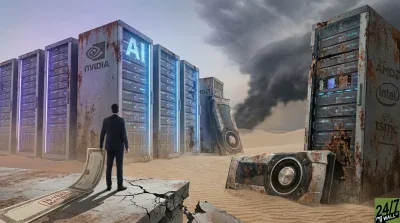
On CNBC’s Closing Bell Overtime the evening of June 30, 2026, a guest said the quiet part out loud about AI hardware: “the AI memory hardware food chain is still trading as if there’s no choice… there’s still reckonings to be had.” The bull case for the shovels in the AI gold rush rests on assumptions about how long those shovels last. That assumption is cracking.
The guest framed the core problem as a maturity mismatch. “If you’re going to issue bonds that are 10 years out… and the depreciation of the asset is 5 years, well, what do you do?” He tagged it as “a Michael Burry bear case for a little while.” Hyperscalers currently depreciate GPUs over roughly five to six years. Shorten that useful life to something more realistic, and near-term operating income at the buyers falls while the capex hole deepens.
NVIDIA (NASDAQ:NVDA | NVDA Price Prediction) disclosed total supply-related commitments of $119 billion and multi-year cloud service commitments of $30.0 billion in its most recent 10-Q. Roughly 50% of Data Center revenue flows from hyperscalers. Rewrite their depreciation schedules downward and both sides of that trade tighten simultaneously.
The food chain that keeps buying its own dog food
NVIDIA’s Q1 FY27 revenue printed at $81.61 billion, up 85.2% year over year, with Data Center at $75.25 billion, up 92%. The stock trades at a forward P/E of 23. That multiple depends entirely on the trailing P/E is 31 and every forward multiple depends on hyperscaler capex staying voracious.
AMD (NASDAQ:AMD) makes the picture more interesting. Q1 2026 revenue hit $10.25 billion, up 37.9%, with a Meta partnership to deploy up to 6 gigawatts of AMD Instinct GPUs. The stock is up 171.25% year to date and trades at a trailing P/E of 192x. On Reddit, one of the higher-engagement threads on the name was titled “AMD is literally funding a startup with $350M just so they can buy AMD chips” (1,634 upvotes). The circularity anxiety is real.
Intel (NASDAQ:INTC) is the strangest tape in the group: up 278.4% year to date, a forward P/E of 152x, and trailing EPS of negative $0.61. NVIDIA’s $5 billion equity investment and the Xeon selection for DGX Rubin NVL8 systems are real, but Q1 included a $3.73 billion GAAP net loss driven by a $4.07 billion restructuring charge. The market is paying growth-stock multiples for a turnaround.
Taiwan Semiconductor (NYSE:TSM) is the foundry backbone. May consolidated net revenue grew 30.1% year over year to NT$416.98 billion, with CEO C.C. Wei guiding to more than 30% full-year revenue growth. Overseas fab expansion in the US, Japan, and Germany is a structural margin headwind, and TSM sold off 5.08% on June 23 on valuation and capex concerns.
DeepSeek, and the consumer canary in the coal mine
Cheaper “good enough” models like DeepSeek attack the demand side of the equation. If inference gets efficient enough that you need meaningfully fewer GPUs per unit of intelligence, the training-side capex commitments look extended.
The consumer, the eventual funder of all this compute, is wobbling. Nike (NYSE:NKE) posted fiscal Q1 2027 revenue down 1.1%, with Greater China down 12% reported (17% currency-neutral) and NIKE Direct down 7%. The guest on Overtime pointed out that Lululemon also flagged North American weakness, and the pattern looks potentially structural.
May job openings came in at 7.59 million versus the 7.3 million estimate, so the labor market is not obviously buckling. But AI has not visibly reduced headcount, which means the productivity payoff justifying $119 billion in supply commitments is still hypothetical.
What breaks first
Polymarket traders assigned only a 49.5% probability that NVDA closes above $200 by end of July, and the crowd’s near-term same-day read on July 1 was 87.2% down. That crowd has been right on NVDA 74.4% of the time across 195 resolved markets. The Burry critique only requires the depreciation schedule to be wrong by a couple of years. Then the earnings power investors are paying for gets rebuilt with different numbers, and the food chain that has been trading as if there is no choice discovers there is one.
Contact [email protected] for any questions or corrections.
Omor Ibne Ehsan is a writer at 24/7 Wall St. He is a self-taught investor with a focus on growth, cyclical, and dividend equities that have strong fundamentals, value, and long-term potential. He also has an interest in high-risk, high-reward investments such as penny stocks.