Ford Vs. Tesla: 2 American Icons With Upside, Which to Buy
Ford (NYSE:F | F Price Prediction) and Tesla (NASDAQ:TSLA) just closed the books on Q1 2026. Ford leaned on trucks, fleet software, and a raised outlook. Tesla leaned on margin recovery, FSD subscriptions, and a roadmap stuffed with robots. Both…


Ford (NYSE:F | F Price Prediction) and Tesla (NASDAQ:TSLA) just closed the books on Q1 2026. Ford leaned on trucks, fleet software, and a raised outlook. Tesla leaned on margin recovery, FSD subscriptions, and a roadmap stuffed with robots. Both grew revenue. Only one is priced like a growth story.
Trucks Carry Ford. Margins Carry Tesla.
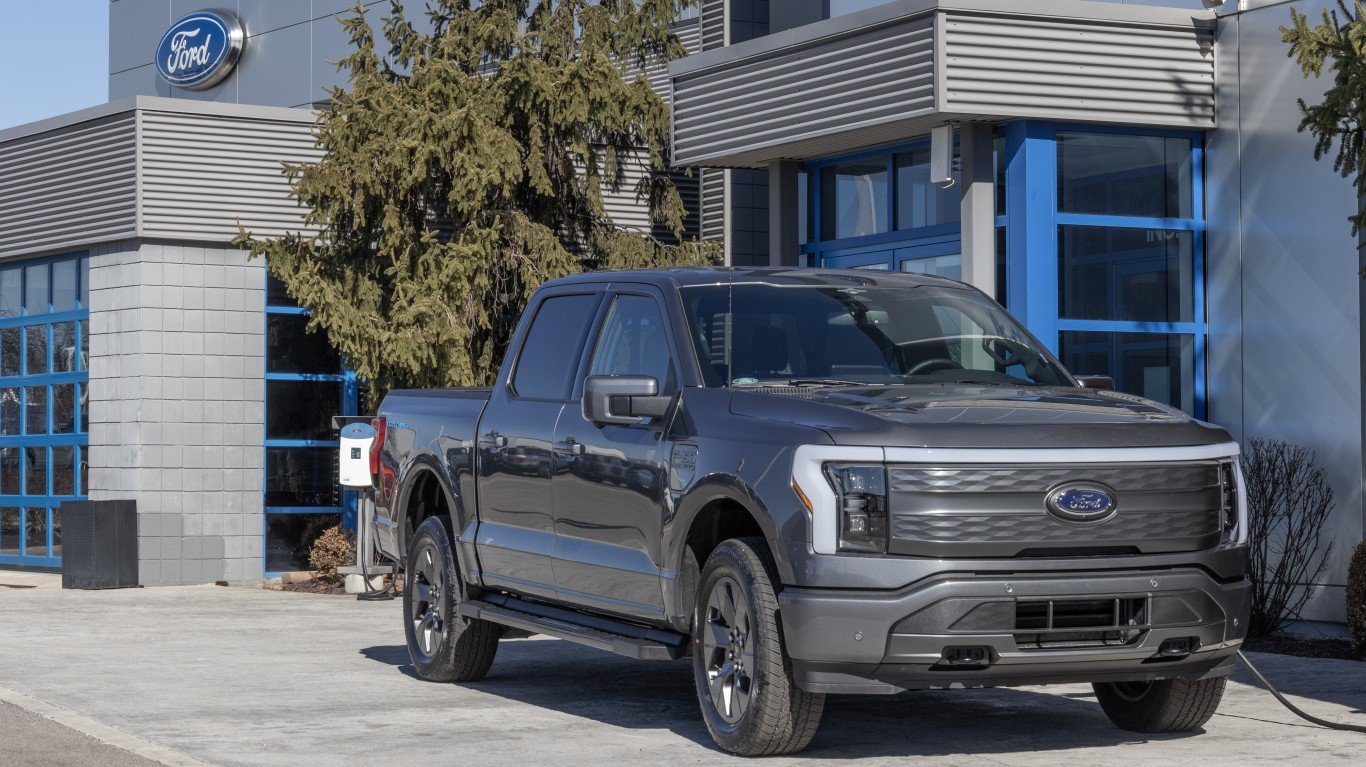
Ford posted $43.25 billion in revenue, EPS of $0.66, and adjusted EBIT of $3.49 billion. Ford Blue drove the quarter with $23.9 billion in revenue (up 14%) as F-Series, Bronco, and Expedition kept humming, with off-road trims making up roughly a quarter of U.S. sales. Ford Pro delivered an 11.4% margin and grew paid software subscriptions 30% year over year to 879,000. Model e still bled $777 million.
Tesla posted revenue of $22.39 billion (up 15.78%), non-GAAP EPS of $0.41, and automotive gross margin of 21.1% from 16.2%. FSD subscriptions climbed to 1.28 million, up 51%. Services revenue jumped 42%. Energy storage dropped 12%.
Deep Value Truck Maker vs. AI Fleet Operator
| Lens | Ford | Tesla |
| Forward P/E | 8 | 200 |
| Market Cap | $53.2B | $1.48T |
| Core Bet | F-Series cash funding Model e | FSD licensing, robotics, compute |
| Dividend Yield | 4.4% | None |
Jim Farley framed the quarter as validation: “Our strong first-quarter results and raised full-year guidance reflect the momentum of the Ford+ plan.” Ford lifted 2026 adjusted EBIT guidance to $8.5B to $10.5B. A $1.30 billion IEEPA tariff benefit flattered the earnings report, and commodity headwinds run near $2 billion. Tesla is spending $1.95 billion on R&D and sitting on $44.7 billion in cash, funding Cybercab, Semi, Megapack 3, and Optimus lines rated for 1 million robots per year at Fremont.
The Next Test Is Whether AI Revenue Scales
Watch two things. For Ford, whether the Universal EV platform can narrow Model e’s $4.0B to $4.5B projected 2026 loss without gutting Blue’s cash generation. For Tesla, whether robotaxi rides in Dallas and Houston convert into real revenue. Polymarket traders assign only 12% odds to an Optimus release by year-end and 7.5% to Robovan orders opening before 2027. That is significant runway priced into a 357 trailing multiple.
Why I Lean Toward Tesla, With One Caveat
Ford at a forward multiple of 8 and a 4.4% yield is tempting, especially after 13 directors bought stock at $13.22 on May 21. If you want income and a turnaround narrative, Ford fits.
But structure matters. Tesla’s 21.1% automotive gross margin and scaling FSD base signal a software mix shift, while Ford funnels combustion profits into an EV unit losing billions. Tesla is the better long-term compounder. I would trim conviction if FSD monetization stalls or if one-time warranty and tariff gains reverse next quarter. Both can work. Tesla’s ceiling is higher.
Contact [email protected] for any questions or corrections.
Alex Sirois is a financial writer with experience spanning both retail and institutional investing. He has written for InvestorPlace and held roles at BNY Mellon and Bernstein, giving him a perspective that bridges Main Street portfolios and Wall Street analysis.
Alex holds an MBA from George Washington University and has built his career across multiple industries, including e-commerce, education, and translation — a breadth of experience that informs how he breaks down complex financial topics for everyday investors. His writing is conversational, actionable, and grounded in long-term, buy-and-hold investing principles.
At 247 Wall St., Alex focuses on delivering analysis that is both accessible and useful, with a clear emphasis on helping readers make more informed decisions with their money.