Goldman’s Top Strategist Sees a Dangerous Amount of Leverage Piling Up
Ben Snider, Chief U.S. Equity Strategist at Goldman Sachs, went on CNBC to say something that should register with anyone who has been happily riding this market higher. The character of this market is shifting midyear, and the driver is…


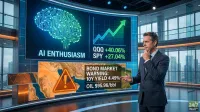
Ben Snider, Chief U.S. Equity Strategist at Goldman Sachs, went on CNBC to say something that should register with anyone who has been happily riding this market higher. The character of this market is shifting midyear, and the driver is a substantial increase in a substantial increase in leverage across investor types: retail margin debt, hedge-fund leverage, and leveraged ETFs. With the S&P 500 up 9.6% year to date and the Nasdaq-100 up 16%, the complacency reading is doing exactly what complacency readings do before the next air pocket.
The Leverage Warning
Leverage is a crowbar. It lets you move something heavier than you could move on your own, and it does the same thing on the way back down when the object lands on your foot. When Snider says leverage is up across retail, hedge funds, and leveraged ETF assets, he is saying the crowbar is getting longer for all three groups at the same time.
That matters because the VIX at 15.81 sits in the 22.6th percentile of its one-year range, which is precisely the environment where investors talk themselves into more risk on the belief that volatility is contained. It is also the environment in which the March 27, 2026 spike to 31.05 was born, back when the VIX stayed above 20 from March 6 through April 9. The gauge decays slowly and spikes fast. Leverage does the same thing in reverse.
Why This Means More Volatility
Snider is already seeing the fingerprints in price action, particularly in the momentum factor and semiconductors. That is the mechanical part of the story. When positioning gets crowded and leveraged into the same names, small moves in the underlying trigger larger moves in the derivatives, which trigger forced buying or selling from leveraged ETFs rebalancing at the close, which feeds back into the underlying.
The rate backdrop is not helping. The 10-year Treasury yield sits at 4.49%, in the 93.2nd percentile of its one-year range, and the 10-year minus 2-year spread has compressed to 0.35%, in the 4th percentile. Expensive leverage plus a flattening curve is not the backdrop where you want to be maximum long the most crowded factor.
The Rotation Into Health Care
Snider’s playbook is not calling for AI capitulation; fundamentals in the AI complex remain strong. He wants investors to balance AI exposure with less-correlated areas like health care, which he described as having a quiet, solid run. The numbers agree with him. The Health Care Select Sector SPDR Fund (NYSEARCA:XLV) is up 6.31% over the past month versus the SPDR S&P 500 ETF Trust‘s (NYSEARCA:SPY) 1.86%, and up 21.61% over the past year.
Snider also thinks the AI infrastructure trade may lose near-term momentum because capex guidance upgrades tend to land at the end and beginning of the calendar year, not midyear, so the big upward revisions that juiced last quarter are probably not repeating in Q2 prints.
If you want the deeper reading on why diversification within the boom matters, our 7 Stocks Powering the AI Boom (That Aren’t Chipmakers) report walks through the enabler names that sit outside the crowded semi trade. Goldman’s own view on this concentration risk is laid out in its 2026 Investment Outlook.
The Median Company’s Earnings Bar Is Lower Than the Headline
The number that matters most is the one you will not see in the CNBC chyron. Consensus S&P 500 earnings growth is 22%, the highest bar since 2021, but that figure is skewed by mega-caps. Snider prefers the median company’s growth number, which is 9%, down from 13% last quarter. That is a materially more beatable bar for the other 493 stocks.
So if you are trying to reconcile a scary headline expectation with a market that keeps grinding higher, this is the reconciliation. The index has to clear a hurdle only the top ten names can clear. Everyone else has room to surprise. Which, if Snider is right about leverage, is exactly the asymmetry you want to own into a volatility regime shift.
Contact [email protected] for any questions or corrections.
Omor Ibne Ehsan is a writer at 24/7 Wall St. He is a self-taught investor with a focus on growth, cyclical, and dividend equities that have strong fundamentals, value, and long-term potential. He also has an interest in high-risk, high-reward investments such as penny stocks.