Wall Street Missed the Plot on MELI: Why This Massive 49% Top-Line Surge Is My E-Commerce No-Brainer
I keep buying MercadoLibre (NASDAQ:MELI | MELI Price Prediction) every time the market throws a tantrum about it, and the last two months have handed me plenty of chances. The stock is down 5.7% since the Q1 print on May…


I keep buying MercadoLibre (NASDAQ:MELI | MELI Price Prediction) every time the market throws a tantrum about it, and the last two months have handed me plenty of chances. The stock is down 5.7% since the Q1 print on May 7, 2026, down 28.67% over the past year, and short-term holders keep hitting the sell button because provisions for doubtful accounts jumped to $1.244 billion from $603 million a year earlier. That reaction is exactly why I keep adding.
Here is the story the market is missing. Revenue in Q1 2026 grew 49.03% year over year to $8.85 billion, beating consensus by $522 million. CFO Martín de los Santos called it “our strongest growth rate since Q2 2022”. Brazil accelerated to 55% revenue growth with items sold up 56%, Mexico ran at 62%, and unique buyer growth in Brazil hit its fastest pace in five years. This is a company adding customers faster while its unit shipping costs in Brazil fall 17% year over year in local currency.
The fintech side is the second engine, and it is why I treat this as an ecosystem bet rather than a retail stock. Fintech revenue grew 51%, the credit card portfolio grew 104% year over year to $6.6 billion, Mercado Pago now has 83 million monthly active users, and assets under management climbed 77% to nearly $20 billion. Operating cash flow more than doubled to $2.075 billion in the quarter alone. S&P upgraded MELI to investment grade (BBB-) in July 2025, giving a fintech book that size a cheaper cost of capital just as it scales.
The runway is why I refuse to trade around this. The average Latin American makes 7 online purchases per year versus 41 in the US, 85% of Mexican small purchases still use cash, and credit to individuals as a share of GDP in Argentina sits at one-fifth of Brazil’s level. This is a decade-plus penetration story wearing a quarterly earnings costume.
Now the risk I take seriously. Operating margin compressed 600 basis points to 6.9%, adjusted free cash flow flipped to negative $56 million, and net debt climbed to $5.748 billion. Management extended average loan durations from 5 months to 8 months, which drove those provisions higher and prompted a securities fraud investigation by Kirby McInerney LLP. If credit losses in Brazil run hotter than modeled, this thesis takes real damage. What keeps me holding is that de los Santos was explicit: “margins are a consequence of our investment posture, and we can dial the investment intensity up or down”. The margin is a choice, and the growth is the result.
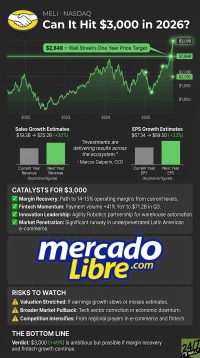
The market seems to be catching on late. Analyst consensus target sits at $2,208.62 against a current price of $1,763.36, with 20 buy ratings, 4 holds, and zero sells. SVP Marcelo Melamud bought 124.64 shares at $1,604.62 on June 11, 2026, and Director Alejandro Aguzin purchased 600 shares in May 2026. Insiders are buying the same drawdown I am.
Forward P/E of 34 for a company compounding revenue near 50% inside a continent where e-commerce penetration is roughly half of US/UK/China is a price I will keep paying.
Every panic sale is somebody handing me shares of the operator building the payments, credit, and logistics rails of an entire continent, and I plan to keep taking them.
Contact [email protected] for any questions or corrections.
Alex Sirois is a financial writer with experience spanning both retail and institutional investing. He has written for InvestorPlace and held roles at BNY Mellon and Bernstein, giving him a perspective that bridges Main Street portfolios and Wall Street analysis.
Alex holds an MBA from George Washington University and has built his career across multiple industries, including e-commerce, education, and translation — a breadth of experience that informs how he breaks down complex financial topics for everyday investors. His writing is conversational, actionable, and grounded in long-term, buy-and-hold investing principles.
At 247 Wall St., Alex focuses on delivering analysis that is both accessible and useful, with a clear emphasis on helping readers make more informed decisions with their money.