NVDA Vs. AMD: Even if Nvidia’s Kyber Rack AI is Delayed, It is the Better Buy Over AMD
NVIDIA just reported revenue nearly eight times larger than AMD's AI hardware business, yet AMD shares have surged over 150% this year while NVIDIA barely moved. One of these valuations is pricing in a future that may not arrive on…

NVIDIA (NASDAQ: NVDA | NVDA Price Prediction) and AMD (NASDAQ: AMD) both just reported, and the results reveal two very different AI hardware businesses. NVIDIA posted $81.61 billion in quarterly revenue on 85.23% growth. AMD delivered $10.253 billion at 37.85% growth. Even with a rumored 12-month delay of the vertical Kyber NVL144 rack architecture into 2028, the gap in scale, margins, and software lock-in is widening.
Rubin Ships in Volume. Helios Is Still Chasing.
NVIDIA’s Data Center segment produced $75.246 billion, up 92% YoY, with networking alone growing 199% YoY to $14.8 billion. That networking figure is roughly 1.4x AMD’s entire Data Center segment of $5.775 billion. Jensen Huang framed the moment plainly: “The buildout of AI factories, the largest infrastructure expansion in human history, is accelerating at extraordinary speed.”
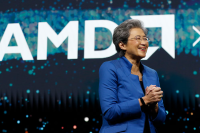
AMD’s story is real, but smaller in absolute terms. Lisa Su highlighted that “Customer engagement around MI450 Series and Helios is strengthening, with leading customer forecasts exceeding our initial expectations.” Meta committed to up to 6 gigawatts of Instinct GPU deployment. Encouraging, yet AMD is still a fast-follower renting hyperscaler capacity NVIDIA already dominates.
| Business Driver | NVIDIA | AMD |
| Data Center revenue | $75.25B | $5.78B |
| Non-GAAP gross margin | 75.0% | 55% |
| Networking growth | +199% YoY | Pensando (partner-dependent) |
Full Stack vs. Fast Follower
NVIDIA sells a system: CUDA, Dynamo 1.0, NVLink, InfiniBand, and now Vera Rubin CPUs. Rubin systems are already in full production and shipping to all eight major hyperscalers this fall. AMD counters with ROCm 7 and the open UALink consortium, which sounds inclusive but slows unified execution.
Capital returns also diverge. NVIDIA authorized $80.0 billion in fresh buybacks and lifted its dividend from $0.01 to $0.25 per share. AMD’s insiders, meanwhile, have been trimming: Lisa Su sold heavily across May and June at prices between $436.89 and $476.43. Routine or not, it is a contrast worth noting when AMD trades at a P/E near a triple-digit multiple.
The Next Test Is Kyber Timing and Rubin Volume
NVIDIA guided Q2 revenue to $91.0 billion with $119.0 billion in supply commitments already booked. AMD guided to roughly $11.20 billion at ~56% gross margin. I will be watching whether MI450 Helios racks convert engagements into shipped gigawatts, and whether Kyber slippage actually opens the window bulls hope for.
Why I Still Lean NVIDIA Despite the Kyber Noise
For the cleanest exposure to AI infrastructure, NVIDIA carries the structural edge today. The 157.77% year-to-date run in AMD versus 4.98% for NVIDIA has already priced in a lot of MI450 optimism. NVIDIA is compounding 75% gross margins on a base 8x larger, buying back stock aggressively, and locking in optics and packaging partners years out. AMD suits investors chasing beta into a rack-scale ramp. The platform every model still trains on remains the structural winner.
Contact [email protected] for any questions or corrections.
Alex Sirois is a financial writer with experience spanning both retail and institutional investing. He has written for InvestorPlace and held roles at BNY Mellon and Bernstein, giving him a perspective that bridges Main Street portfolios and Wall Street analysis.
Alex holds an MBA from George Washington University and has built his career across multiple industries, including e-commerce, education, and translation — a breadth of experience that informs how he breaks down complex financial topics for everyday investors. His writing is conversational, actionable, and grounded in long-term, buy-and-hold investing principles.
At 247 Wall St., Alex focuses on delivering analysis that is both accessible and useful, with a clear emphasis on helping readers make more informed decisions with their money.