The Trump Administration Presses for More Memory Plants in America: These 3 Stocks Could Be Winners
Washington is leaning hard on foreign chipmakers to build memory fabs on American soil, and the pressure is creating a narrow window for investors who know where to look in the semiconductor supply chain.

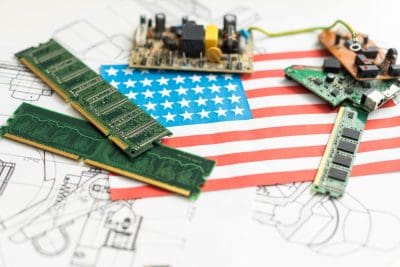
The Trump administration is pressuring foreign memory chipmakers to expand their U.S. footprint, framing memory as a strategic asset for the AI era. According to a Benzinga report, Commerce Secretary Howard Lutnick has publicly pressed Samsung and SK Hynix, saying they will have “no choice but to follow” Micron Technology‘s (NASDAQ:MU | MU Price Prediction) domestic expansion, and adding that “strengthening America’s semiconductor supply chain” outweighs corporate rivalries.
The two Korean giants are reportedly in active expansion talks with Washington and reportedly plan $880 billion of combined investment in the coming years to serve AI memory demand. SK Hynix‘s (NASDAQ:SKHY) U.S.-listed ADR recently began trading on the NASDAQ exchange, signaling the memory supply chain is orienting west.
Tesla (NASDAQ:TSLA) CEO Elon Musk unveiled plans for “Terafab,” a vertically integrated chip mega-facility in Austin, Texas, pursued jointly by Tesla, xAI, and SpaceX (NASDAQ:SPCX). Musk described it as a “large-scale domestic production facility that includes logic, memory, and packaging,” targeting 1 terawatt of annual chip output. Terafab remains a stated vision with no disclosed timeline, but it reinforces the direction of travel.
Three publicly traded companies look positioned to benefit if U.S. memory investment accelerates. Each occupies a distinct point in the fab value chain, from lithography tools to metrology to physical construction.
1. ASML
ASML (NASDAQ:ASML) holds a global monopoly on extreme ultraviolet (EUV) lithography, meaning no advanced memory or logic fab can be built without its systems. The company reported Q2 2026 revenue of $10.65 billion, up 21.3% year over year (YoY), with EPS of $8.67 and operating margin of 37.1%.
Management raised FY2026 revenue guidance to $43 billion to $45 billion and outlined plans to add 30% to low-NA EUV capacity for 2027, with a matching expansion planned for DUV immersion systems. ASML CEO Christophe Fouquet cited “ongoing AI-related investments” driving demand for advanced logic and memory chips.
ASML stock is up 64% year to date (YTD) and carries a trailing 12-month P/E ratio of 60x. The valuation is elevated, and the business is more logic and EUV-levered than pure memory. However, any U.S. memory fab wave necessarily pulls through ASML tools.
The risks include export control restrictions and tariff overhang, both flagged by management. A domestically focused U.S. policy could partly offset ASML’s lost China revenue, though not fully.
2. Onto Innovation
Onto Innovation (NYSE:ONTO) specializes in process control, metrology, and inspection with heavy exposure to high-bandwidth memory (HBM) and advanced packaging, the exact segments driving AI memory capex. The company’s Q1 2026 revenue hit a record $291.95 million, up 9.5% YoY, with non-GAAP EPS of $1.42.
Onto Innovation’s advanced-nodes business grew 13% quarterly, and management guided Q2 revenue to $320 million to $330 million. A prior volume purchase agreement estimated at over $240 million with a leading HBM manufacturer runs through 2027, and Onto also holds a 27% ownership stake in Rigaku valued at $710 million.
CEO Mike Plisinski stated that “global AI investment fueling a robust upcycle in semiconductor capital equipment spending” positions Onto’s portfolio across advanced packaging, advanced nodes, and specialty devices to capture high-growth segments.
Onto Innovation stock is up 89% YTD, but ONTO’s trailing 12-month P/E ratio sits near 132x, a rich level that leaves little room for execution slips. The consensus analyst target price is $369.60; Onto Innovation’s valuation and smaller-cap volatility are among the main risks.
3. EMCOR Group
EMCOR Group (NYSE:EME) provides the electrical and mechanical construction that physically builds fabs, cleanrooms, data centers, and mission-critical facilities. The company’s Q1 2026 revenue was $4.63 billion, up 19.7% YoY, with EPS of $6.84 and operating margin of 8.7%.
EMCOR’s Remaining Performance Obligations reached a record $15.62 billion, up 32.9% YoY, and management raised FY2026 revenue guidance to $18.5 billion to $19.25 billion. Furthermore, the company’s U.S. Electrical Construction revenue jumped 33.1% and U.S. Mechanical Construction climbed 28.8%.
EMCOR stock is up 23% YTD with a trailing 12-month P/E ratio near 25x, a comparatively modest multiple among the three names. The consensus analyst price target sits at $1,000.14.
The risks are project-based rather than technological: tariffs on materials, skilled labor scarcity, and inflation. EMCOR isn’t a pure semiconductor play, so fab exposure competes with data centers, healthcare, and institutional work in its backlog.
The ETF Angle and Broader Takeaways
Investors seeking diversified exposure could consider the VanEck Semiconductor ETF (NASDAQ:SMH), which holds ASML at around 8% of net assets as a top-tier position. The ETF excludes EMCOR entirely, and Onto Innovation falls outside its top ten holdings, so it delivers only partial coverage of the memory-fab construction theme.
The SMH ETF is a concentrated single-sector fund that carries sector-concentration risk. For context on how AI capex is reshaping adjacent industries, our research team’s briefing on 7 Stocks Powering the AI Boom (That Aren’t Chipmakers) explores that theme in depth.
The thesis for ASML, Onto Innovation, and EMCOR rests on a policy push and announced plans whose timelines and outcomes remain uncertain. Investors may want to watch fab groundbreaking announcements, HBM order flow, and further Commerce Department signals for confirmation, and should size their positions modestly given the elevated valuations in the equipment-segment businesses.
Contact [email protected] for any questions or corrections.
David Moadel is financial writer specializing in stocks, ETFs, options, precious metals, and Bitcoin. David has written well over 1,000 articles for leading online publications, helping investors understand markets, income strategies, and risk.His work has appeared in The Motley Fool, InvestorPlace, U.S. News & World Report, TipRanks, ValueWalk, Benzinga, Market Realist, TalkMarkets, Finmasters, 24/7 Wall St., and others.With a master’s degree in education, David has taught at the elementary, high school, and college levels. That teaching background shapes his writing style: clear, educational, and practical. David has also built a loyal social-media audience by providing trustworthy financial content on YouTube, X/Twitter, and StockTwits.