Oracle is Falling Fast. Here’s Why This Wall Street Firm Believes The Stock Will Triple in 12 Months
Oracle just shed a third of its value in a month while sitting on a backlog that one top Wall Street analyst calls the clearest forward-revenue signal he has ever seen in enterprise software. Something in that math does not…


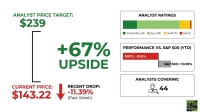
Oracle (NYSE:ORCL | ORCL Price Prediction) trades at $124.21 against a consensus Wall Street price target of $251.85, a gap of roughly 103%.
Oracle sells database and enterprise software, but the cloud story dragged the stock up and then down. Over the last two years the company reinvented itself as a hyperscale landlord chasing AI training and inference workloads, embedding 72 multicloud datacenters inside Amazon, Google, and Microsoft. That pivot put Oracle on every generalist’s radar and is why the recent decline matters. Analysts built their bullish thesis on a $638 billion contracted backlog, and the market has spent the last month acting as if that backlog is not there.
Why a Cloud Darling Just Lost a Third of Its Value in a Month
Oracle has fallen 33.43% over the past month and 35.29% year to date, closing within a rounding error of the $123.66 52-week low. S&P cut Oracle’s credit rating to BBB-, one notch above junk, citing debt implications of massive AI infrastructure spending and concentration risk tied to OpenAI. Two days later, IBM cratered on a software miss that Bloomberg tied to enterprise budgets shifting from software into AI servers, dragging every large-cap software name lower.
The underlying anxiety is cash. Free cash flow for FY2026 came in at negative $23.69 billion on $55.66 billion of trailing capex, and management expects another ~$70 billion capex outlay in FY2027 plus a ~$40 billion debt and equity raise. A New Mexico pipeline permit denial and nationwide protests around data-center energy use added execution risk.
The Case Guggenheim Is Still Making at Three Times the Current Price
Guggenheim’s John DiFucci has kept a $400 price target on Oracle and named it his best software idea for 2026, implying upside that more than triples the current share price and sits well above the Street average. His core argument is that there is “no apparent good reason” for the pullback and anxiety over near-term margin compression is drowning out an unprecedented backlog signal.
Remaining performance obligations exploded to $638 billion, up 363% year over year. Cloud infrastructure revenue grew 93% in the June quarter, cloud is now 52% of total revenue, and management reconfirmed a $90 billion FY2027 revenue target with $8.05 in non-GAAP EPS. CFO Hilary Maxson told analysts the “unprecedented level of RPO provides exceptional visibility into our future revenue growth”, with steady-state ROIC in the high 20s at the project level.
DiFucci’s timeline is the piece the market seems least willing to underwrite. He expects free cash flow to rebound dramatically starting in fiscal 2029 as front-loaded infrastructure spend converts into recurring, high-margin revenue. Consensus already reflects broad agreement on direction if not magnitude:
- Strong Buy: 8
- Buy: 29
- Hold: 5
- Sell: 1
How the Cloud Software Peer Group Stacks Up
Every large-cap enterprise software name has sold off this year, but Oracle has fallen furthest and carries the widest analyst-implied gap.
Microsoft (NASDAQ:MSFT) is down 16.69% year to date to $401.10, well behind Oracle’s slide. The consensus target of $558.66 implies roughly 39% upside, with ratings overwhelmingly bullish at 54 buy or strong-buy calls against 3 holds and no sells.
Salesforce (NYSE:CRM) is down 34.47% year to date to $172.68. The consensus target of $245.16 implies about 42% upside, with a ratings mix that skews buy but includes two strong-sell calls.
IBM (NYSE:IBM) trades at $219.05 after a 25.82% one-week drop tied to its Q2 preannouncement. The $283.80 consensus target implies roughly 30% upside, with revisions skewed lower since the miss.
Oracle carries by far the largest analyst-implied upside across the group, signaling either that consensus is behind the curve on risks or that sector rotation has punished Oracle for something the fundamentals do not yet show.
What the Selloff Looks Like Next to the Market
Oracle’s 35.29% year-to-date decline compares with a 10.09% gain for the S&P 500, underperforming the index by more than 45 points in seven months. The stock trades on a forward P/E of 16 against a trailing 23, with a PEG of 0.74. The average target of $251.85 implies roughly 103% upside, and analyst revisions and the trailing five-year total return of 52.77% both point to a market that has priced Oracle for a slower ramp than management is guiding to.
The Investment Case
The bull case holds if the RPO conversion story arrives on management’s schedule and the FY2029 free-cash-flow inflection Guggenheim models shows up on time. The path back to consensus runs through steady quarterly proof that OCI margins hold at the 30% to 40% range, GPU utilization stays near 97.5%, and the balance sheet absorbs the $40 billion raise without another downgrade.
The bear case sharpens if the credit market keeps flashing yellow. A second S&P notch would take Oracle to junk, force selling from investment-grade mandates, and reprice the entire capital plan. Concentration risk in the OpenAI relationship, permit fights around data centers, and customer defections toward in-house AI tools are real risks that chip at the recurring-revenue premium the bull case demands.
On balance the dislocation looks larger than the underlying deterioration. The setup rewards investors with a tolerance for another leg down while the FY2029 cash-flow thesis proves itself.
Contact [email protected] for any questions or corrections.
Alex Sirois is a financial writer with experience spanning both retail and institutional investing. He has written for InvestorPlace and held roles at BNY Mellon and Bernstein, giving him a perspective that bridges Main Street portfolios and Wall Street analysis.
Alex holds an MBA from George Washington University and has built his career across multiple industries, including e-commerce, education, and translation — a breadth of experience that informs how he breaks down complex financial topics for everyday investors. His writing is conversational, actionable, and grounded in long-term, buy-and-hold investing principles.
At 247 Wall St., Alex focuses on delivering analysis that is both accessible and useful, with a clear emphasis on helping readers make more informed decisions with their money.