Price Prediction: Two Big Reasons Oracle Stock Could Surge 60% This Year
Oracle's cloud backlog just shattered records while the stock collapsed to near its 52-week low, creating a gap between fundamentals and price that rarely survives for long. Two overlooked forces from last quarter suggest the selloff may have handed investors…


Oracle (NYSE: ORCL | ORCL Price Prediction) has been the AI cloud story of the year, then the AI cloud panic of the last month. Shares are down 35.29% year to date and 33.43% over the past month, yet the underlying business is growing faster than at any point in Oracle’s history.
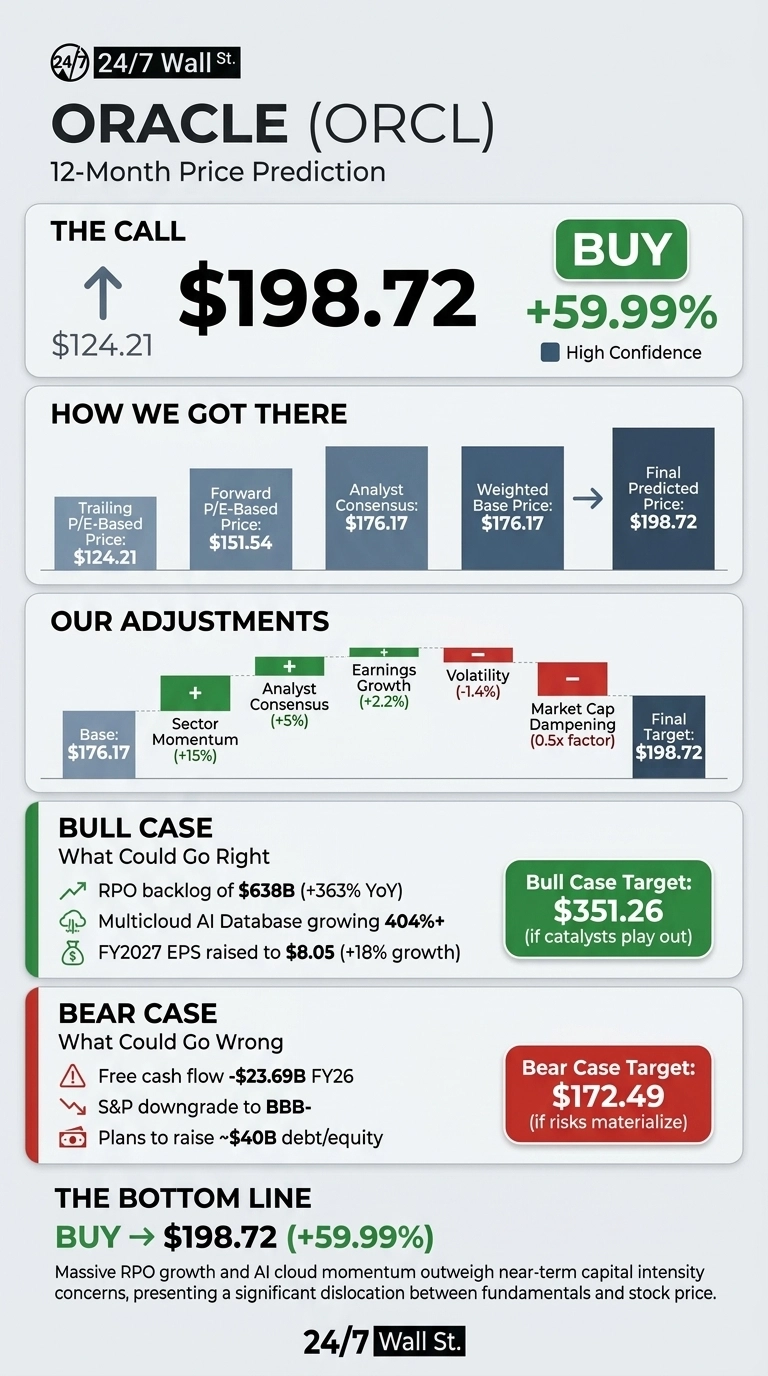
Our 24/7 Wall St. price target for Oracle is $198.72 over the next 12 months, implying 59.99% upside from current levels. Our recommendation is buy with high confidence.
24/7 Wall St. Price Target Summary
| Metric | Value |
|---|---|
| Current Price | $124.21 |
| 24/7 Wall St. Price Target | $198.72 |
| Upside | 59.99% |
| Recommendation | BUY |
| Confidence Level | 90% |
Why Oracle Just Cratered
Oracle sits 26% below its 52-week high of $341.82 and just above the 52-week low of $123.66.
Recent catalysts include S&P Global downgrading Oracle from BBB to BBB- on July 13 tied to AI infrastructure debt, New Mexico rejecting a gas pipeline permit for an Oracle data center, and sector contagion after IBM (NYSE:IBM) shares dropped more than 25% on a Q2 miss.
Yet Q4 FY2026 delivered EPS of $2.11 on revenue of $19.18 billion, with IaaS growing 93% year over year to $5.79 billion and remaining performance obligations exploding 363% to $638 billion. The fundamentals and the tape have completely decoupled.
The Case for $250+
The bull thesis rests on two engines that both accelerated last quarter. First, multi-cloud database revenue grew 531% year over year, with Oracle now live in 33 Microsoft regions, 14 Google regions, and exiting Q4 with 22 AWS regions.
Second, $75 billion of the $638 billion RPO is tied to customer-supplied GPUs, dramatically shrinking Oracle’s capex burden.
Management guides FY2027 revenue of $90 billion with non-GAAP EPS raised to $8.05, and Safra Catz’s five-year OCI roadmap climbs from $18 billion to $144 billion. Our bull case implies $351.26 within 12 months, roughly matching the Street’s $251.85 consensus.
What Could Go Wrong
The bear case starts with the balance sheet. Free cash flow was negative $23.69 billion for FY2026 against capex of $55.66 billion, and Oracle plans to raise roughly $40 billion in debt and equity in FY2027, including a $20 billion at-the-market equity program.
S&P’s downgrade to BBB- leaves Oracle one notch above junk. Bulls counter that greater than 90% of AI capacity is fully funded through partners and negative cash flow reflects heavy investment in capacity buildout. If AI demand cools, the bear case sits at $172.49.
How Oracle Compares to Microsoft and Salesforce
Microsoft (NASDAQ: MSFT) is the direct hyperscaler comp. Microsoft trades at a trailing P/E of 29 with Azure growing 40% and commercial RPO of $627 billion. Oracle’s trailing P/E of 23 and $638 billion RPO now match or exceed Microsoft’s backlog at a discount, making our target look conservative.
Salesforce (NYSE: CRM) is the applications-side comparison. Salesforce trades at a P/E of 19 after its own drawdown, growing revenue 13.3% in Q1 FY27. Oracle’s Fusion suite grew 11% on a much larger cloud infrastructure base, suggesting the sum-of-parts case is stronger for ORCL.
| Company | Forward P/E | Recent Cloud Growth |
|---|---|---|
| Oracle | 16 | IaaS +93% |
| Microsoft | 29 | Azure +40% |
| Salesforce | 19 | Agentforce ARR +205% |
The Setup After the Selloff
Our 24/7 Wall St. price target of $198.72 implies 59.99% upside with 90% confidence. RPO grew 363% while the stock lost a third of its value. That dislocation rarely lasts.
The bullish setup depends on the FY2027 $90 billion revenue target holding through the first two earnings reports. The key risk to watch is whether equity issuance dilutes shareholders faster than RPO converts to recognized revenue.
| Year | 24/7 Wall St. Price Target |
|---|---|
| 2026 | $141 |
| 2027 | $198.72 |
| 2028 | $257 |
| 2029 | $332 |
| 2030 | $429 |
These projections assume Oracle converts its RPO backlog on schedule and OCI compounds toward management’s $144 billion five-year target. Significant upside or downside could result from AI capex discipline, GPU sourcing, or the pace of Oracle Health rollout.
Contact [email protected] for any questions or corrections.
Vandita Jadeja is a financial publisher with over a decade of experience writing about financial topics, including investment, savings, retirement, insurance and banking. Vandita is a Chartered Accountant who loves to debunk financial concepts for readers.
Her work has appeared on sites that include The Motley Fool, InvestorPlace, and Benzinga. She covers investing and focuses on stock picks and price prediction for 24/7 Wall St.
When not looking for the next stock investment opportunity, she can be found traveling, reading, chasing sunsets and enjoying her iced latte.