Oracle Could Be a $1 Trillion Company By This Date
Oracle (NYSE:ORCL | ORCL Price Prediction) just posted one of the strongest cloud quarters in software history. Infrastructure revenue grew 93% year over year to $5.79 billion, and remaining performance obligations hit $638 billion. Yet shares trade at $148.53, down…

Oracle (NYSE:ORCL | ORCL Price Prediction) just posted one of the strongest cloud quarters in software history. Infrastructure revenue grew 93% year over year to $5.79 billion, and remaining performance obligations hit $638 billion. Yet shares trade at $148.53, down 23.33% YTD. Market cap sits at $427.8 billion. Can this stock reach $400 a share and push Oracle past a $1 trillion market cap by 2030?
The Real Reason Oracle Is Down 23% This Year
Capital intensity. Oracle spent $55.66 billion on capital expenditures in FY2026 to build AI infrastructure, generating free cash flow of negative $23.69 billion. Total liabilities climbed to $218.7 billion, and management plans to raise roughly $40 billion in debt and equity in FY2027.
Investors are nervous. Shares fell 19.4% over the past week and 22.22% over the past month, taking ORCL from $190.96 to current levels. A beta of 1.655 makes the unwind worse than the market. The bear case: Oracle is borrowing heavily to chase AI workloads, and any slip in cloud margins detonates the model.
Wall Street Sees 70% Upside. Our Model Sees More
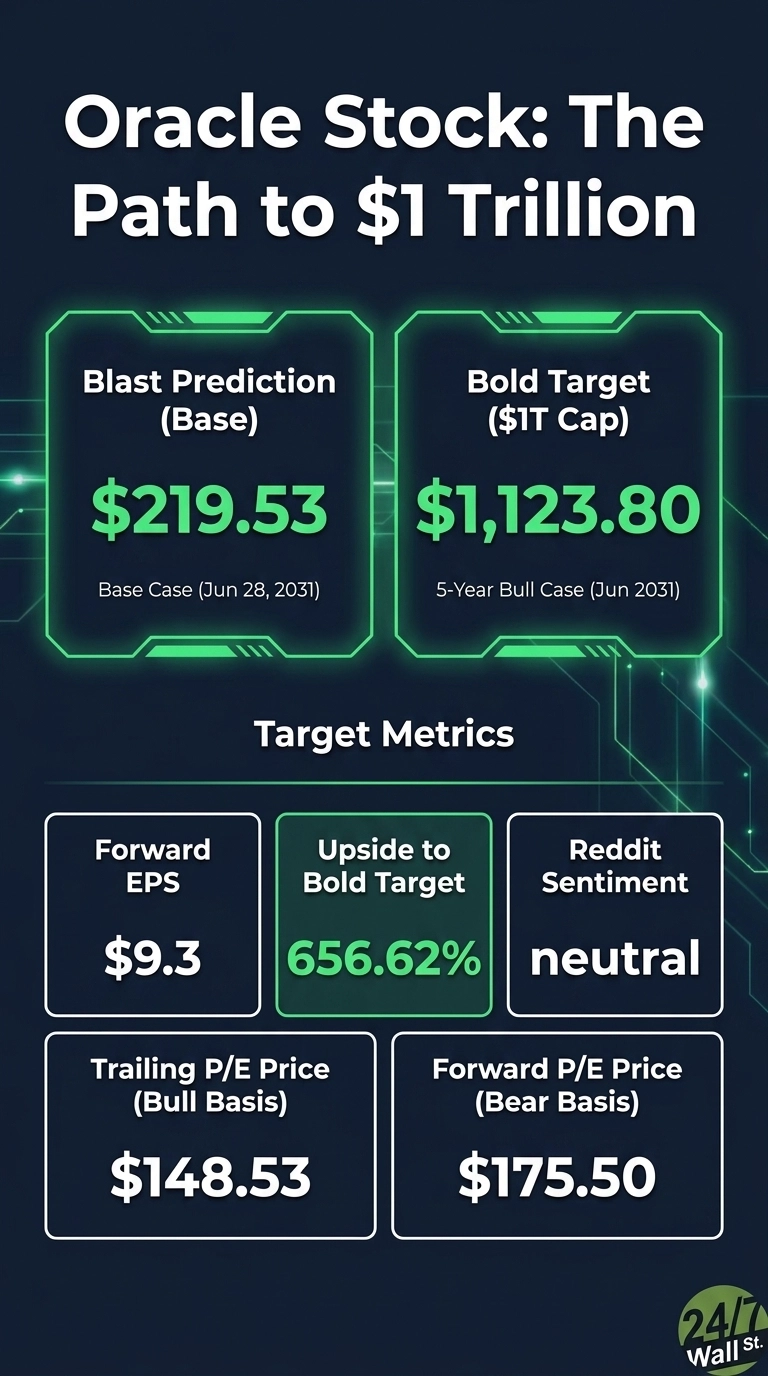
Wall Street’s consensus target is $252.64, with 6 Strong Buy, 30 Buy, 6 Hold, and 1 Sell ratings. Our base case lands at $219.53, implying 47.8% upside with 90% confidence. The bull scenario reaches $351.63. The bear scenario still gets to $190.

Analysts appear to be modeling the next twelve months, not the booked backlog. With 84% bullish analyst sentiment and 21.9% YoY earnings growth, $252 looks conservative once OCI scales toward the FY2030 plan.
The Path to $400 Per Share
Reaching $400 from $148.53 requires a gain of 169.3%. With forward EPS of $9.30, a price of $400 implies a forward P/E of 43. Our base case of $219.53 already implies 19x, meaning the bold target requires 24x of additional multiple expansion.
That sounds extreme until you stack the forward EPS curve. Oracle guided FY2027 non-GAAP EPS to $8.05 on $90 billion in revenue, with OCI scaling to $144 billion by FY2030. If those targets land, a 43x multiple today becomes far lower tomorrow.
CEO Clay Magouyrk noted “It is unprecedented to scale a capital-intensive business so quickly while also increasing profitability.” Multicloud database revenue jumped 531% year over year, and AI infrastructure rose 243%. Our model’s 1.136 adjustment factor reflects that. The primary risk is execution slippage on the $55B annual CapEx commitment.

Where Oracle Trades Today vs Its Earnings Power
At $148.53, Oracle trades at roughly 16x forward EPS of $9.30. That is cheap for a software company growing cloud revenue above 50% with a half-trillion-dollar backlog. The 52-week range of $134.57 to $343.01 shows how violently this name moves.
The 10-year return of 340.64% demonstrates the long-term compounding is real. Buyers at today’s multiple are paying a hardware price for a generational software asset.

Is $400 Realistic? Here’s My Verdict
Reaching $400 from $148.53 demands a 169.3% gain. That is a stretch goal, not a base case.
For it to land by 2030, three things need to go right: OCI revenue must hit the $144 billion FY2030 target, AI infrastructure gross margins must keep climbing past the 32% already delivered, and the $638 billion RPO backlog must convert without major customer concentration breaks. What derails it is a sharp pullback in AI capex by hyperscalers or enterprises. We’ve outlined the blueprint for how Oracle could reach $400 in 2030.
Contact [email protected] for any questions or corrections.
Vandita Jadeja is a financial publisher with over a decade of experience writing about financial topics, including investment, savings, retirement, insurance and banking. Vandita is a Chartered Accountant who loves to debunk financial concepts for readers.
Her work has appeared on sites that include The Motley Fool, InvestorPlace, and Benzinga. She covers investing and focuses on stock picks and price prediction for 24/7 Wall St.
When not looking for the next stock investment opportunity, she can be found traveling, reading, chasing sunsets and enjoying her iced latte.