3 Green Energy Stocks to Buy in July
Electricity demand just broke out of a 15-year flat line, and most investors are still pricing renewable stocks like nothing changed. Three names stand out this July, each for a very different reason.


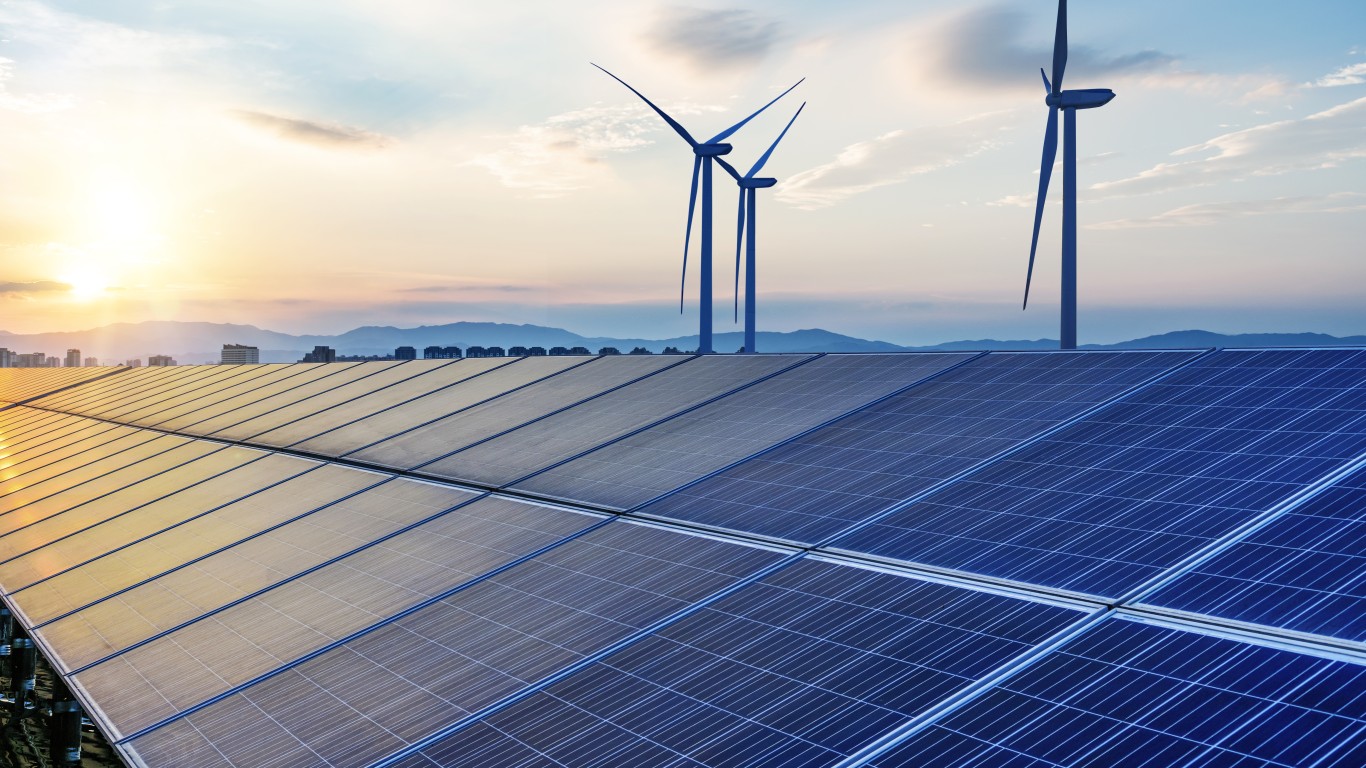
Green energy just hit an inflection point that few investors are pricing correctly. The U.S. Energy Information Administration’s Annual Energy Outlook 2026 projects total electricity generation grows between 25% and 50% through 2050, with natural gas, solar and wind together climbing from about 60% of the mix in 2025 to roughly 80% in most scenarios by 2050. After 15 years of nearly flat U.S. electricity consumption, demand has risen 2.1% per year on average over the last five years, and data centers are the accelerant.
Below are three US-listed renewable names worth examining this month, each backed by real earnings data and each carrying a specific risk to weigh.
First Solar (NASDAQ: FSLR)

First Solar (NASDAQ:FSLR | FSLR Price Prediction) is the largest U.S. thin-film solar manufacturer and the cleanest pure-play on domestic solar capacity. The stock traded around $213.54 as of July 17, down 16.20% over the past month and 22.16% year-to-date, yet still up more than 23% over the past year. That pullback resets the entry point for a name still compounding earnings.
Q1 2026 was a margin story. First Solar delivered EPS of $3.22, beating consensus of $2.98 by 8.02%, on revenue of $1.044 billion, up 23.6% year over year. Adjusted EBITDA hit $519.81 million at a 50% margin, and net income climbed 65% to $346.62 million. Contracted backlog stood at 47.9 GW as of March 31, and management reaffirmed 2026 net sales guidance of $4.9 billion to $5.20 billion with adjusted EBITDA of $2.60 billion to $2.8 billion.
CEO Mark Widmar framed the quarter succinctly: “We delivered a strong start to 2026, with record first-quarter revenue, record sales in India, meaningful margin expansion, and Adjusted EBITDA above the top end of our first quarter preview range.” The bull case rests on three legs: a domestic manufacturing moat, independence from Chinese crystalline silicon supply chains and Section 45X tax credit monetization worth $2.10 billion to $2.19 billion in 2026.
Risk to watch: Underutilization costs of $115 million to $155 million in 2026 and the Section 45X phase-out between 2030 and 2033. Q2 earnings drop after the close on July 29, 2026.
GE Vernova (NYSE: GEV)

GE Vernova (NYSE:GEV) is the purest listed proxy on AI-driven power demand. Shares traded around $1,061.58 on July 17, up 56.22% year-to-date and 86.19% over the past year.
Q1 2026 was extraordinary. Revenue rose 15.8% year over year to $9.30 billion, adjusted EBITDA nearly doubled to $900 million with margin expanding 390 basis points to 9.6% and orders reached $18.30 billion, up 71% organically. The Electrification segment booked $2.4 billion in data center equipment orders in Q1 alone, more than all of 2025, driving a book-to-bill ratio near 2.5x.
CEO Scott Strazik said it plainly: “Demand is accelerating for our Power and Electrification solutions from a diverse set of customers, with our backlog growing by more than $13 billion quarter-over-quarter.” Management raised 2026 revenue guidance to $44.5 billion to $45.5 billion, adjusted EBITDA margin to 12% to 14%, and free cash flow to $6.5 billion to $7.5 billion. GEV also doubled its quarterly dividend to $0.50 per share and repurchased roughly 1.8 million shares for $1.3 billion at an average price of $720 in Q1.
Risk to watch: The Wind segment continues bleeding, with approximately $400 million in EBITDA losses expected in 2026 and revenue down 23% in Q1. Q2 results arrive before the open on July 22.
Brookfield Renewable Partners (NYSE: BEP)

Brookfield Renewable Partners (NYSE:BEP) is the income-and-growth entry. Units traded around $31.76 on July 17, up 13.69% year to date and 18.27% over the past year. Note the structure: BEP is a Canadian-domiciled Bermuda limited partnership listed on the NYSE, and American investors should factor in potential Canadian withholding-tax treatment on distributions.
The Q1 2026 headline was ugly. Revenue of $1.514 billion missed consensus by 10.79%, and GAAP net income swung to a $295 million loss, weighed down by a $193 million mark-to-market hit on long-term energy derivatives. Look past that. Funds from operations rose 19% year over year to $375 million, or 55 cents per unit. The quarterly distribution stepped up to $0.392 per unit, an annualized $1.568, with management targeting 5% to 9% annual distribution growth.
The pipeline supports it. Brookfield operates a 200+ GW global development pipeline, is 92% contracted for the remainder of 2026, and inked a Google Hydro Framework Agreement for up to 3,000 MW alongside an announced Boralex acquisition adding roughly 4,000 MW operating plus 8,000 MW pipeline.
Risk to watch: Corporate borrowings climbed to $4.8 billion from $3.7 billion and the consolidated debt-to-capitalization ratio sits at 45%. Hydrology and FX add variability quarter to quarter.
The Bigger Picture
FSLR offers the highest-margin domestic solar exposure at a discounted entry. GEV is the momentum name riding the AI power supercycle with raised guidance. BEP pairs a growing distribution with a hyperscaler-linked growth pipeline. Different risk profiles, one thesis: electricity demand growth is structural, and the capital cycle behind it has only started.
Contact [email protected] for any questions or corrections.
Joel South covers large-cap stocks, dividend investing, and major market trends, with a focus on earnings analysis, valuation, and turning complex data into actionable insights for investors.
He brings more than 15 years of experience as an investor and financial journalist, including 12 years at The Motley Fool, where he served as an investment analyst, Bureau Chief, and later led the Fool.com investing news desk. He has also co-hosted an investing podcast and appeared across TV and radio discussing market trends.