SK Hynix’s HBM Empire Powers 65% US Revenue — Is This the Must-Own AI Stock?
While investors chase GPU makers, a South Korean chipmaker has quietly locked up the single most critical chokepoint in AI infrastructure, and its latest revenue numbers suggest the market has barely noticed.

This post may contain links from our sponsors and affiliates, and Flywheel Publishing may receive compensation for actions taken through them.

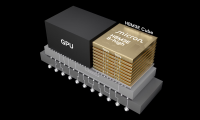
The artificial intelligence revolution has transformed the semiconductor landscape in ways few predicted even two years ago. What started as hype around chatbots has become a voracious appetite for data center infrastructure, where memory chips — especially high-bandwidth memory, or HBM — serve as the critical bridge between processors and massive datasets.
Global memory demand has exploded, with prices for key products rising sharply and suppliers racing to keep up. In this environment, SK Hynix (NASDAQ:SKHY) has emerged as a standout player, leveraging its HBM expertise to capture substantial market share while shifting its revenue base heavily toward the U.S. For everyday investors seeking exposure to AI without chasing every hot GPU name, this South Korean chipmaker offers a compelling, data-backed story worth examining closely.
HBM Leadership Drives Premium Performance
SK Hynix doesn’t lead the entire DRAM market, but it dominates the segment that matters most for AI. In Q1 2026, the company held approximately 58% of the global HBM market by revenue, according to Counterpoint Research, well ahead of Samsung and Micron Technology (NASDAQ:MU | MU Price Prediction) at around 21% each. HBM — a specialized form of DRAM that stacks memory chips for faster data transfer — powers Nvidia‘s (NASDAQ:NVDA) accelerators and similar AI hardware.
This leadership translates into real financial results. SK Hynix reported FY2025 revenue of $65 billion, with DRAM (heavily weighted toward HBM) contributing the lion’s share at roughly $44 billion, compared to NAND flash at $21 billion. HBM sales more than doubled year-over-year, fueling record operating profit of $33 billion. In the broader DRAM market, SK Hynix captured about 29% revenue share in Q1 2026, trailing Samsung’s 38% but outperforming on the high-margin AI side.
While conventional DRAM faces more competition, HBM’s scarcity and premium pricing deliver superior margins. Investors benefit from this mix: strong volume in AI memory plus steady demand for server and other DRAM products.
U.S. Revenue Concentration and Nvidia Partnership
The numbers tell a clear story of geographic realignment. In Q1 2026, the U.S. accounted for about 65% of SK Hynix’s revenue, up dramatically from prior years. For full-year 2025, the figure reached nearly 69%. Nvidia alone contributed around 15% of total revenue in Q1 2026, rising to about 24% for 2025.
This isn’t random. SK Hynix supplies the majority of HBM for Nvidia’s platforms, with long-term agreements and co-development on HBM4 for upcoming architectures like Vera Rubin. The U.S. focus — driven by U.S. hyperscalers and tech giants — has reduced reliance on China for these high-value sales and aligned the company with the epicenter of AI spending. Smart investors recognize this as both opportunity and concentration: when U.S. AI capex accelerates, SK Hynix rides the wave with high-margin products.
Risks and How They Stack Up
That said, no investment is without trade-offs. SK Hynix’s heavy U.S. and Nvidia exposure creates customer concentration risk — a slowdown in AI buildout or shifts in Nvidia’s platform success could hit hard. The memory industry remains cyclical, though HBM’s structural shortages offer more durability than in past cycles.
SK Hynix’s valuation puts it at a premium reflecting growth, but peer comparisons show it delivering stronger AI-tied upside than broader memory plays.
Key Takeaway
SK Hynix stands out as a pure-play beneficiary of the AI memory boom, with HBM leadership powering record results and a U.S.-centric revenue base that captured 65% of sales recently. For investors comfortable with semiconductor volatility and seeking targeted AI exposure, the data supports a bullish case — especially given multi-year demand visibility.
That doesn’t make it a “must-own” for every portfolio, but sharp investors should consider it as a core holding in the memory space.
Contact [email protected] for any questions or corrections.
After two decades of patrolling the dark corners of suburbia as a police officer, Rich Duprey hung up his badge and gun to begin writing full time about stocks and investing. For the past 20 years, he’s been cruising the markets looking for companies to lock up as long-term holdings in a portfolio while writing extensively on the broad sectors of consumer goods, technology, and industrials. Because his experience isn’t from the typical financial analyst track, Rich is able to break down complex topics into understandable and useful action points for the average investor. His writings have appeared on The Motley Fool, InvestorPlace, Yahoo! Finance, Money Morning, and, of course, 24/7 Wall St. He has been featured in both U.S. and international publications, including MarketWatch, Financial Times, Forbes, Fast Company, and USA Today.