These 4 Stocks Fit the Ideal LBO Target Profile Right Now
Buyout shops have a precise checklist for pulling a public company off the market, and right now four beaten-down U.S. stocks are checking every single box for a potential take-private deal.

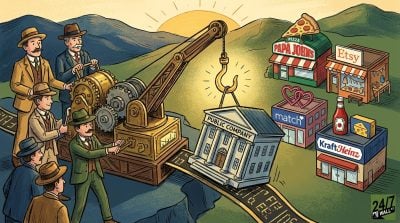
In private equity, pulling a public company off the market requires an alignment of the stars. Buyout shops need a precise playbook:
- Predictable cash generation to service debt
- An equity discount worth exploiting
- Balance sheet capacity for financial engineering
- Clear operational levers to pull
- A check size big enough to actually move the needle for a multi-billion-dollar fund.
When a target checks all five boxes, the conversation rapidly shifts from if a deal makes sense to how quickly it can be executed.
Below are four U.S.-listed names screening well against that framework. Each has been beaten down, throws off real free cash flow, and has levers a sponsor could pull.
4. Papa John’s International
Papa John’s International (NASDAQ:PZZA) has a market cap of just $998.6 million, and shares closed most recently at $30.35, down 30.0% over the past year. That sub-$1 billion equity check is a rounding error for a mid-market sponsor.
The franchise-heavy model produces a royalty-like revenue stream, with FY26 adjusted EBITDA guided to $200 to $210 million, implying an EV/EBITDA around 11x. Q1 FY26 was weak: revenue fell 7.7% to $478.6 million and free cash flow was negative $6.2 million after refranchising 85 stores. Management targets $30 million in corporate cost savings and $60 million in supply chain savings through 2027, the exact playbook PE runs itself.
Comparable sales in North America down 6.4% represents some risk. Plausible acquirers include Roark Capital or Apollo.
3. Etsy
Etsy (NASDAQ:ETSY | ETSY Price Prediction) closed at $80.91, still 61.3% below its 2021 peak despite a 45.9% year-to-date rally. Its forward P/E is 15x, and its EV/EBITDA is 24x.
FY25 free cash flow was $638.75 million on capex of just $54.66 million, a capital-light marketplace profile. The $1.2 billion Depop sale to eBay gives new CEO Kruti Patel Goyal a clean, single-brand focus and a cash position of $1.4 billion. Q1 FY26 GMS grew 5.5%, the second straight quarter of expansion.
The risk here is consumer discretionary exposure. Silver Lake and Advent are plausible acquirers.
2. Match
Match Group (NASDAQ:MTCH) checks nearly every box. Shares at $37.40 are 76.5% below their five-year high. The forward P/E is 14x, and EV/EBITDA is 11x, cheap for a business owning Tinder, Hinge, OkCupid, and Plenty of Fish.
FY25 operating cash flow was $1.08 billion and free cash flow was $1.02 billion, growing every year since 2022. Hinge revenue jumped 28% to $194 million in Q1 FY26, with a path to $1 billion by 2027. Management returned $975 million to shareholders in FY25. Debt of $4.0 billion is manageable against that FCF. Tinder’s ongoing turnaround is a risk, and Blackstone and KKR are plausible acquirers.
1. Kraft Heinz
Kraft Heinz (NASDAQ:KHC) is the textbook take-private candidate. Shares at $25.36 are 54.5% below where they traded a decade ago. The forward P/E is 13x, the price-to-book is 0.73, and the dividend yields 6.3%.
FY25 free cash flow was $3.66 billion, up 15.9%, and Q1 FY26 delivered $766 million in FCF alone. The Heinz, Kraft, Philadelphia, Lunchables, and Ore-Ida brand roster is exactly the moat sponsors underwrite for a decade. New CEO Steve Cahillane bought 213,106 shares at $23.4616 on May 12, 2026. The company paused its previously announced separation, freeing capital for a broader transaction. Analyst sentiment is cautious, with an average target of just $23.97, precisely the setup a sponsor wants: low expectations, high cash generation. Key risks include organic sales guided down 1.5% to 3.5%. Plausible acquirers include 3G Capital and Apollo.
What Happens to Shareholders When a Buyout Hits
When a leveraged buyout offer lands, target shareholders typically receive a cash premium of 20% to 40% over the unaffected price. For beaten-down names like Kraft Heinz, where the market has priced in years of underperformance, a take-private premium could deliver in weeks what public-market patience has failed to produce in years. The names above may well test that thesis next.
Contact [email protected] for any questions or corrections.
Trey has been an editor and author at 24/7 Wall St. for more than a decade, where he has published thousands of articles analyzing corporate earnings, dividend stocks, short interest, insider buying, private equity, and market trends. His comprehensive coverage spans the full spectrum of financial markets, from blue-chip stalwarts to emerging growth companies.
Beyond 24/7 Wall St., Trey has created and edited financial content for Benzinga and AOL's BloggingStocks, contributing additional hundreds of articles to the investment community.
Trey's editorial expertise extends across multiple publishing environments. He served as production editor at Dearborn Financial Publishing and development editor at Kaplan, where he helped shape financial education materials. Earlier in his career, he worked as a writer-producer at SVE. His freelance editing portfolio includes work for prestigious clients such as Sage Publications, Rand McNally, the Institute for Supply Management, the American Library Association, Eggplant Literary Productions, and Spiegel.
Outside of financial journalism, Trey writes fiction and has been an active member of the writing community for years, moderating workshop sessions at regional conventions.