Agentic Shopping Is Coming. These Stocks Will Ride Walmart’s Google AI Bet.
Walmart just handed Google's Gemini AI the keys to its checkout lane, and the ripple effects stretch far beyond one retailer. Five stocks across logistics, robotics, payments, and merchant platforms stand to capture the most value as AI agents take…

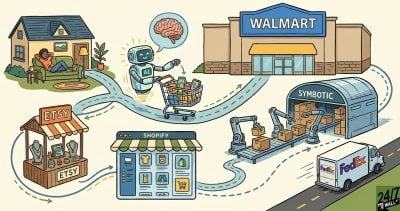
Walmart’s agentic shopping push with Google’s Gemini has flipped a long-simmering thesis into a live catalyst: AI agents that browse, compare, and check out on behalf of consumers are moving from concept to production at the largest retailer on earth. That reroutes value across the entire e-commerce stack, from storefront platforms to payments rails to the warehouses and trucks that turn a chatbot cart into a doorstep delivery.
To rank the top beneficiaries, we weighted five factors: e-commerce growth, agentic AI readiness, marketplace or platform positioning, financial momentum, and direct linkage to the Walmart-Google flywheel. The beneficiary set includes such names as Target, Wayfair, UPS, Mastercard, and PayPal, but the five below are closest to the action.
5. FedEx
FedEx (NYSE:FDX | FDX Price Prediction) is the parcel backbone for packages agentic carts will generate. Q4 FY26 revenue hit $25.01 billion (+12.5% year on year) with adjusted EPS of $6.31, the fourth consecutive beat. U.S. Priority Package yield rose 10%, and management guided calendar 2026 to roughly 11% revenue growth. Shares are up 68.1% year to date through July 1. Yield discipline and the June 1, 2026, Freight spin-off leave a leaner parcel business ready to price agentic-driven volume.


4. Etsy
Etsy (NASDAQ:ETSY) is the most direct pure-play agentic-commerce partner. The marketplace has plugged into OpenAI’s shopping framework and cites partnerships with OpenAI, Microsoft, and Google as incremental traffic drivers. Q1 FY26 GMS grew 5.5% to $2.50 billion, active buyers grew sequentially for the first time in two years, and take rate expanded 180 bps to 25.7%. CEO Kruti Patel Goyal said, “As technology continues to evolve, particularly with the rise of AI, we believe those qualities become more important, not less.” Shares are up 31.4% year to date, with analysts carrying a $72.71 target.


3. Symbotic
Symbotic (NASDAQ:SYM) is the purest picks-and-shovels play on Walmart’s fulfillment buildout. Q2 FY26 revenue rose 23.1% to $676.48 million, adjusted EBITDA more than doubled to $77.75 million, and operational systems reached 52 (up from 37). The contracted backlog sits near $22.7 billion, anchored by Walmart and buttressed by the SoftBank Exol JV worth roughly $11 billion. Symbotic acquired Walmart’s Advanced Systems and Robotics business, deepening the linkage. Shares are down 24.4% year to date, which arguably prices in the GAAP EPS miss while leaving room for re-rating if agentic order flow lifts throughput.


2. Shopify
Shopify (NASDAQ:SHOP) is the merchant-side AI backbone for millions of storefronts an agent will transact against. Q1 FY26 revenue jumped 34.3% to $3.17 billion, GMV reached $100.74 billion (+35%), and free cash flow was $476 million at a 15% margin. Merchant Solutions revenue grew 39%, and Shopify is layering AI commerce intelligence, agentic checkout tooling, and merchant-facing AI directly into its stack. Shares trade at a rich 120 times earnings and are down 24.44% year to date, giving forward-looking investors a cheaper entry into the agentic distribution layer than a year ago.


1. Walmart
Walmart (NYSE:WMT) is the story. Q1 FY27 revenue hit $175.68 billion (+6.1% year on year), global e-commerce grew 26% and now represents 23% of net sales, marketplace sales rose nearly 50%, and Walmart Connect advertising grew 44% ex-VIZIO. Store-fulfilled delivery is up 45%, with expedited orders under three hours accounting for roughly 36% of store-fulfilled volume. CEO John Furner said Walmart is “adopting innovative technologies, driving productivity through automation, and growing higher-margin commerce solutions.” A $30 billion repurchase authorization underpins the investment case. Analysts carry a $138.59 target versus a current price near $111.60. The Google Gemini agentic shopping tie-in gives Walmart a distribution moat few competitors can replicate: physical stores, a booming marketplace, its own ad platform, robotics via Symbotic, and an AI front door.


The Bottom Line
Walmart owns the anchor deal, Shopify powers the merchant layer, Symbotic automates the warehouses, Etsy is already inside the ChatGPT shopping surface, and FedEx moves what agents buy. Consumer sentiment is soft (the University of Michigan index printed 44.8 in May 2026, well into recessionary territory), yet retail sales still hit a 12-month high of $763.7 billion. The clear risk: agentic commerce adoption is early and unproven, and any of these stocks could see the narrative outrun the numbers before consumers meaningfully shift to AI-mediated checkout.
Contact [email protected] for any questions or corrections.
Trey has been an editor and author at 24/7 Wall St. for more than a decade, where he has published thousands of articles analyzing corporate earnings, dividend stocks, short interest, insider buying, private equity, and market trends. His comprehensive coverage spans the full spectrum of financial markets, from blue-chip stalwarts to emerging growth companies.
Beyond 24/7 Wall St., Trey has created and edited financial content for Benzinga and AOL's BloggingStocks, contributing additional hundreds of articles to the investment community.
Trey's editorial expertise extends across multiple publishing environments. He served as production editor at Dearborn Financial Publishing and development editor at Kaplan, where he helped shape financial education materials. Earlier in his career, he worked as a writer-producer at SVE. His freelance editing portfolio includes work for prestigious clients such as Sage Publications, Rand McNally, the Institute for Supply Management, the American Library Association, Eggplant Literary Productions, and Spiegel.
Outside of financial journalism, Trey writes fiction and has been an active member of the writing community for years, moderating workshop sessions at regional conventions.