The AI Trade Is Still On: Why Nvidia Remains at the Center of It
Nvidia has already handed investors a 14,797% return over the past decade, yet the forces driving that run show no sign of exhausting themselves. Whether the next leg holds depends on a few fault lines most bulls are not watching…


The AI capex cycle keeps compounding, and NVIDIA (NASDAQ:NVDA | NVDA Price Prediction) sits at the wheel. My model sees room to run from here, even after a decade in which the stock returned 14,797.5%.
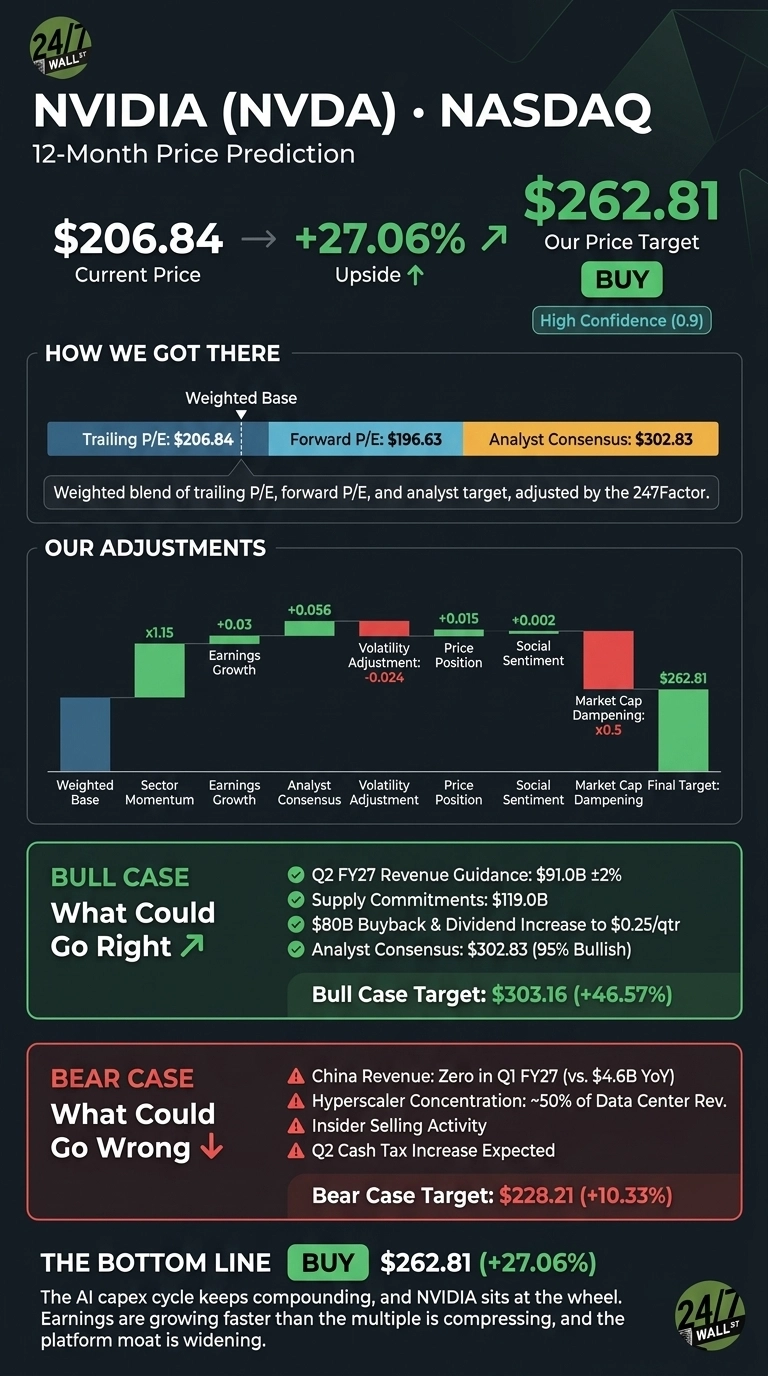
Our 24/7 Wall St. price target for NVIDIA is $262.81, pointing to 27.06% upside from the current $206.84 quote. The recommendation is buy, with high model confidence of 0.9. Earnings are growing faster than the multiple is compressing, and the platform moat is widening.
24/7 Wall St. Price Target Summary
| Metric | Value |
|---|---|
| Current Price | $206.84 |
| 24/7 Wall St. Price Target | $262.81 |
| Upside | 27.06% |
| Recommendation | BUY |
| Confidence Level | 90% |
Where the Stock Sits Today
NVIDIA is up 11.04% year to date and 19.21% over the past year, with the current $206.84 quote sitting 28% below its $236.26 52-week high.
The Q1 FY27 report on May 20 was the fourth consecutive beat, with revenue of $81.615 billion up 85.23% YoY and non-GAAP EPS of $1.87 clearing the $1.7738 consensus. Data Center hit $75.246 billion, with networking alone up 199% YoY. Recent partnership headlines reinforce the sovereign-AI thesis.

The Bull Case
Q2 FY27 guidance calls for revenue of $91 billion at a 75% gross margin, explicitly excluding China Data Center compute revenue. Supply commitments of $119 billion signal demand runway well beyond current quarters.
The board authorized an additional $80 billion buyback and lifted the quarterly dividend to $0.25. Analyst consensus sits at $302.83, with 58 buy ratings against a single sell. Our bull case fair value lands at $303.16, a 46.57% return.
What Could Go Wrong
The bear case starts with China. The H20 line generated $4.6 billion a year ago and delivered zero this quarter. Concentration risk is real: hyperscalers make up roughly 50% of Data Center revenue.
Insider activity has skewed toward selling. Counter-argument: $119 billion in commitments and a 75% gross margin point to sustained demand well beyond a single-quarter window. Our bear scenario still lands at $228.21, a 10.33% gain.

How NVIDIA Compares to AMD and Broadcom
Advanced Micro Devices (NASDAQ:AMD) is the closest direct competitor on merchant GPUs and EPYC server CPUs. AMD posted Q1 FY26 revenue of $10.253 billion, up 37.9%, with Data Center up 57%. AMD trades at a P/E near 196 against NVIDIA’s 42, so NVIDIA looks cheaper on trailing earnings despite its scale.
Broadcom (NASDAQ:AVGO) is the custom-silicon and AI-networking counterweight. AVGO’s Q2 FY26 AI semiconductor revenue hit $10.80 billion, up 143%, and management guided Q3 AI to $16 billion. Broadcom’s $1.82 trillion market cap makes NVIDIA’s $5 trillion cap look demanding, but NVIDIA’s $48.554 billion quarterly free cash flow dwarfs peer generation. The peer set makes our $262.81 target reasonable.

The Bottom Line
The 24/7 Wall St. price target of $262.81 stays a buy at high confidence. Free cash flow of nearly $50 billion in a quarter buys forgiveness on multiple compression.
The setup rewards investors who tolerate a beta above 2 and want direct exposure to AI factory capex. Caution is warranted if hyperscaler capex guides roll over into 2027 or a China escalation forces inventory writedowns.
Extending the 24/7 Wall St. price target model forward using the base-case annualized return of 14.97%, here is where NVDA could trade if the AI trade stays intact and margin structure holds near current levels.
| Year | 24/7 Wall St. Price Target |
|---|---|
| 2026 | $238 |
| 2027 | $273 |
| 2028 | $314 |
| 2029 | $361 |
| 2030 | $415 |
These projections assume NVIDIA continues converting Blackwell and Vera Rubin demand into free cash flow at current margin levels. Meaningful upside or downside could result from sovereign AI expansion, a full China Data Center reopening, or a hyperscaler capex reset.
Contact [email protected] for any questions or corrections.
Vandita Jadeja is a financial publisher with over a decade of experience writing about financial topics, including investment, savings, retirement, insurance and banking. Vandita is a Chartered Accountant who loves to debunk financial concepts for readers.
Her work has appeared on sites that include The Motley Fool, InvestorPlace, and Benzinga. She covers investing and focuses on stock picks and price prediction for 24/7 Wall St.
When not looking for the next stock investment opportunity, she can be found traveling, reading, chasing sunsets and enjoying her iced latte.