Prediction: Robinhood Stock Could Double by 2030
Robinhood just delivered 13 business lines each clearing $100M in annualized revenue, yet the stock sits 20% in the hole for the year. The case for a double by 2030 hinges on whether Wall Street is still pricing the wrong…


Robinhood Markets (NASDAQ:HOOD | HOOD Price Prediction) has quietly become one of the most diversified consumer finance platforms in America, yet the stock is down 20.57% year to date.
CEO Vlad Tenev just posted a monster quarter, with 13 business lines running at $100M+ annualized revenue and platform assets at $369 billion. Shares closed at $89.84. My question is simple: can Robinhood double from here and hit $180 by 2030?
The Real Reason Robinhood Is Down 20% This Year
Q2 revenue grew 32% YoY to $1.308 billion and net income jumped 48% to $573 million. Yet HOOD is down 14.01% in the past week and 11.77% over the past month.
Three things are weighing on shares. Crypto revenue dropped 38% YoY to $100 million, reminding investors how cyclical this business can be. A class action lawsuit alleges the prediction markets hub operates as unlicensed sports gambling. And with a beta of 2.34, HOOD gets hit twice as hard as the market on any risk-off day. That combination has crushed sentiment even as the underlying business accelerates.
Wall Street Sees 36% Upside. Our Model Sees More.
The Street consensus target sits at $121.86, with 4 Strong Buy, 17 Buy, 4 Hold, and 2 Sell ratings. That is 78% bullish. Our own base case lands at $126.16 for a 1-year horizon, implying 40.43% upside, with a bull case of $159.67 and confidence rated High.
My take: analysts are still anchoring to a crypto-heavy revenue mix that no longer describes Robinhood. Event contracts alone printed $156M in Q2, up more than 10x YoY. Options revenue hit $342M. The Street should be modeling a super app.
The Path to $180 Per Share
Reaching $180 from $89.84 requires a gain of 100.4%. With forward EPS of $2.68, a $180 stock implies a forward P/E of 67x. Our base case of $126.16 already implies 40x, meaning $180 requires roughly 27x of additional multiple expansion or, more realistically, EPS growth that shrinks that multiple back to a defensible number.
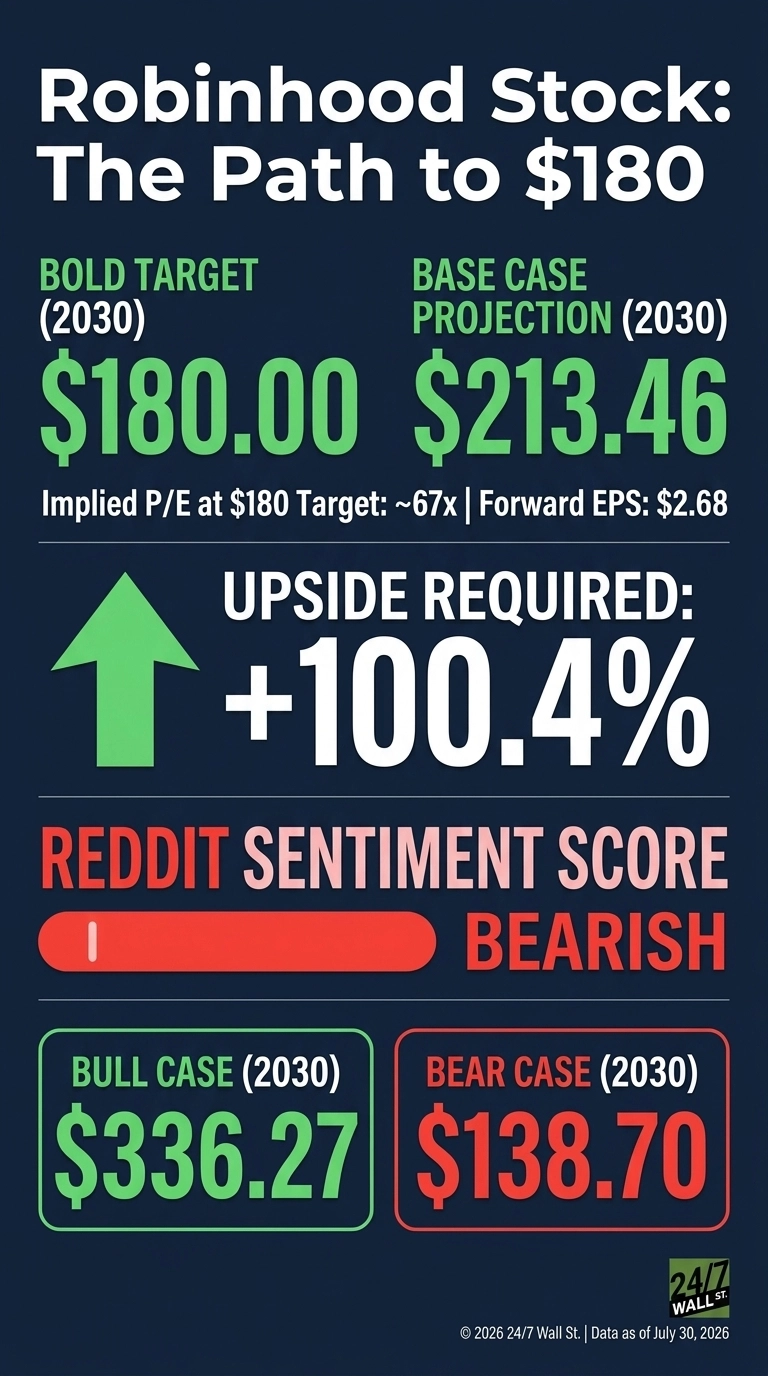
Here is where the math turns friendly. Analysts already model 2028 EPS of $4.56. Push that trajectory to 2030 at Robinhood’s product velocity, and $180 becomes a P/E in the low 30s on forward earnings.
That is achievable given Trump Accounts with 7M+ sign-ups and $1.5B deposited, Robinhood Chain, and international expansion. Tenev put it plainly: “Whether it’s the Robinhood Chain, Robinhood Ventures, or Trump Accounts, our product velocity is focused on one goal: making everyone an owner.”
The primary risk is a crypto-driven earnings reset that resets sentiment before EPS catches up.
Where Robinhood Trades Today vs Its Earnings Power
At $89.84 against forward EPS of $2.68, HOOD trades at roughly 34x forward earnings. That is not cheap on a static view, but shares sit 21% below the 52-week high of $153.86 and well above the low of $63.52. Barclays lowered the firm’s price target on Robinhood to $105 from $122 and keeps an Overweight rating.
Over five years HOOD has returned 155.59%. If EPS grows into the multiple the way the segment mix suggests, today’s valuation looks reasonable rather than rich.

Is $180 Realistic? Here’s My Take
Doubling to $180 by 2030 requires a 100.4% gain, which lines up neatly with our base case 5-year target of $213.46 by mid-2030. That makes $180 a realistic goal, not a stretch.
Three things need to keep working: event contracts scaling past $1B annualized, Trump Accounts converting sign-ups into sticky deposits, and international revenue passing 15% of the mix. A regulatory ruling that cripples prediction markets would derail the thesis fastest. Returns at this level shouldn’t be expected every year, but we’ve outlined the blueprint for how Robinhood could reach $180 in 2030.
Contact [email protected] for any questions or corrections.
Vandita Jadeja is a financial publisher with over a decade of experience writing about financial topics, including investment, savings, retirement, insurance and banking. Vandita is a Chartered Accountant who loves to debunk financial concepts for readers.
Her work has appeared on sites that include The Motley Fool, InvestorPlace, and Benzinga. She covers investing and focuses on stock picks and price prediction for 24/7 Wall St.
When not looking for the next stock investment opportunity, she can be found traveling, reading, chasing sunsets and enjoying her iced latte.