Robinhood’s Vlad Tenev: Trump Accounts Could Become “The Biggest Element of Long-Term Saving and Investing in This Country Within Possibly Even a Decade”
Robinhood's CEO believes a federal program that barely exists yet could reshape how Americans build wealth for generations, but independent economists see a very different outcome unfolding.

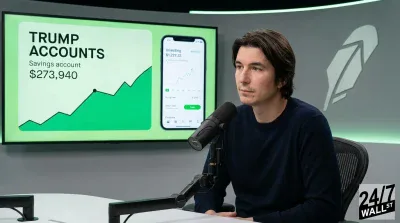
Speaking on the Moonshots with Peter Diamandis podcast, Robinhood chief executive Vlad Tenev made a striking forecast about the federal child-savings program his firm helps administer. Robinhood (NASDAQ:HOOD | HOOD Price Prediction) is serving as the initial brokerage and trustee for Trump Accounts, and Tenev told the show that “You don’t have to squint too hard to see it being the biggest element of long-term saving and investing in this country within possibly even a decade.”

What Tenev Described
Tenev framed Trump Accounts as an ownership vehicle that begins at age zero. The program creates individual brokerage accounts for children born in the United States starting January 1, 2025, seeded with $1,000 from the U.S. Treasury. On the podcast, Tenev compared the program’s potential scale to 401(k) plans and projected that with $50 a month in additional contributions, a child could have hundreds of thousands of dollars by age 28 and potentially millions by retirement.
Those numbers are Tenev’s forecast, offered on a podcast. They are not a calculation this publication endorses, and they say nothing about what any actual account will hold.
How the Program Is Structured
Tenev also clarified the plumbing, which has been described loosely elsewhere. State Street provides the index funds. BNY serves as financial agent. Robinhood is the brokerage and trustee that owns the client-side experience. Robinhood is one of multiple parties selected for the program.
Investors following the company can review its own account of that role in Robinhood’s Q2 2026 shareholder letter and 8-K, filed with the SEC on July 29, 2026.
Nixon Goes to China
The sharpest exchange in the segment came when a co-host pressed Tenev on the irony of it all. Robinhood is publicly associated with frictionless, gamified trading. Now it is the client-side front end introducing low-cost index investing to an entire generation of new Americans at birth. The framing on the show was that only Robinhood could pull this off.
Tenev’s response was that Robinhood’s position was earned. If you look at what features become standard across the brokerage industry, he argued, they are Robinhood features. It is a genuinely interesting turn: the app most identified with active trading becoming the default onboarding tool for buy-and-hold index ownership from day one.
Efficiency and Its Critics
A co-host on the podcast argued that, compared with traditional registered charities carrying high operational overhead, Trump Accounts offer incredibly efficient direct giving. That view is contested.
The Urban Institute published an analysis on January 15, 2026 titled “Don’t Cut Out the Middleman: The Dells’ Pledge to Support Trump Accounts and the Importance of Nonprofit Infrastructure,” arguing for the value of nonprofit infrastructure rather than bypassing it. The Economic Policy Institute argued on January 6, 2026 that billionaire-funded Trump Accounts will not end child poverty and will widen structural inequities in the U.S. economy.
Dell Money, Now Flowing
The largest philanthropic backer to date is the Dell family. NPR reported a $6.25 billion commitment from Michael and Susan Dell, with the Associated Press dating the announcement to December 2, 2025. Fortune reported the Dells believe it is the largest single private commitment to U.S. kids. CNBC reported on August 31, 2026 that the Dell Foundation said Trump Account holders may begin receiving a $250 grant, moving the effort from pledge to distribution. Newsweek reported on January 30, 2026 that the White House and the Dells were at odds over the donation.
Tension Investors Are Left With
Tenev is forecasting that a program barely underway becomes the dominant long-term savings vehicle in the country. Independent analysts at the Urban Institute and the Economic Policy Institute question whether the model does what its backers claim. Both positions are on the record, and HOOD shareholders watching the company’s role in Trump Accounts will be sizing up the same gap.

Contact [email protected] for any questions or corrections.
AJ spent 10 years writing about financial markets at The Motley Fool. His coverage centers on technology stocks and the broader macroeconomic trends, from interest rates to geopolitics, that shape where markets are headed next. AJ is drawn to the stories where big-picture economics and individual companies collide.