Why the Best May Be Yet to Come for NVIDIA, Micron, and SanDisk
NVIDIA, Micron, and SanDisk have already delivered jaw-dropping returns in 2026, but a surprising set of catalysts suggests the biggest gains for all three stocks may still be sitting on the table.


The AI infrastructure buildout keeps rewriting the earnings power of the companies supplying its picks and shovels. NVIDIA (NASDAQ: NVDA | NVDA Price Prediction) is up 4.7% year-to-date after last year’s monster run, while memory partners Micron Technology (NASDAQ: MU) and SanDisk (NASDAQ: SNDK) have surged 206.65% and 439.2% respectively in 2026.
With Jensen Huang calling this “the largest infrastructure expansion in human history,” here is how each could reach a bolder target in 2027.
NVIDIA: The Path to $325 Per Share
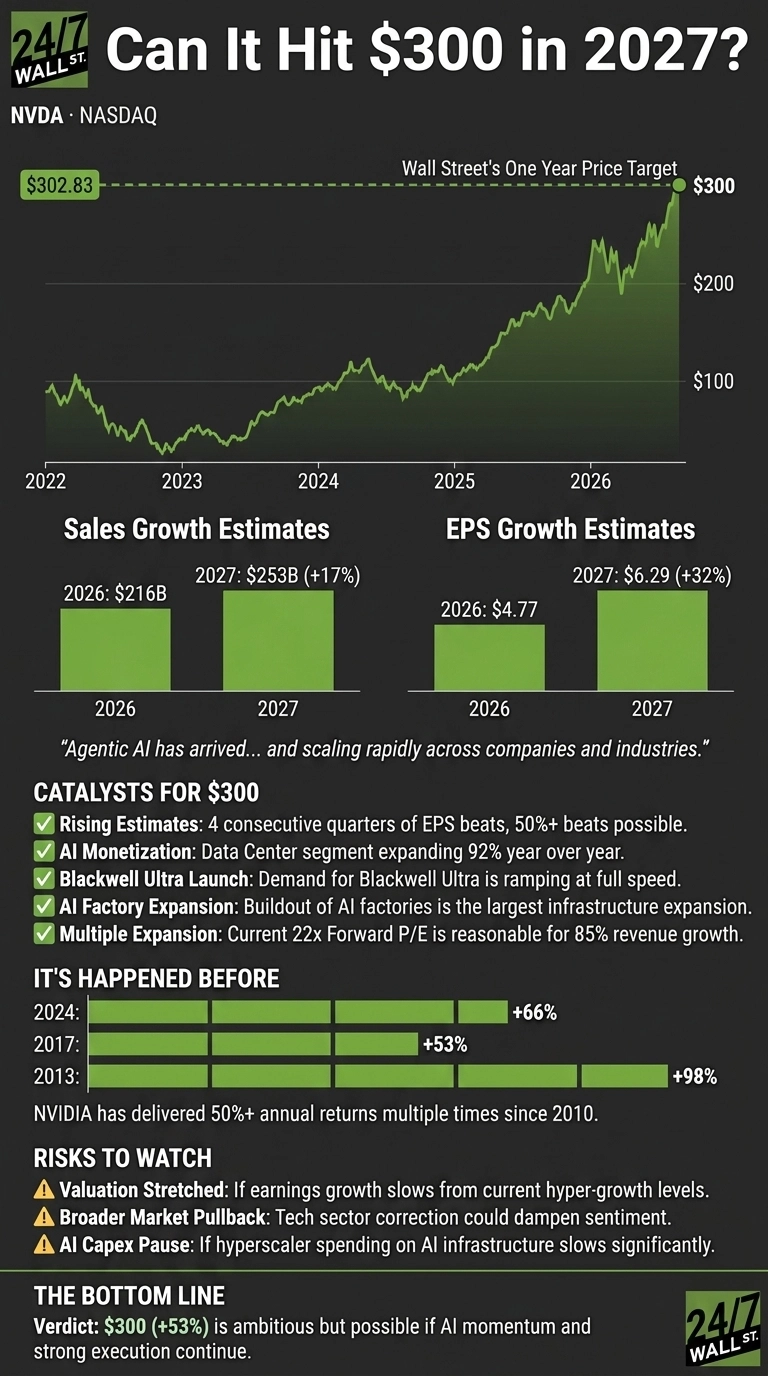
At roughly $196.73, NVIDIA trades at a forward P/E of 22x, hardly demanding for a company that just posted 85.23% revenue growth and a Data Center segment expanding 92% year over year. Wall Street’s consensus target sits at $302.83, backed by 48 Buy and 10 Strong Buy ratings.
Getting to $325 would still mean a reasonable multiple against next year’s earnings if NVIDIA keeps its 4 consecutive quarter beat streak alive. The Q2 FY27 guide of $91 billion and $119 billion in supply commitments telegraph durable demand. Add a fresh $80 billion buyback authorization, and the setup rhymes with 2023 and 2024, years when shares gained triple digits.

Micron: How $1,600 Comes Into View
Micron’s fiscal Q3 was extraordinary: revenue of $41.46 billion, up 345.7% year over year, with non-GAAP EPS of $25.11 beating consensus by 23.79%. That is 7 consecutive quarters of EPS beats. Non-GAAP gross margin has climbed to 84.9%, with Q4 guided to $50.0 billion in revenue and roughly 86% margins.
Shares recently pulled back 24.21% in a month, creating a re-entry window. Forward P/E of just 5x looks strikingly cheap against Wall Street’s $1,507.38 target. CEO Sanjay Mehrotra says multi-year “Strategic Customer Agreements” will lock in durability. With HBM4 shipping and HBM4E targeting calendar 2027 volume, $1,600 requires only modest multiple expansion.

SanDisk: The Case for $2,000
SanDisk’s transformation is the most dramatic of the three. Q3 FY26 revenue jumped 251.03% to $5.95 billion, and non-GAAP EPS of $23.41 beat consensus by 59.67%. The Datacenter segment exploded 645% year over year to $1,467 million. Q4 guidance calls for revenue of $7.75 billion to $8.25 billion and EPS of $30 to $33.
CEO David Goeckeler calls it “a fundamental inflection point” enabled by a shift to higher-value datacenter mix and 5 signed multi-year customer agreements. With zero long-term debt, a newly authorized buyback, and Q3 free cash flow of $2,993 million, roughly 63% upside toward $2,000 lines up with an annualized EPS run rate north of $120 at a modest teens multiple.
The Bottom Line on the AI Memory Trio
None of these targets are guaranteed. All three stocks carry high betas (NVDA at 2.211, MU at 2.142) and would suffer in an AI capex pause. Vanguard notes AI scalers plan to spend $2.1 trillion between 2025 and 2027, and Huang has flagged CapEx trending toward 3 to 4 trillion dollars annually by the end of the decade.
If that spend holds, NVIDIA at $325, Micron at $1,600, and SanDisk at $2,000 are all defensible outcomes for 2027. Returns like these should not be expected every year, but we have outlined the blueprint for how the best could indeed still lie ahead.
Contact [email protected] for any questions or corrections.
Vandita Jadeja is a financial publisher with over a decade of experience writing about financial topics, including investment, savings, retirement, insurance and banking. Vandita is a Chartered Accountant who loves to debunk financial concepts for readers.
Her work has appeared on sites that include The Motley Fool, InvestorPlace, and Benzinga. She covers investing and focuses on stock picks and price prediction for 24/7 Wall St.
When not looking for the next stock investment opportunity, she can be found traveling, reading, chasing sunsets and enjoying her iced latte.