Alphabet’s Cloud vs Meta’s Superintelligence: Who Wins Q2?
Google and Meta both reported blowout Q2 revenue growth, yet only one of them left investors rattled and sitting on a year of losses. The divergence between their AI bets reveals a fundamental split in how Big Tech survives the…

This post may contain links from our sponsors and affiliates, and Flywheel Publishing may receive compensation for actions taken through them.

Alphabet (NASDAQ: GOOG | GOOG Price Prediction) and Meta Platforms (NASDAQ: META) both dropped Q2 2026 results in late July, with sharply diverging results.
Google leaned on Cloud and Gemini adoption to power a clean beat. Meta grew ad revenue at a healthy clip but watched costs blow past guidance, snapping a long earnings streak and rattling investors.
Cloud Carries Google. Costs Bite Meta.
Alphabet posted revenue of $119.8 billion, up 24.23% year over year, with Google Cloud accelerating to $24.77 billion and 82% growth.
Sundar Pichai told investors that “nearly 90% of the Fortune 100” now use Gemini Enterprise, while Gemini models process 22 billion API tokens per minute. Search still did the heavy lifting at $63.27 billion, up 17%, and YouTube pulled in 1.7 billion unique viewers for World Cup content. Operating margin expanded to 34%. Clean.
Meta’s top line looked fine on the surface: revenue of $60.8 billion, up 27.96%, ad revenue of $59.36 billion, and impressions up 14% with pricing up 12%. The problem sat below the fold.
EPS came in at $6.18 versus $7.2173 expected, missing expectations by 14.42% and ending a six-quarter beat streak. Total costs jumped 55%, weighed down by $2.40 billion in legal charges and $1.18 billion in severance tied to an 8,000-employee reduction. Operating margin collapsed from 43% to 31%.
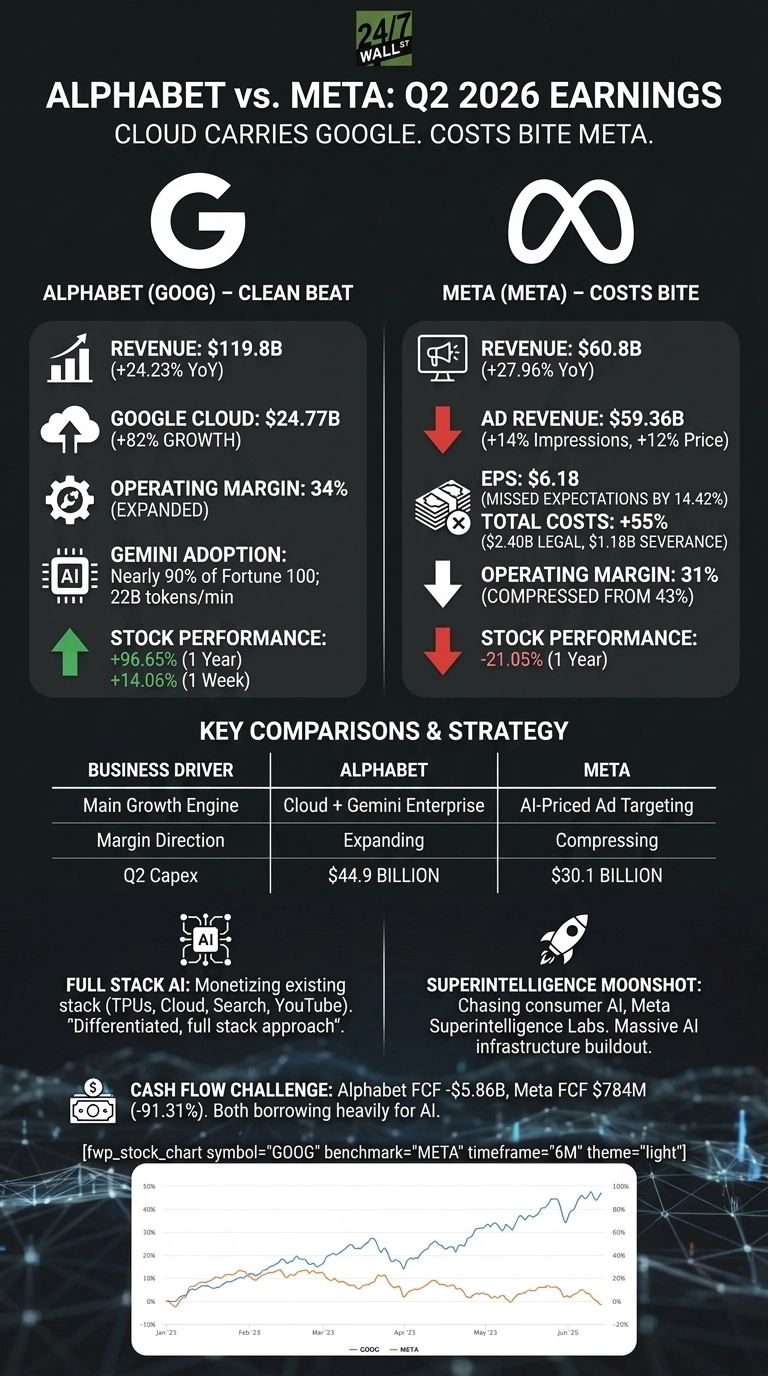
| Business Driver | Alphabet | Meta |
| Main growth engine | Cloud + Gemini Enterprise | AI-priced ad targeting |
| Margin direction | Expanding | Compressing |
| Q2 capex | $44.9 billion | $30.1 billion |
Full Stack vs. Superintelligence Moonshot
Alphabet is monetizing AI across a stack it already owns: TPUs, Gemini models, Cloud, Search, YouTube, Workspace. Pichai framed it as a “differentiated, full stack approach“, and the Cloud number backs him up.
Meta is spending to invent something further out. Zuckerberg’s Meta Superintelligence Labs is chasing consumer AI on top of a family of apps that reaches 3.60 billion daily users. He called AI “accelerating our core business today“, but the P&L is doing the paying.
Both are borrowing heavily. Alphabet raised roughly $70 billion in combined equity and debt and suspended its buyback. Meta guided full-year capex to $130 billion to $145 billion, with expenses raised to $165 billion to $169 billion. Free cash flow tells the story: Alphabet swung to negative $5.86 billion, and Meta’s fell 91.31% to $784 million.
The Next Test Is Whether Capex Pays
I want to see three things. For Google, whether Cloud can hold that 82% pace as capacity floods online, and whether Search query growth truly benefits from AI features rather than getting cannibalized.
For Meta, whether the Q3 revenue guide of $61 billion to $64 billion materializes without another cost surprise. The youth-related U.S. trials scheduled for 2026 are a wildcard I do not think retail has priced in.
Why I Lean Google Right Now
On the fundamentals, Alphabet looks like the cleaner setup. Cloud is compounding, margins are widening, and shares are up 14.06% in the past week and 96.65% over one year.
Meta is a harder call. The ad engine still works, but shares are down 21.05% over the last year, and Polymarket traders assign only a 44% probability that META revisits $640 in August.
If you like turnarounds with defined catalysts, Meta has more upside variance. For investors focused on current fundamentals, Alphabet screens more favorably until Meta demonstrates cost discipline.
Contact [email protected] for any questions or corrections.
Vandita Jadeja is a financial publisher with over a decade of experience writing about financial topics, including investment, savings, retirement, insurance and banking. Vandita is a Chartered Accountant who loves to debunk financial concepts for readers.
Her work has appeared on sites that include The Motley Fool, InvestorPlace, and Benzinga. She covers investing and focuses on stock picks and price prediction for 24/7 Wall St.
When not looking for the next stock investment opportunity, she can be found traveling, reading, chasing sunsets and enjoying her iced latte.