ASML Dropped 5% Over a Month But a Prominent Wall Street Wealth Manager Sees 50% Returns Coming
A single Chinese headline erased weeks of gains from one of the semiconductor world's most irreplaceable companies, but Wall Street's most bullish analysts are treating the dip as a gift. Here is why the bear case just got harder to…

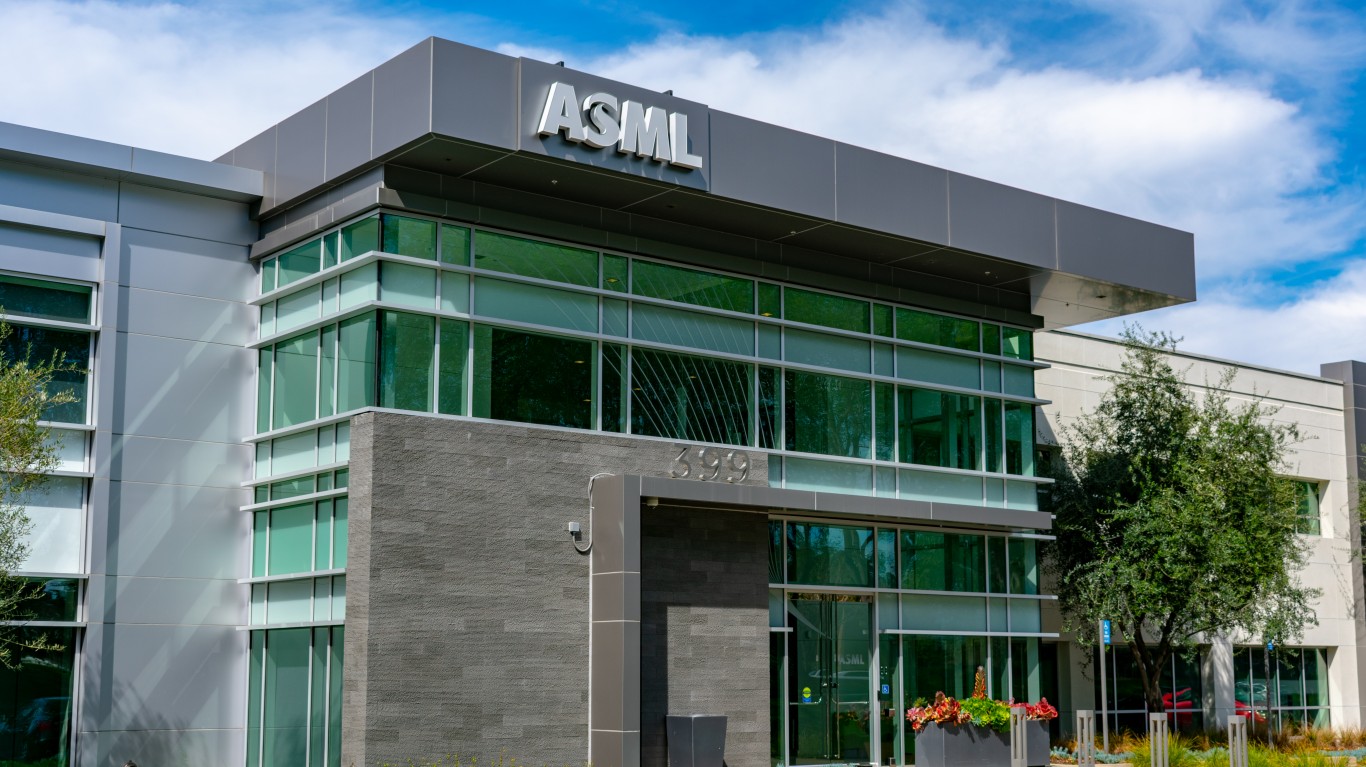
ASML (NASDAQ:ASML | ASML Price Prediction) currently trades at $1,740.99, while the Street-high price target from Bernstein sits at $2,623, implying roughly 50% upside from here.
ASML is the Dutch supplier of extreme ultraviolet (EUV) and deep ultraviolet (DUV) lithography systems, the multi-hundred-million-dollar machines every advanced chipmaker needs to print sub-3nm logic and next-generation HBM memory. ASML’s order book is a leading indicator for AI-driven semiconductor capex. When the stock pulls back while bookings climb, the gap gets scrutinized quickly.
The recent selling was catalyst-driven. Q2 numbers vindicated the bull case.
A China Headline Bruised a Stock the Earnings Had Just Vindicated
The pullback traces to a Bloomberg report on July 27, 2026 that a Chinese state-backed firm had begun mass-producing immersion DUV lithography tools. ASML fell more than 7% intraday, hitting its lowest level since early June, with ticker sentiment scores collapsing to -0.807.
Two secondary pressures followed: chatter about tighter U.S. export restrictions on DUV shipments to China, and worries that High-NA EUV adoption was moving slower than the bull case required. Over the past month, ASML is down 1.43%, but the intramonth drawdown to support near $1,538 was closer to 13% before a sharp bounce. The sector sold off with it, but ASML took the sharpest hit because its China DUV exposure is the most direct.
Why Bernstein Won’t Blink at a China Scare
Analysts stayed put because Q2 made the bear case harder. ASML delivered revenue of $10.65 billion, up 21.25% year over year, with EPS of $8.67 extending the beat streak to four straight quarters. Management raised full-year revenue guidance to €43 billion to €45 billion and telegraphed plans to add 30% capacity to both low-NA EUV and DUV immersion for 2027.
Bernstein’s $2,623 target, carrying an Outperform rating, rests on four pillars: an absolute monopoly on EUV indispensable for sub-3nm nodes, aggressive High-NA adoption as leading foundries scale Gate-All-Around logic, an HBM capacity surge tied to accelerator roadmaps, and an expanding installed-base service line that Bernstein views as a rising cash-flow floor. Wells Fargo sits at $2,500 and Bank of America at $2,345, both echoing the same AI capex thesis.
CEO Christophe Fouquet framed it plainly on the call: “Ongoing AI-related investments and continued progress in AI technologies are driving demand for advanced Logic and Memory chips… Our customers, in turn, continue to accelerate their capacity expansion plans.” The recent coverage has been reiterations and upgrades. JR Research moved to Buy the same day China headlines hit, arguing the forward multiple reset made the risk/reward more attractive.
The WFE Peers Sold Off Together, But ASML Has the Widest Gap
The wafer-fab-equipment group moved as a cohort during the July decline, but analyst-implied upside varies widely across the group. ASML is the outlier on the top end.
Applied Materials (NASDAQ:AMAT) is down 5.5% over the past month at $539.14, against an average target of $629.06, roughly 17% upside. Coverage skews Buy with 32 of 39 analysts positive.
Lam Research (NASDAQ:LRCX) trades at $311.35, off 6.54% on the month, versus a $368.13 average target for about 18% upside. Sentiment stays firmly Buy-tilted.
KLA Corp (NASDAQ:KLAC) has been hit hardest, down 10.43% over the past month at $198.11. Its $230.85 target implies roughly 17% upside, with analyst posture more mixed at 10 Hold ratings.
ASML’s implied upside toward the Bernstein Street-high dwarfs anything in the peer set. Even against more conservative consensus, ASML’s gap remains the widest.
What the Consensus Numbers Actually Say
Consensus across 44 analysts sits at an average target of $2,178.04, roughly 25% above the current $1,740.99. The ratings distribution: 7 Strong Buy, 33 Buy, 3 Hold, 1 Sell.
Year to date, ASML is up 63.53%, running well ahead of the S&P 500’s 13.39% YTD gain. Over one year, the shares have returned 145.76%. The stock trades at a 38 forward P/E, elevated but well below where it sat before the summer pullback.
My Take: The Monopoly Wins Unless China Cracks It Faster Than Expected
The bull case holds if the AI capex cycle keeps pulling forward, if High-NA EUV adoption tracks Bernstein’s ramp assumptions, and if China DUV competition stays generations behind. The path to a $2,623 target runs through continued backlog growth, the guided 30% capacity expansion converting into orders, and margins holding above 55%.
The thesis weakens if Chinese domestic DUV closes the gap faster than expected, or if U.S. export rules widen enough to strand ASML’s China revenue. A slower-than-modeled High-NA ramp would also erode the highest-margin part of the bull case.
On balance, I lean bullish. Bernstein’s 50% call may be aggressive, but even the more sober consensus target implies enough upside to make the current price a discount on a business that just raised guidance and posted a fourth straight beat.
Contact [email protected] for any questions or corrections.
Alex Sirois is a financial writer with experience spanning both retail and institutional investing. He has written for InvestorPlace and held roles at BNY Mellon and Bernstein, giving him a perspective that bridges Main Street portfolios and Wall Street analysis.
Alex holds an MBA from George Washington University and has built his career across multiple industries, including e-commerce, education, and translation — a breadth of experience that informs how he breaks down complex financial topics for everyday investors. His writing is conversational, actionable, and grounded in long-term, buy-and-hold investing principles.
At 247 Wall St., Alex focuses on delivering analysis that is both accessible and useful, with a clear emphasis on helping readers make more informed decisions with their money.