




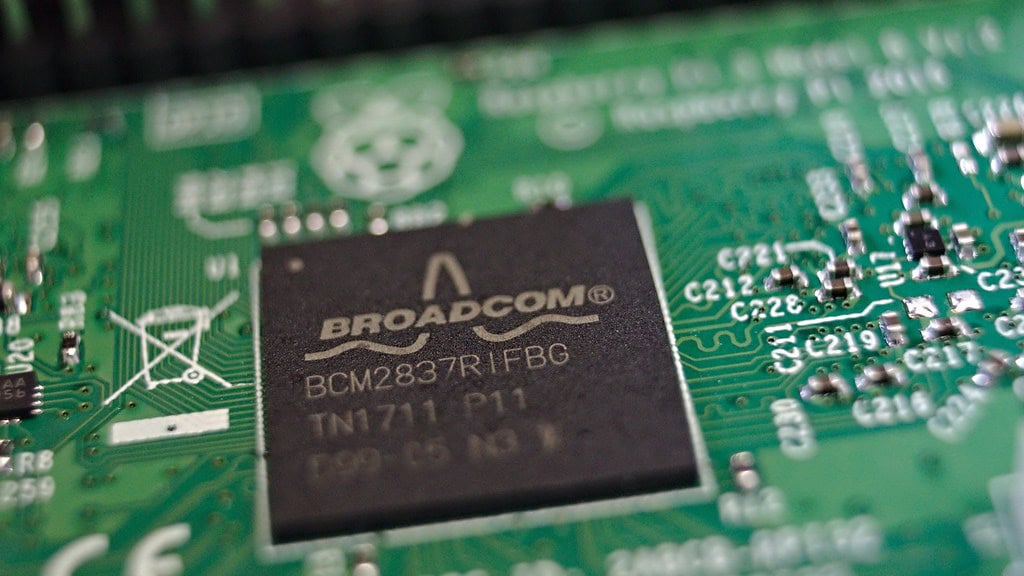
Broadcom (NASDAQ: AVGO | AVGO Price Prediction) and NVIDIA (NASDAQ: NVDA) both just posted AI-fueled quarters, but the numbers reveal two very different bets. NVIDIA is selling a full-stack GPU platform to every buyer on Earth. Broadcom is quietly designing the custom silicon those same hyperscalers actually want to own.
Custom XPUs Carry Broadcom. Blackwell Carries NVIDIA.
Broadcom’s Q2 FY2026 revenue hit $22.19 billion, up 47.9% year over year, with AI semiconductor revenue of $10.80 billion growing 143%. CEO Hock Tan said Q3 AI revenue should reach $16 billion, and Q2 AI bookings hit over $30 billion against that $10.8 billion shipped. That backlog is the tell.
NVIDIA’s Q1 FY2027 was larger in absolute terms: revenue of $81.61 billion with a Data Center segment of $75.25 billion, up 92%. Jensen Huang framed it as “the largest infrastructure expansion in human history.” The scale is stunning, but growth is decelerating relative to Broadcom’s smaller, faster-compounding AI base.
| Business Driver | Broadcom | NVIDIA |
| AI Growth Rate | 143% YoY | 92% YoY |
| Core Model | Custom ASICs and networking | Merchant GPU platform |
| Second Engine | VMware software | None material |
Where the Strategies Really Diverge
Broadcom’s pitch is economics. Custom accelerators strip away redundant GPU execution units and deliver 30% to 50% lower Total Cost of Ownership for hyperscalers running fixed workloads at massive scale. Tan now names Google, Meta, OpenAI, and Anthropic among core customers, with Anthropic committed to 5 gigawatts of next-gen TPU-based compute starting 2027.
NVIDIA’s counter is ecosystem lock-in. CUDA, NVLink, and Spectrum-X still define the default AI stack. But margin pressure is real: Q2 non-GAAP gross margin is guided to 72.0%, and China Data Center compute revenue was zeroed out of guidance after H20 export restrictions cost roughly $8 billion in expected Q2 sales.
What I’m Watching Next
Tan says visibility now extends into 2028, with AI semiconductor revenue targeted in excess of $100 billion. Prediction markets look skeptical, giving only a 62% chance Broadcom’s Q3 AI revenue clears $16 billion. You should watch whether Meta’s 3 gigawatts through 2028 and OpenAI’s 1.3 gigawatts in 2027 actually ship on schedule.
Why I Lean Toward Broadcom Here
For me, Broadcom is the more interesting business right now. The $30 billion in Q2 AI bookings, the $10.26 billion in free cash flow, and VMware’s 17% ARR growth give it two profit engines that NVIDIA lacks. NVIDIA fits investors who want the dominant platform and can tolerate China risk and margin compression. Both names face pressure if hyperscaler capex cools. Until then, custom silicon is quietly rewriting the AI economics story, and Hock Tan is the one holding the pen.
Contact [email protected] for any questions or corrections.










 Top Gaining Stocks
 Top Losing Stocks