Johnson & Johnson Nearing 52-Week High: Buy, Sell or Hold?
Johnson & Johnson has surged more than 50% in a year and now sits within striking distance of its 52-week high, but a closer look at the valuation, insider activity, and pipeline pressures raises a pointed question about who actually…


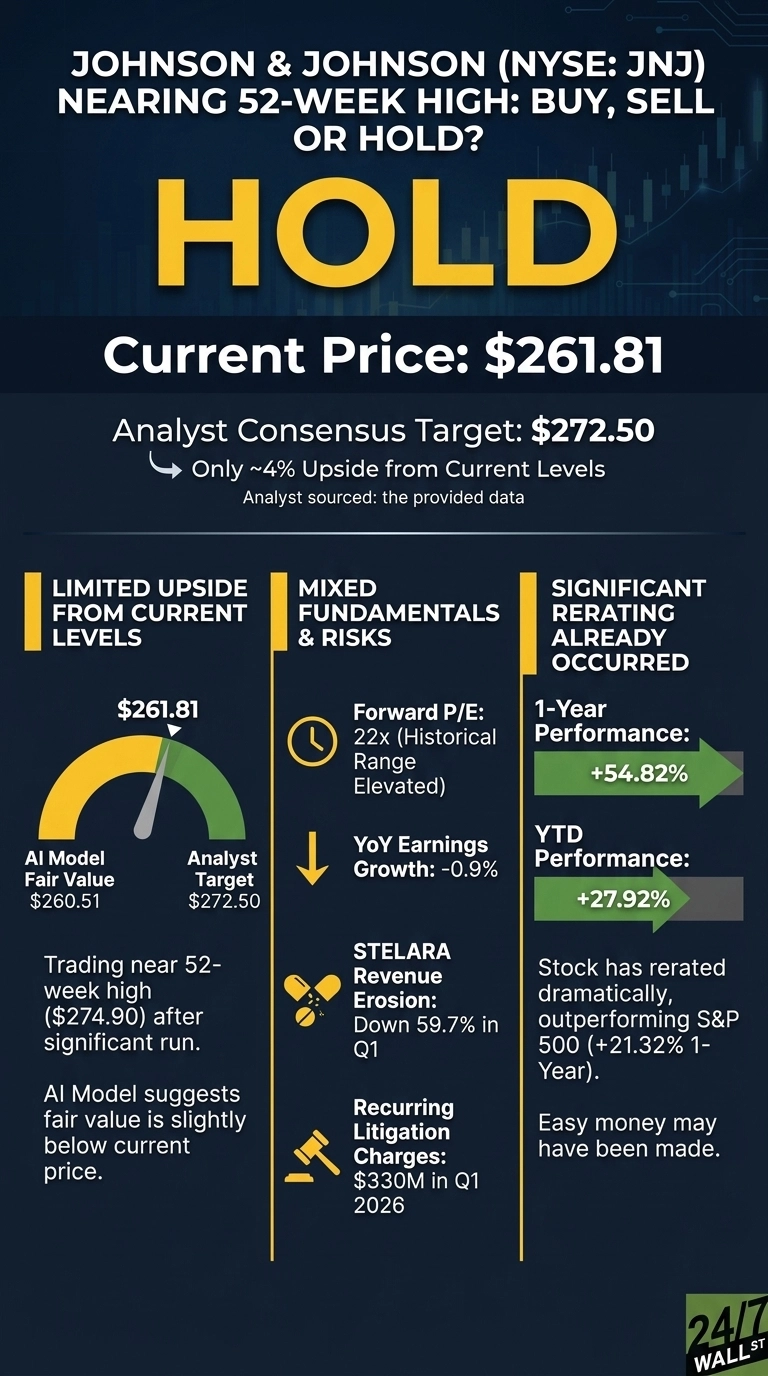
At $261.81, Johnson & Johnson (NYSE:JNJ | JNJ Price Prediction) is a hold. The stock sits roughly 1% below its 52-week high of $274.90 after a startling run, and investors deserve clarity on whether the next leg is up or sideways.
Johnson & Johnson is the largest diversified healthcare company on the NYSE, with operations spanning Innovative Medicine (oncology, immunology, neuroscience) and MedTech (cardiovascular, surgery, vision). The stock has rerated dramatically over the past year, up 54.82%, as investors rewarded a clean pipeline, resilient guidance, and the pending DePuy Synthes orthopaedics spinoff.
Why the Rerating May Have More Room to Run
The bull case rests on accelerating fundamentals. Q1 2026 revenue hit $24.06 billion, up 9.9% year over year, and Q2 pushed higher to $25.3 billion with adjusted EPS of $2.90. Management raised full-year guidance to a midpoint of $101.1 billion in sales and $11.68 in reported EPS, with CEO Joaquin Duato pointing to “line of sight to double-digit growth by the end of the decade.”
Growth engines are real. DARZALEX cleared $4 billion in Q2, TREMFYA hit its first $2 billion quarter growing 71%, and CAPLYTA grew 70.9%. Add the forward P/E of 22, a beta of 0.23, and 64 consecutive years of dividend increases, and JNJ looks like a defensive compounder still catching a bid.
Why the Chart Has Sprinted Ahead of Fundamentals
The bear case is valuation. The stock trades at a trailing P/E of 30, well above its historical range, while quarterly earnings growth is -0.9% year over year. STELARA continues to bleed, falling 59.7% in Q1 and stripping roughly 920 basis points from Innovative Medicine growth.
MedTech is stumbling. Q2 operational growth was just 3.6%, with Abiomed declining 2% on physician caution after a neutral U.K. trial. Litigation charges remain a recurring drag ($330 million in Q1 2026), insider activity shows net selling across 17 transactions, and the average analyst price target of $272.50 sits barely above the current quote.
Why Patience Beats Conviction Right Now
The hold case fits the setup. JNJ is executing, but the easy money on the rerating has been made. The bull-case one-year target of $300.96 offers 14.95%, while the bear case sits at $246.76 for a 5.75% loss. That asymmetry qualifies as adequate but underwhelming.
Catalysts that would shift the verdict are visible: pivotal ICOTYDE data in psoriatic arthritis, IMAAVY approval in warm autoimmune hemolytic anemia, Abiomed stabilization, and the Enterprise Business Review on December 8, 2026.
Any could reset the growth narrative. Absent a pullback toward the 200-day moving average of $228.04, chasing here means paying full price for a story the market already believes.

What the Numbers Say
Shares trade at $261.81 against an analyst consensus target of $272.50, implying roughly 4% upside from 23 covering analysts. Sentiment skews bullish with 5 Strong Buy, 11 Buy, 6 Hold, and 1 Sell rating.

Performance context: JNJ is up 27.92% year to date and 54.82% over one year, versus the S&P 500 at 13.36% YTD and 21.32% for the same stretch. Valuation carries a trailing P/E of 30 and forward P/E near 22, with a dividend yield of 2.04%.
Why Waiting Is the Right Call at $261.81
At $261.81, Johnson & Johnson is a hold.
The fundamental story is intact, but price has closed most of the gap to fair value. With shares hugging the 52-week high, analyst targets only 4% away, and the AI model pinning fair value near $260.51, upside depends on multiple expansion rather than earnings surprises.
Current shareholders may prefer to wait and monitor three triggers. A pullback into the low $230s, coinciding with the 200-day, would offer a cleaner entry. Confirmation that Abiomed and MedTech reaccelerate in the second half would strengthen conviction into 2027. A hard signal from the December 8 Enterprise Business Review on double-digit growth pace would settle the debate.
The cost of patience is a modest dividend and the possibility of missing another leg higher. The cost of chasing is paying peak multiples for a rerated defensive name after a 55% run. Waiting for a better price or sharper catalyst may be the more measured approach on a stock that has already priced in most of the good news.

Contact [email protected] for any questions or corrections.
Vandita Jadeja is a financial publisher with over a decade of experience writing about financial topics, including investment, savings, retirement, insurance and banking. Vandita is a Chartered Accountant who loves to debunk financial concepts for readers.
Her work has appeared on sites that include The Motley Fool, InvestorPlace, and Benzinga. She covers investing and focuses on stock picks and price prediction for 24/7 Wall St.
When not looking for the next stock investment opportunity, she can be found traveling, reading, chasing sunsets and enjoying her iced latte.