Prediction: This Dividend King Could End The Year With a New All-Time High Stock Price
Johnson and Johnson has quietly become one of the best-performing mega-caps of the past year, but with a fresh pullback and a pipeline firing on multiple cylinders, the bigger question is whether the next leg higher finally breaks through to…

Johnson & Johnson (NYSE:JNJ | JNJ Price Prediction) is up 24.03% year to date and 65.92% over the past year, riding oncology strength and a raised full-year outlook. Our proprietary model sees room to run.
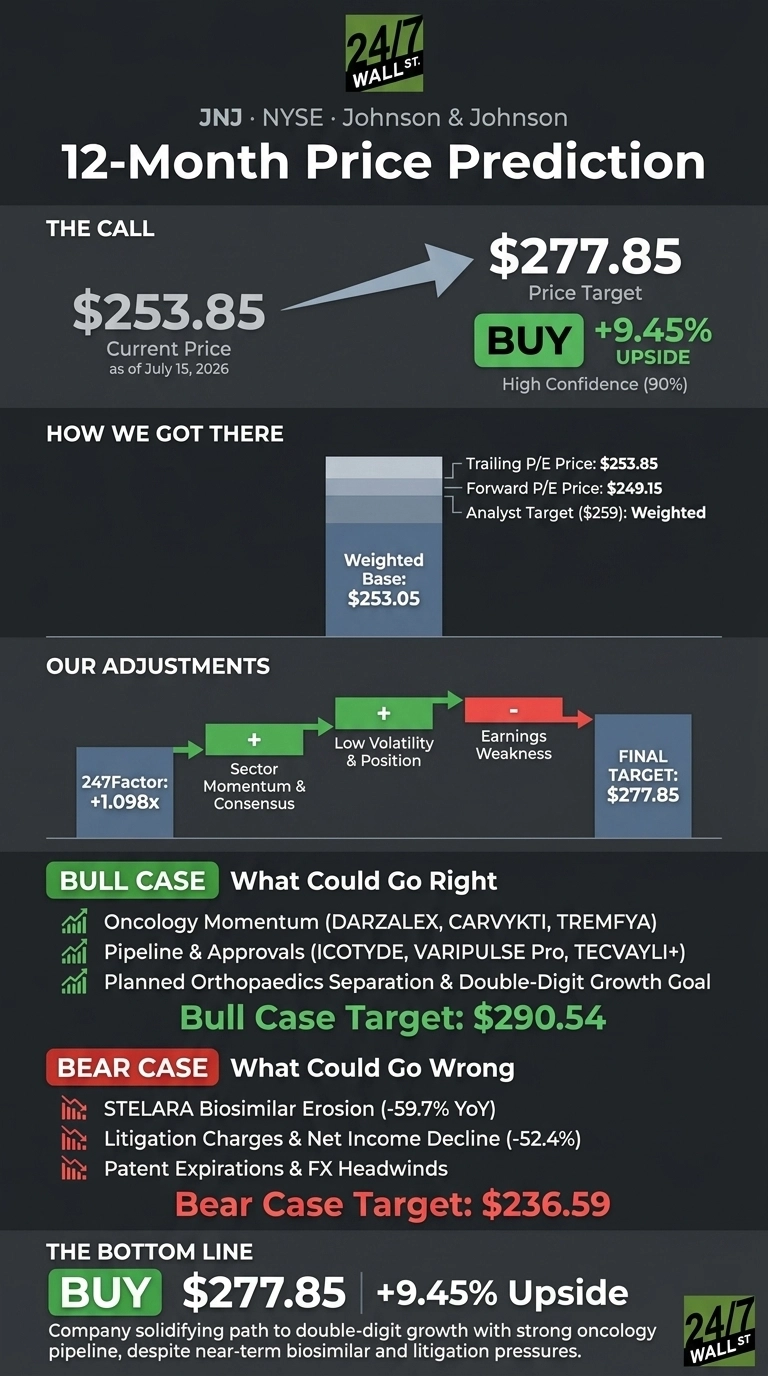
Our 24/7 Wall St. price target for JNJ is $277.85, implying 9.45% upside from the current $253.85. The recommendation is buy with 90% confidence, high by our standards for a mega-cap.
24/7 Wall St. Price Target Summary
| Metric | Value |
|---|---|
| Current Price | $253.85 |
| 24/7 Wall St. Price Target | $277.85 |
| Upside | 9.45% |
| Recommendation | BUY |
| Confidence Level | 90% |
A Year of Accelerated Growth Is Playing Out
JNJ delivered Q1 2026 revenue of $24.06 billion, up 9.9% year over year, with adjusted EPS of $2.70 beating the $2.6773 consensus. Q2 2026 reinforced the trajectory with reported sales of $25.3 billion (up 6.6%) and adjusted EPS of $2.90, prompting another guidance raise.
Management now targets full-year revenue of $100.30 billion to $101.30 billion and adjusted EPS of $11.45 to $11.65. The stock traded as low as $155.89 in the past 52 weeks and now sits just below its $269.43 high after a 5.01% pullback in the last week.

Why Bulls See a Breakout Above $290
Oncology remains the engine. DARZALEX grew 22.5% to $3.96 billion in Q1, TREMFYA surged 68.3%, CARVYKTI jumped 62.1%, and RYBREVANT/LAZCLUZE climbed 82.7%. Recent approvals for ICOTYDE, VARIPULSE Pro, and TECVAYLI plus DARZALEX FASPRO extend the runway.
Management committed to double-digit growth by decade’s end, and the planned Orthopaedics separation could unlock a valuation re-rating. Our bull case price target over the next 12 months is $290.54, a 14.45% total return.
What Could Go Wrong
STELARA collapsed 59.7% to $656 million as biosimilar competition intensified, and litigation charges of $330 million weighed on GAAP net income, which fell 52.4%.
Bulls view the decline as optics driven by TREMFYA absorbing STELARA share, with the litigation charge running as a non-recurring item. Our bear case target is $236.59, a 6.8% drawdown if patent cliffs bite harder than expected.
How JNJ Compares to Merck and Pfizer
Merck (NYSE:MRK) is the closest oncology-driven comp given KEYTRUDA’s dominance. Merck guides 2026 non-GAAP EPS of $8.93-$9.03 on revenue of $64.3B-$64.8B, but a $0.37 Cidara acquisition charge muddies the trailing picture. JNJ’s diversified MedTech plus Innovative Medicine mix looks cleaner, supporting our target’s forward P/E of roughly 23.
Pfizer (NYSE:PFE) trades at a trailing P/E of just 14 with a dividend yield near 6%, versus JNJ’s 30 P/E and 2.01% yield. Pfizer looks statistically cheaper, but the discount reflects post-COVID revenue erosion and patent-cliff risk. JNJ’s premium is earned, and our target leaves room versus the sell-side consensus of $259.
I’d Buy It Here
The 24/7 Wall St. price target of $277.85 with 90% confidence and a buy rating reflects a company hitting on innovation while paying investors to wait through a 64th consecutive dividend increase.
I’d be a buyer if the December 8 Enterprise Business Review confirms the double-digit growth path. I’d stay sidelined if litigation charges reaccelerate or if the Orthopaedics separation gets delayed.
| Year | 24/7 Wall St. Price Target |
|---|---|
| 2026 | $277.85 |
| 2027 | $298.00 |
| 2028 | $318.00 |
| 2029 | $337.00 |
| 2030 | $356.79 |
These projections assume JNJ executes on its path toward double-digit growth by decade’s end. Significant upside or downside could result from oncology pipeline outcomes or the Orthopaedics separation.
Contact [email protected] for any questions or corrections.
Vandita Jadeja is a financial publisher with over a decade of experience writing about financial topics, including investment, savings, retirement, insurance and banking. Vandita is a Chartered Accountant who loves to debunk financial concepts for readers.
Her work has appeared on sites that include The Motley Fool, InvestorPlace, and Benzinga. She covers investing and focuses on stock picks and price prediction for 24/7 Wall St.
When not looking for the next stock investment opportunity, she can be found traveling, reading, chasing sunsets and enjoying her iced latte.