Elon Musk and Jensen Huang’s New Partnership Could Create the Next Era of Technology
Four seemingly unrelated headlines dropped over two weeks, and when you line them up in sequence, they point to a partnership that could reshape who controls the next trillion dollars of AI infrastructure.

Over the past two weeks, four separate headlines may look unrelated, but my bet is they’re adding up to something much larger.
First, Elon Musk committed SpaceX exclusively to NVIDIA GPUs during the company’s first conference call on August 4th. Second, Musk set a target of 10 gigawatts of AI compute by the end of 2027. Third, on August 10, NVIDIA announced financing partnerships with Apollo, BlackRock, Blackstone, Brookfield, Goldman Sachs and KKR to mobilize over $500 billion of third-party capital. And fourth, NVIDIA disclosed roughly 122.8 million SpaceX shares worth about $21 billion in its Q2 13F filed August 14, 2026.
Together, they tell one story: the buildout Jensen Huang calls “the largest infrastructure expansion in human history” now has a defining partnership.
Putting Together the Partnership That Could Define the AI Factory Buildout
NVIDIA (NASDAQ:NVDA | NVDA Price Prediction) sells the GPUs, networking, and full-stack software behind essentially every frontier AI model. Data Center revenue reached $75 billion last quarter, up 92% year over year.
SpaceX (NASDAQ:SPCX) is the newest hyperscale AI buyer. Beyond rockets and Starlink, its AI segment (Grok, Colossus II, cloud services) delivered $2.56 billion in Q2 revenue, up 247% year over year, with $15.83 billion of a $18.37 billion single-quarter capex bill directed to AI infrastructure. Here’s why those numbers will soon look tiny.
On August 4th, Musk spoke of driving SpaceX to 10 gigawatts of computing capacity by the end of 2027, which is up from 1.4 gigawatts today. The cost of getting SpaceX to 10 gigawatts by the end of 2027? Somewhere around $500 billion.
The day after earnings, the market didn’t ‘buy’ Musk’s vision. SpaceX shares fell. Several Wall Street firms questioned how Musk could possibly receive the financing to build out the scale of compute he was discussing. However, a couple of days later (August 7th), SpaceX shares began a massive rally that soon brought the company back above its IPO price.
The catalyst for the rally? Research from SemiAnalysis stated that SpaceX was actually in position to achieve its goals and reach up to 10 gigawatts by the end of 2027. If SpaceX hit that target, SemiAnalysis predicted they would exit 2027 with an ARR of around $305 billion.
Wall Street is currently modeling $98 billion in 2027 revenue and $157 billion in 2028 revenue.
NVIDIA Announces $500 Billion in Funding
Then, on August 10th, NVIDIA announced a brand new ‘Compute Infrastructure Financing Platform‘ alongside Wall Street’s largest banks. The platform would mobilize over $500 billion in third-party capital, with NVIDIA agreeing to backstop up to 25% of the project’s cost.
And finally, NVIDIA’s 13F released on August 14th revealed the company had established a $21 billion position in SpaceX.
First, we had SpaceX announcing its intention to build a massive amount of data centers (exclusively using NVIDIA’s chips), and then NVIDIA announcing a $500 billion financing initiative and large investment into SpaceX’s stock.
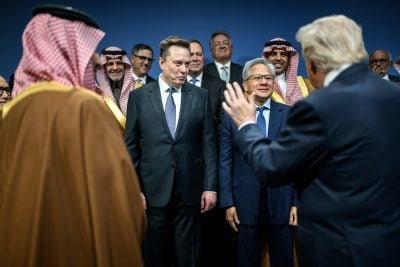
I trust you’re following along with the sequence of events. NVIDIA’s CEO Jensen Huang has repeatedly expressed his admiration for Elon Musk’s drive and ability to stand up data centers in record time. Musk is now targeting a data center buildout that is extremely ambitious, but one which faces challenges in financing Musk’s ambitions.
It’s a partnership that makes sense. NVIDIA has been looking for more ways to use its balance sheet to develop the AI ecosystem, and Musk gives them a ‘backdoor’ to the creation of a new hyperscaler. The company’s $500 billion platform becomes a way for not just SpaceX, but other neoclouds, to receive more capital and compete with the largest companies like Amazon, Alphabet, Microsoft, and Meta Platforms.
And by creating a new funding source for this group, NVIDIA continues to diversify its customer list. The fact that NVIDIA’s revenue remains so concentrated amongst a small group of customers remains one of the largest reasons the company trades near a market-average forward P/E despite its incredible growth rates.
The Future of AI Hinges on Elon Musk and Jensen Huang’s Partnership
Jensen Huang has said he expected AI infrastructure spending to reach $3 trillion to $4 trillion annually by the end of the decade. When he started using that number on conference calls, many analysts mistakenly believed it was an amount of total spending across the next five years.
AI infrastructure estimates vary, but they’re generally around $800 billion in 2026. Consensus continues to grow for 2027, but many estimates place spending next year at closer to $1.2 trillion. That number is eye-watering for those who have been following AI, but it’s still just 1/3 of where Huang sees the market going by the end of the decade.
So, it’s clear that Huang envisions a future for AI that’s much larger and happens much sooner than just about anyone else imagines. Well, anyone else aside from Elon Musk.
My bet: the budding partnership between NVIDIA and SpaceX will become a key driver across the next generation of the AI race. What we’ve seen the past two weeks is just the beginning.
Contact [email protected] for any questions or corrections.
Eric Bleeker, CFA has been investing for more than 20 years. He began his career working at Microsoft before joining Motley Fool, one of the largest publishers of financial research. In his 15 years at Motley Fool Eric served as the General Manager for Fool.com and led coverage in the Technology & Telecom sector. In addition, he was a featured columnist and has hosted dozens of investing seminars attended by more than a million total investors. Eric has more than 1,000 financial bylines to his name and has been featured in The Wall Street Journal, CNBC, Fox Business, and many other leading publications. He is currently focused on artificial intelligence investing and is a CFA Charterholoder.