Korean Stocks Rally Again Overnight. KOSPI Closes Up 2.41% As SK Hynix and Samsung Rally.
A single investor day in Milpitas just sent shockwaves through Seoul, and the ripple effects are repricing an entire asset class that Korean giants are preparing to take public.

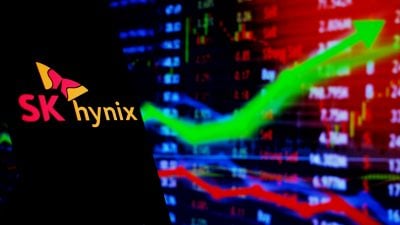
The KOSPI closed Friday up 2.41% at 6,977.34, capping a cumulative weekly gain of 11.5% and snapping a seven-week losing streak. Memory chip leaders drove the move. SK Hynix jumped 3.26% to 1,645,000 Korean won and Samsung Electronics rose 2.43% to 274,500 won. Japan followed, with the Nikkei 225 up 0.59% at 68,713.80.
SanDisk Investor Day Reprices the NAND Complex
The catalyst came from Milpitas, not Seoul. SanDisk (NASDAQ:SNDK | SNDK Price Prediction) hosted its Investor Day Wednesday and laid out a multi-year model that shocked the memory group. Management guided to mid-to-high teens revenue growth from FY2028 through FY2030, approximately 80% non-GAAP gross margins, approximately 75% non-GAAP operating margins, and a roughly 50% adjusted free cash flow margin with 100% of excess cash returned to shareholders. The framework rests on 8 New Business Model long-term agreements covering roughly 50% of bits in FY2027 and two-thirds in FY2028, and an enterprise data-center flash TAM reaching 1.2 zettabytes by 2030.
SanDisk closed Thursday at $1,528.11, up 13.7%, and is now up 544% year to date. That single presentation reset how the market values NAND cash flows.
The Solidigm Read-Through
The sharpest signal runs through Solidigm, SK Hynix’s NAND arm, which is reportedly planning a Nasdaq listing at roughly a 50 trillion won valuation. SanDisk just told the market that a NAND-focused pure play can print 80% gross margins through 2030. That directly reprices the asset SK Hynix is preparing to take public.
Here is the nuance investors should hold onto. Both Samsung and SK Hynix are primarily DRAM and high-bandwidth memory businesses, with NAND a secondary line. The market is treating a NAND-specific datapoint as a memory-wide signal, while the Korean names’ actual earnings leverage sits more in HBM. The rally makes sense, but there is some nuance to digest.
Supporting the rally: Samsung held the Q2 2026 NAND shipment crown, server-led enterprise SSDs reached 48% of NAND shipments, and top-five NAND suppliers’ combined revenue rose 83.7% quarter over quarter in Q1 2026. On Friday, SK Group Chairman Chey Tae-won said the company is considering building new memory chip plants via a joint-venture model and warned tight memory supply could intensify further in 2027.
The US-Listed Playbook
The cleanest US proxy is the iShares MSCI South Korea ETF (NYSEARCA:EWY), which closed Thursday at $178.62, up 1.6%. EWY is up 8.8% over the past week, 0.9% over the past month, 84% year to date, and 144% over the past year. The fund is concentrated: SK Hynix and Samsung Electronics together represent 55% of net assets. Other Korea vehicles exist, including a Franklin FTSE South Korea fund and a leveraged Direxion Daily South Korea Bull 3X product. The leveraged option is materially higher risk.
SK Hynix’s US-listed ADS, SK Hynix (NASDAQ:SKHY), only began trading around July 9, 2026 and closed Thursday at $165.67, up 7.3%. US peers are already riding the same move: Micron Technology (NASDAQ:MU) closed up 4.2% and Western Digital (NASDAQ:WDC) closed up 7.3% Thursday.
Prior coverage of the SanDisk model unveiling is available to read here.
What to Watch
upply tightness may extend into 2027, and foreign investors net bought roughly $2 billion in South Korean stocks this week, versus cumulative net outflows exceeding $100 billion earlier this year. At 6,977 the KOSPI is still well below its June 2026 peak above 9,000. The drawdown began in late June, worsened through July with back-to-back circuit breakers in late July, and China’s YMTC just broke into the global top three NAND suppliers for the first time. Watch the US open in memory names today as an extended rally could be a positive catalyst for where the KOSPI begins trading next week.
Contact [email protected] for any questions or corrections.
Eric Bleeker, CFA has been investing for more than 20 years. He began his career working at Microsoft before joining Motley Fool, one of the largest publishers of financial research. In his 15 years at Motley Fool Eric served as the General Manager for Fool.com and led coverage in the Technology & Telecom sector. In addition, he was a featured columnist and has hosted dozens of investing seminars attended by more than a million total investors. Eric has more than 1,000 financial bylines to his name and has been featured in The Wall Street Journal, CNBC, Fox Business, and many other leading publications. He is currently focused on artificial intelligence investing and is a CFA Charterholoder.