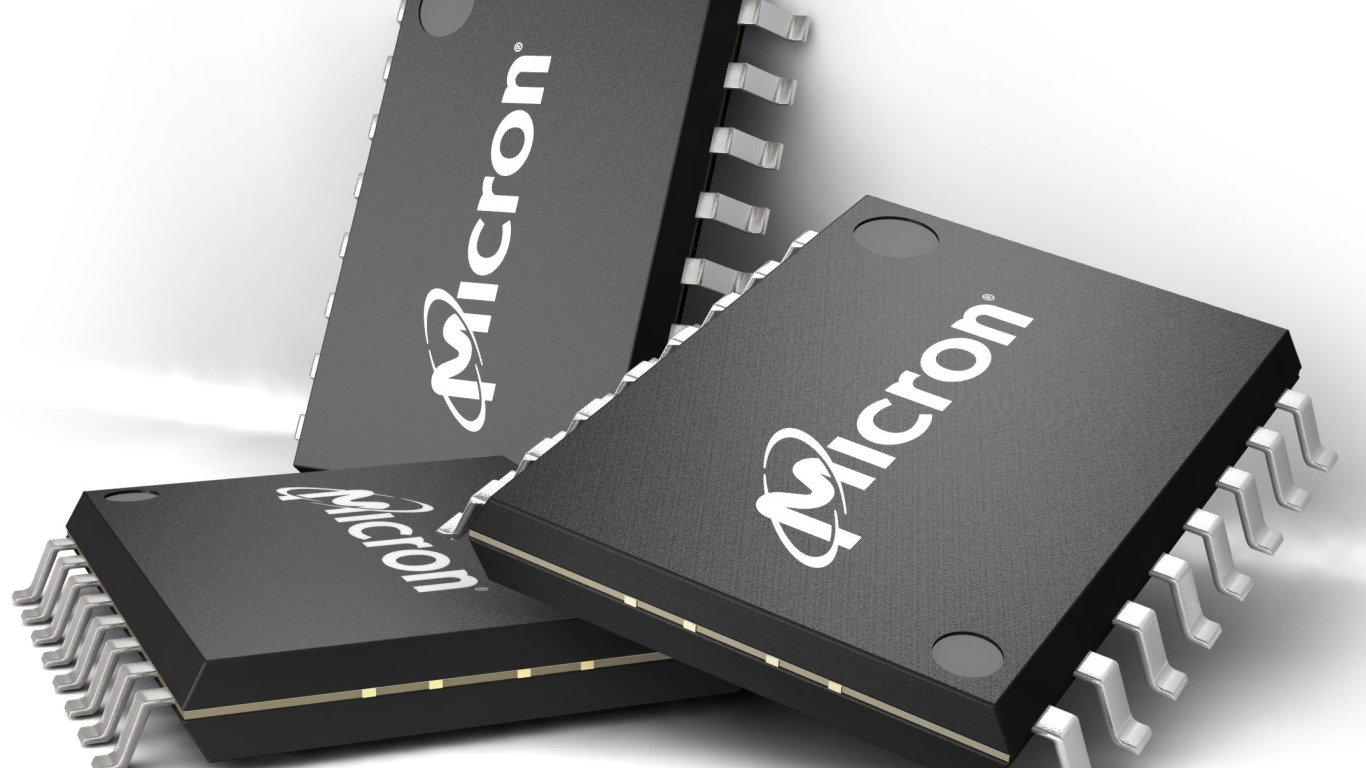
Micron Is Hot Again: Here’s Why The Rally Has Legs
Micron has surged over 600% in a year while insiders quietly unload shares at the highs, yet analysts still see substantial room to run. Something in this picture does not add up, and the answer changes how you think about…


Micron Technology (NASDAQ:MU | MU Price Prediction) at $949.83 looks compelling, and the rally still has room to run. Quarterly revenue jumped from $11.3 billion in Q4 2025 to $41.5 billion in Q3 2026, making memory the scarce commodity of the AI era. Micron is the only U.S.-based supplier.
Micron sells DRAM and NAND memory into cloud, mobile, automotive, and embedded markets. High Bandwidth Memory (HBM) sits alongside every AI accelerator shipped by NVIDIA (NASDAQ:NVDA) and AMD (NASDAQ:AMD), moving from a rounding error to the company’s most strategic revenue stream in under two years.
The move from $118.29 in early September 2025 to $949.83 reflects fundamental repricing. Earnings, margins, and forward guidance have all reset higher in lockstep.
An HBM Franchise That Prices Like a Monopoly
Micron’s Q3 FY26 non-GAAP gross margin hit 84.9%, more than double year-ago levels, driven by HBM pricing and NAND increases in the mid-80s percentage range sequentially. Management has signed 16 Strategic Customer Agreements covering roughly $100 billion of minimum committed revenue, with about $22 billion in cash deposits and letters of credit backing them.
CEO Sanjay Mehrotra said “the gross margins at the floor will be well beyond the peaks that we experienced” in past cycles, meaning even a downturn should clear prior peak profitability. Q4 FY26 guidance calls for $50 billion in revenue and $31 in non-GAAP EPS, leaving the stock near 6x forward earnings.
Insider Selling and Cyclical Risk
The bear case starts with insider behavior. CEO Mehrotra executed 122 separate sell transactions across three months, and CPO April Arnzen sold 35,364 shares at $1,077 to $1,096. No insiders bought.
Citi cut its price target to $1,150 from $1,400 on August 7, arguing memory prices peak in 2027, and SK Hynix announced a $38 billion fab expansion will add competing HBM capacity. Memory is cyclical, and $7.8 billion in quarterly capex assumes AI demand keeps compounding.
Why Patience Has a Real Cost
A Hold case rests on tension between record fundamentals and heavy insider distribution near the top. The stock has returned 665.57% over one year, and pullbacks of 20% or more have been routine. Waiting for the next reset is defensible.
The cost is watching a company under multi-year take-or-pay contracts continue to compound. Watch HBM4E qualification milestones, quarterly SCA disclosures, and any sign that memory pricing rolls over.
What the Data Says
Micron trades at $949.83 with a market cap near $1.03 trillion, a trailing P/E of 20, and a forward P/E of 6. The consensus analyst price target sits at $1,501.98, implying meaningful upside.
Coverage tilts decisively bullish, with 40 Buy ratings, 5 Hold, and zero Sell. Year to date Micron is up 233% against a much smaller gain for the S&P 500, and the beat streak has reached seven consecutive quarters.
Why The Bull Case Holds At $949.83
At $949.83, the bull case remains intact. The path to further appreciation runs through the September earnings report, where guidance of $50 billion in revenue and $31 EPS would annualize to more than $120 in earnings power, leaving forward multiples in the mid-single digits.
Strategic Customer Agreements de-risk the traditional memory bust by locking floor pricing above prior peak margins across roughly half of expected revenue. This structural change separates this cycle from every prior one and is not yet reflected at 6x forward earnings.
The thesis breaks if HBM pricing cracks meaningfully before 2027, if lead customer concentration on HBM4 turns into share loss, or if capex overshoots demand. Watch pricing commentary quarter to quarter and whether SCA coverage grows toward the targeted 50% of revenue.
Memory is now a strategic asset. Micron owns the U.S. supply, and the market is pricing the stock like a commodity cyclical, which is why the current level still looks reasonable on the fundamentals.
Contact [email protected] for any questions or corrections.
Alex Sirois is a financial writer with experience spanning both retail and institutional investing. He has written for InvestorPlace and held roles at BNY Mellon and Bernstein, giving him a perspective that bridges Main Street portfolios and Wall Street analysis.
Alex holds an MBA from George Washington University and has built his career across multiple industries, including e-commerce, education, and translation — a breadth of experience that informs how he breaks down complex financial topics for everyday investors. His writing is conversational, actionable, and grounded in long-term, buy-and-hold investing principles.
At 247 Wall St., Alex focuses on delivering analysis that is both accessible and useful, with a clear emphasis on helping readers make more informed decisions with their money.