SK Hynix and Sandisk May Have Just Solved AI’s Biggest Bottleneck — And It Could Reshape the Memory Market
AI processors have gotten dramatically faster, but the memory feeding them has struggled to keep pace, creating a bottleneck that no GPU upgrade can fix. Two major chipmakers think they have found the missing piece of the puzzle.

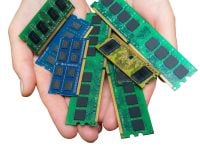
Artificial intelligence has turned computing into a memory problem as much as a processing problem. Chipmakers have spent years building faster GPUs, but those processors can only work as quickly as data reaches them. That has made high-bandwidth memory (HBM) one of the hottest commodities in technology.
Demand has outpaced supply so badly that HBM prices nearly doubled during 2026, with additional increases expected through 2027 before meaningful new manufacturing capacity begins arriving in 2028. For investors, that shortage highlights a simple truth: AI’s next leap won’t come from faster chips alone. It also requires a better way to feed them data.
That is why today’s announcement from SK Hynix (NASDAQ:SKHY) and Sandisk (NASDAQ:SNDK | SNDK Price Prediction) could be a major breakthrough.
A New Layer In AI’s Memory Hierarchy
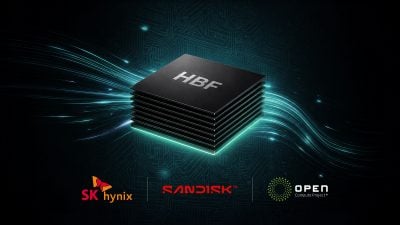
At the Flash Memory Summit 2026, SK Hynix and Sandisk published the industry’s first open specifications for High-Bandwidth Flash (HBF) through the Open Compute Project. Google and Tenstorrent also helped develop the standard, giving it broad industry backing rather than creating another proprietary technology.
The easiest way to understand HBF is to think of today’s AI memory system as having only two gears: one optimized for speed and another optimized for capacity. HBF creates the missing middle gear.
| Memory Type | Speed | Capacity | Best Use |
| HBM | Up to several TB/s | Tens to low hundreds of GB | Data AI chips need immediately |
| SSD (NAND) | Much slower over PCIe | Multiple terabytes | Long-term storage |
| HBF | 0.4 to 3.0 TB/s (1.6 TB/s first generation) | Up to 512 GB per stack | Large AI models kept close to processors |
Today’s AI models often exceed HBM’s limited capacity, forcing data onto much slower SSDs. Every transfer adds latency and consumes more power.
HBF applies HBM-style stacking and advanced packaging to NAND flash, placing dense, lower-cost memory much closer to processors. The result is bandwidth approaching HBM with several times the capacity and a lower cost per bit.
Why This Matters More Than It First Appears
The biggest opportunity isn’t training AI models but running them after they’re built. During inference, AI systems mostly read model weights instead of constantly rewriting data, making flash memory well suited despite NAND’s higher latency and lower write endurance than DRAM.
Because NAND is non-volatile, it also avoids the constant refresh cycles DRAM requires, reducing power consumption for many AI workloads.
Together, those advantages could:
- Increase memory available near AI processors
- Lower system costs compared with adding more HBM
- Reduce power consumption for inference
- Minimize data transfers between processors and SSDs
That directly addresses what engineers call the “memory wall”—the widening gap between processor performance and memory bandwidth.
Investors Should Keep Expectations Grounded
This isn’t a commercial product yet. What SK Hynix and Sandisk announced is an industry blueprint, not shipping hardware. According to the companies, HBF memory samples are expected during the second half of 2026, AI inference devices could appear in early 2027, and broader commercial adoption would likely follow afterward.
That timeline matters because open standards often shape future ecosystems before products ship. By releasing HBF through the Open Compute Project, SK Hynix and Sandisk improve the odds that GPU, CPU, and accelerator makers design around a common architecture instead of competing proprietary solutions.
Key Takeaway
In short, HBF isn’t replacing HBM. It fills the gap between expensive, capacity-limited HBM and much slower SSD storage.
With support for up to 512 GB per stack and bandwidth reaching 3.0 TB/s in future performance grades, HBF could allow AI systems to run larger models at lower cost while easing pressure on HBM supplies.
For investors, this announcement isn’t about near-term revenue. It’s about the next stage of AI infrastructure. GPUs may dominate the headlines, but memory has become AI’s limiting factor. If HBF delivers on its promise, SK Hynix and Sandisk may have taken an important step toward breaking through the memory wall—and that could create another long-term opportunity in the AI supply chain.
Contact [email protected] for any questions or corrections.
After two decades of patrolling the dark corners of suburbia as a police officer, Rich Duprey hung up his badge and gun to begin writing full time about stocks and investing. For the past 20 years, he’s been cruising the markets looking for companies to lock up as long-term holdings in a portfolio while writing extensively on the broad sectors of consumer goods, technology, and industrials. Because his experience isn’t from the typical financial analyst track, Rich is able to break down complex topics into understandable and useful action points for the average investor. His writings have appeared on The Motley Fool, InvestorPlace, Yahoo! Finance, Money Morning, and, of course, 24/7 Wall St. He has been featured in both U.S. and international publications, including MarketWatch, Financial Times, Forbes, Fast Company, and USA Today.