AMD’s $566 Million SpaceX Stake Raises a Bigger Question Than AI Chip Orders
SpaceX just told the world it will build its AI infrastructure exclusively on Nvidia chips, yet AMD quietly poured more than half a billion dollars into Elon Musk's company anyway. The reason has nothing to do with GPU contracts, and…

Every August, Wall Street gets a fresh batch of 13F filings — and a glimpse into what some of the world’s biggest investors were buying three months earlier. This year’s filings offered something more unusual: a look at who owned SpaceX (NASDAQ:SPCX | SPCX Price Prediction) after its blockbuster June IPO.
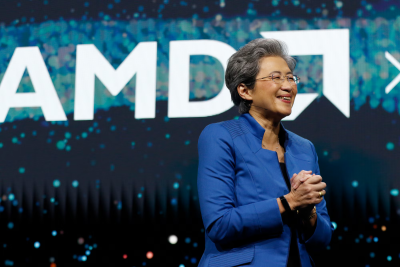
The list included some obvious names. Alphabet (NASDAQ:GOOG) had a massive position built over years. Nvidia (NASDAQ:NVDA) held a stake tied to its AI ambitions. Then there was Advanced Micro Devices (NASDAQ:AMD), which revealed roughly 3.3 million SpaceX shares worth more than $565 million.
That would be interesting enough on its own, but there’s a wrinkle: Just two months before SpaceX’s IPO, Elon Musk said the company’s AI infrastructure would be built exclusively on Nvidia chips.
So why is AMD putting more than half a billion dollars into a company that appears to have chosen its biggest rival?
The Filing, in Plain Numbers
SpaceX priced 555.6 million Class A shares at $135 apiece in its June 12 IPO, raising roughly $75 billion. The offering also brought previously private holdings into the spotlight through mandatory 13F filings.
| Holder | Class A Shares | Stake Value as of June 30 |
| Alphabet | 551.2 million | $94.2 billion |
| Nvidia | 122.76 million | $21 billion |
| AMD | ~3.3 million | ~$565 million |
Nvidia’s stake traces back to its $10 billion investment in xAI, which SpaceX subsequently acquired in early 2026. The commercial connection is obvious. AMD’s position is far smaller and lacks an obvious chip-sales connection. That’s what makes it interesting.
Why Own a Customer That Picked Someone Else?
On Aug. 4, during SpaceX’s first earnings call as a public company, Musk made the company’s AI-chip strategy clear.
SpaceX plans to build exclusively on Nvidia’s technology, he said, because it believes Nvidia’s Vera Rubin architecture is the best available option. The company also expects to expand AI compute capacity from more than 2 gigawatts by the end of 2026 to nearly 10 gigawatts by late 2027.
That’s potentially billions of dollars of AI infrastructure spending — and AMD isn’t getting that business. But owning a piece of SpaceX isn’t the same thing as selling SpaceX chips. AMD’s roughly $565 million stake gives it exposure to SpaceX’s overall value, not just its AI infrastructure spending.
And SpaceX is becoming much more than an AI company. Starlink’s subscriber base grew from 2.3 million users at the end of 2023 to 8.9 million by the end of 2025. The company is also scaling satellite manufacturing, rocket launches, and potentially space-based data centers. It has since surpassed 12 million subscribers.
AMD doesn’t need the GPU contract for its investment to pay off. It simply needs SpaceX to become more valuable.
That makes the stake look less like a secret chip deal and more like a financial investment in a rapidly expanding customer and ecosystem partner.
AMD’s Real Investment Thesis Is Somewhere Else
Investors shouldn’t confuse the SpaceX stake with what’s actually driving AMD’s stock. At roughly $565 million, the position is tiny compared with AMD’s approximately $840 billion market capitalization. AMD’s operating results are doing the heavy lifting.
The company generated a record $11.5 billion of revenue in its latest quarter, up 50% year over year. Data center revenue jumped 107% to $6.7 billion as demand for EPYC processors and Instinct accelerators surged. AMD expects third-quarter revenue of $12.7 billion to $13.3 billion, implying roughly 41% year-over-year growth at the midpoint.
The market is already pricing in that growth. AMD’s forward P/E of roughly 46 is more than twice the sector median of about 24. The SpaceX investment doesn’t change that equation. It’s simply a small, potentially lucrative piece of a company sitting at the intersection of space, communications, AI infrastructure, and satellite technology.
Key Takeaway
AMD’s SpaceX stake is intriguing precisely because it isn’t a backdoor bet on winning SpaceX’s AI-chip business. Musk has made the hardware decision clear: Nvidia is the preferred supplier.
Instead, AMD appears to be taking a financial position in an increasingly valuable company whose growth extends far beyond GPUs. If SpaceX’s Starlink, launch, satellite, and orbital-computing businesses continue expanding, AMD can participate in that upside even while Nvidia captures the AI silicon dollars.
But investors shouldn’t lose sight of the bigger picture. The SpaceX stake is a $565 million side bet. AMD’s real investment thesis rests on whether it can keep taking share in the data-center market — and whether that growth ultimately justifies the premium valuation investors are already assigning to the stock.
Contact [email protected] for any questions or corrections.
After two decades of patrolling the dark corners of suburbia as a police officer, Rich Duprey hung up his badge and gun to begin writing full time about stocks and investing. For the past 20 years, he’s been cruising the markets looking for companies to lock up as long-term holdings in a portfolio while writing extensively on the broad sectors of consumer goods, technology, and industrials. Because his experience isn’t from the typical financial analyst track, Rich is able to break down complex topics into understandable and useful action points for the average investor. His writings have appeared on The Motley Fool, InvestorPlace, Yahoo! Finance, Money Morning, and, of course, 24/7 Wall St. He has been featured in both U.S. and international publications, including MarketWatch, Financial Times, Forbes, Fast Company, and USA Today.