The Odds for a September Fed Rate Hike Plunged to 25%. Here’s Why the Betting Markets Might Be Wrong
Betting markets just slashed the odds of a September Fed rate hike to 25%, and investors are exhaling. But three more inflation reports stand between now and that meeting, and the numbers already in hand tell a very different story.

The inflation debate has entered a strange new phase. During the Biden administration’s inflation surge, gas pumps sprouted stickers featuring President Biden with the words “I did that!”
Now, during the so-called “Trumpflation” era, the joke has flipped. A $15 million campaign from the Republican-aligned group Home of the Brave has a whistling Trump emoji bouncing through supermarkets and gas stations, changing price stickers to higher numbers. Its message is political, but the economic problem is real: energy costs have risen sharply, and those increases can spread through the economy.
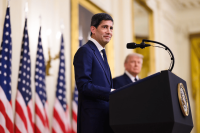
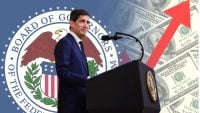
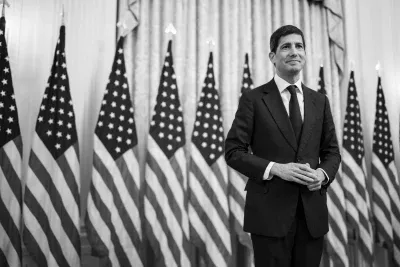
For investors, that matters because the Federal Reserve is no longer debating when to cut rates. The question has become when Kevin Warsh will raise them.
Energy Costs Are Keeping Inflation Alive
Home of the Brave’s Sticker Shock Summer campaign highlights gas prices roughly 36% above their pre-Iran-war level, electricity costs 18% higher, and a tariff burden that Yale Budget Lab estimates at roughly $1,100 per household under the group’s assumptions. The campaign’s current tracker puts gasoline at $4.06 a gallon, 38% above its Feb. 28 pre-war level.
The politics are debatable. The inflationary mechanics are less so.
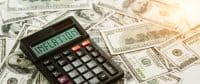
The Bureau of Labor Statistics reported that energy prices were still 15.7% higher year-over-year in June. Gasoline was 26.7% higher. Energy feeds into transportation, manufacturing, utilities, and eventually consumer prices.
That is why the Fed’s hoped-for pivot from “higher for longer” to rate cuts has disappeared. After three Fed officials voted for a quarter-point hike in July, the case for another increase was already on the table.
Betting Markets May Be Getting Ahead of Themselves
Then inflation delivered two friendlier reports. June CPI fell 0.4% month over month, while annual inflation dropped to 3.5% from 4.2% in May. July followed with a 0.1% monthly increase and 3.4% annual inflation. Core CPI fell to 2.5%.
That was enough to send September rate-hike bets tumbling. As recently as early August 1, markets were pricing roughly a 60% probability of a quarter-point September increase. After July’s CPI report, that probability crashed to 25% today, leaving a strong majority probability of no change.
But investors should remember what these markets actually measure: the price of a bet, not a guarantee. And three important inflation reports remain before the September FOMC meeting: July PCE on Aug. 26, followed by August PPI on Sept. 10 and August CPI on Sept. 11.
The Cleveland Federal Reserve’s Inflation Nowcasting model already sees July core PCE inflation running around 3.3% year-over-year, with monthly core PCE at 0.27%. That’s hardly a return to the Fed’s 2% target.
The Economy Isn’t Giving Warsh Much Reason To Wait
There is another problem for investors betting on a permanent pause: economic growth remains resilient.
The Institute for Supply Management’s manufacturing index jumped to 55.6 in July, its highest reading since May 2022 and its seventh consecutive month above 50, the dividing line between expansion and contraction. New orders and production also expanded.
Granted, the labor market is sending weaker signals, which gives Warsh a reason to move carefully. But a growing economy gives the Fed more room to tighten without immediately tipping the country into recession.
Key Takeaway
In short, investors shouldn’t treat today’s 25%-ish September hike probability as destiny. Energy prices remain elevated, core inflation is still well above 2%, manufacturing is expanding, and three more inflation reports are coming.
If CPI and PPI accelerate again, the market could quickly rediscover the rate-hike trade it abandoned this month. Smart investors should treat the market’s 75% odds of no change as a starting point, not a forecast, and position their portfolios accordingly before the next inflation surprise moves the odds again.
Contact [email protected] for any questions or corrections.
After two decades of patrolling the dark corners of suburbia as a police officer, Rich Duprey hung up his badge and gun to begin writing full time about stocks and investing. For the past 20 years, he’s been cruising the markets looking for companies to lock up as long-term holdings in a portfolio while writing extensively on the broad sectors of consumer goods, technology, and industrials. Because his experience isn’t from the typical financial analyst track, Rich is able to break down complex topics into understandable and useful action points for the average investor. His writings have appeared on The Motley Fool, InvestorPlace, Yahoo! Finance, Money Morning, and, of course, 24/7 Wall St. He has been featured in both U.S. and international publications, including MarketWatch, Financial Times, Forbes, Fast Company, and USA Today.