Broadcom Has Taken a Haircut Over 3 Months: One Analyst Expects 72% Returns From Here
Broadcom has quietly slipped while the rest of the AI chip complex surged, leaving it as the only major name trading at a steep discount to analyst consensus. The question now is whether that gap closes upward or the bears…

This post may contain links from our sponsors and affiliates, and Flywheel Publishing may receive compensation for actions taken through them.
Broadcom (NASDAQ:AVGO | AVGO Price Prediction) trades at $392.99, well below the Wall Street average analyst price target of $527.88, a gap of roughly 34%. The dominant custom silicon partner for hyperscale AI buildouts supplies Google TPUs, Meta MTIA accelerators, and Ethernet networking for AI clusters. Its most recent quarter posted AI semiconductor revenue of $10.8 billion, up 143% year over year, with management guiding the current quarter to $16 billion.
A Sharp Fade From the $494 Peak
Broadcom shed 8.13% in a single week, sliding from a 52-week high of $494.18 to $392.99. The three-month move sits at negative 6.43%.
The business remains solid. Q2 fiscal 2026 delivered revenue up 47.9% year over year and non-GAAP EPS of $2.44 against a $2.40 estimate, extending the streak to eight consecutive EPS beats. Investors are questioning whether triple-digit AI growth sustains into 2027 and whether hyperscaler capex remains durable. A broader wobble in AI-capex sentiment drove Reddit sentiment on Broadcom to its lowest reading of the year, a very bearish score of 12, and the stock got caught in that downdraft.
Why Sell-Side Analysts Remain Bullish
Coverage has essentially ignored the pullback. Roughly 92% of covering analysts remain bullish, with 7 Strong Buy and 37 Buy ratings against 4 Holds and zero Sells. The mean price target of $527.88 implies 34% upside. The Street-high sits at $675 from BNP Paribas Exane, worth roughly 72% upside from here.
The bull thesis rests on three pillars. First, custom AI ASIC dominance. Google TPU deployments, Meta MTIA acceleration, and expanded custom ASIC partnerships all lean on Broadcom’s design leadership. Q2 AI bookings hit $30 billion against $10.8 billion shipped, and management has guided fiscal 2026 AI revenue to roughly $56 billion, with fiscal 2027 targeted in excess of $100 billion. Second, AI networking. The Tomahawk 6 Ethernet switch platform already accounts for almost 40% of AI revenue at “very rich margins,” per CFO Kirsten Spears. Third, VMware. Infrastructure Software delivered $7.2 billion at a 79% operating margin as customers migrated to VCF 9.1 subscription pricing.
The AI Chip Cohort Has Split Two Ways
The AI chip complex has diverged sharply. NVIDIA and Marvell have rallied hard year to date, and AMD has more than doubled. Broadcom stands alone as the major AI silicon name trading at a meaningful discount to consensus.
NVIDIA (NASDAQ:NVDA) sits at $225.16, up 20.87% YTD. The average $302.83 target implies roughly 34% upside, essentially matching Broadcom’s mean, with 10 Strong Buy, 48 Buy, 2 Hold, and 1 Sell rating.
AMD (NASDAQ:AMD) trades at $514.39, up 140.19% YTD after landing OpenAI and Anthropic gigawatt deals. The $612.84 target implies about 19% upside. Ratings run 5 Strong Buy, 36 Buy, 10 Hold, 0 Sell.
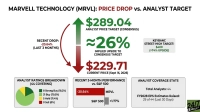
Marvell Technology (NASDAQ:MRVL) sits at $222.02, up 161.64% YTD on custom AI silicon momentum. The $257.29 target implies roughly 16% upside. Ratings run 8 Strong Buy, 30 Buy, 5 Hold, 0 Sell.
The largest analyst-implied upside in the group sits with Broadcom on both the mean and the Street-high. NVIDIA is comparable on the mean, while AMD and Marvell have already priced in most of theirs.
Where the Broadcom Numbers Land
Broadcom trades at $392.99 against a mean 12-month target of $527.88 across roughly 45 covering sell-side analysts, implying 34% upside. The Street-high $675 target from BNP Paribas Exane implies 72%. Ratings distribute as 7 Strong Buy, 37 Buy, 4 Hold, 0 Sell.
The stock is off 8.13% over the past week and 6.43% over three months, yet still up 13.97% YTD, essentially matching the S&P 500’s 13.85% year-to-date gain. Trailing PE runs 65 and forward PE runs 21. Q2 free cash flow reached $10.3 billion, or 46% of revenue. Management has cited demand visibility running into 2028.
What to Watch Next
The bull case rests on hyperscaler AI capex sustaining through 2027 and CEO Hock Tan’s guide to “semiconductor revenue from AI to grow over 200 percent year-over-year to $16.0 billion” in Q3. The path to the $527 mean target runs through the next earnings report validating that guide, the $30 billion AI backlog converting to shipments, and networking holding roughly 40% of AI mix. Deliver on all three, and BNP Paribas Exane’s $675 becomes plausible.
The bear case builds if the AI-capex sustainability narrative develops real teeth. Broadcom carries genuine hyperscaler concentration risk across six named core customers. If even one meaningfully pulls back TPU or MTIA orders, the forward 21x multiple compresses quickly.
Given eight consecutive earnings beats, backlog visibility into 2028, and a 34% mean target upside that widens to 72% at the Street-high, the setup leans cautiously bullish. The bear case is real, but it lives at the macro AI-capex level rather than inside Broadcom itself.
Contact [email protected] for any questions or corrections.
Alex Sirois is a financial writer with experience spanning both retail and institutional investing. He has written for InvestorPlace and held roles at BNY Mellon and Bernstein, giving him a perspective that bridges Main Street portfolios and Wall Street analysis.
Alex holds an MBA from George Washington University and has built his career across multiple industries, including e-commerce, education, and translation — a breadth of experience that informs how he breaks down complex financial topics for everyday investors. His writing is conversational, actionable, and grounded in long-term, buy-and-hold investing principles.
At 247 Wall St., Alex focuses on delivering analysis that is both accessible and useful, with a clear emphasis on helping readers make more informed decisions with their money.