Jim Cramer Says One Group of Stocks is ‘So Hated’ Right Now. Is it Time to Buy?
Jim Cramer called packaged food stocks 'so hated' right now, but the data behind the sentiment tells a more complicated story that could catch contrarian buyers off guard.


CNBC’s Jim Cramer, host of Mad Money, posted on X on Monday, “Hard to believe the drug stocks are so out of sync with food stocks. Food so hated”. The comment captures a mood building for months as packaged food shares have trailed pharmaceuticals by a wide margin.
The question for investors is whether that sentiment gap is an opportunity or a trap. A real dislocation opened over the past year between the two groups, much tied to fears around GLP-1 weight-loss drugs, but the 2026 picture is more mixed than a blanket “food so hated” label suggests.
Where Cramer Is Right
The one-year gap between drugs and food is stark. Eli Lilly (NYSE:LLY | LLY Price Prediction) stock is up 74% over the past year, while several food names sit well in the red. Campbell’s (NASDAQ:CPB) stock is down 24% over the past year, General Mills (NYSE:GIS) stock is down 16% over the past year, and Conagra Brands (NYSE:CAG) stock is down 13% over the past year.
Meanwhile, Ingredion (NYSE:INGR) stock is down 14% over the past year. That divergence between a mega-cap drug winner and beaten packaged food shares is exactly what Cramer is flagging.
Where the Blanket Label Breaks Down
Moving on to some familiar names, Kraft Heinz (NASDAQ:KHC) stock is down 2% over the past year but up 9% year to date, making one of the most-criticized names a year-to-date gainer. Hershey (NYSE:HSY) stock is up 6% over the past year and up 4% year to date, never fitting the hated framing. The company posted five consecutive quarters of EPS beats and management raised full-year guidance.
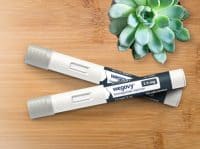
Novo Nordisk (NYSE:NVO) stock is down 6% over the past year and down 7% year to date, even as it sells Ozempic and Wegovy. Only Eli Lilly carries the drug side. “Drug stocks up, food stocks down” is too broad in both directions.
The Dislocation Is Already Closing
Ingredion stock is down 2% year to date, a much smaller decline than its one-year figure. Conagra Brands stock is down 5% year to date, also smaller than its trailing twelve-month move. The pattern suggests most damage happened earlier and buyers have stepped in ahead of Cramer’s post; for anyone reading his comment as a fresh entry signal, the easiest repricing may already be behind the group.
Looking through the lens of a couple of benchmark funds, the iShares U.S. Pharmaceuticals ETF (NYSEARCA:IHE) is up 51% over the past year and up 22% year to date. The Invesco Food & Beverage ETF (NYSEARCA:PBJ) is up 3% over the past year and up 8% year to date. Positive returns over both windows sit oddly against the “so hated” label, since a diversified food and beverage basket has held up better than the worst individual names.
The GLP-1 Overhang
The dominant headwind for packaged food is GLP-1 weight-loss drugs, including Eli Lilly’s Mounjaro and Zepbound and Novo Nordisk’s Ozempic and Wegovy. Lilly reported combined Mounjaro and Zepbound revenue of $14.9 billion in Q2 2026, with obesity utilization still in single to mid-single digits globally.
The market is pricing a long-duration demand risk on processed food, not a demonstrated sales collapse. On Mad Money on June 17, an executive discussing the pending Ingredion and Tate & Lyle merger stated: “Look, the whole food sector I think has had a little bit of a cloud hanging over at GLP1, drugs, etc. We’ve had a couple of tough quarters related to one issue at one of our manufacturing facilities.”
Ingredion has a pending all-cash acquisition of Tate & Lyle at 595 pence per share, approved by Tate & Lyle shareholders on July 28. Private-label pressure, weak volume growth, and heavy debt at some names also predate the drug narrative. Conagra cut its quarterly dividend from $0.35 to $0.175, a reminder that some of these stocks are cheap for reasons the chart alone won’t reveal.
Is It Time to Buy?
Cramer identified a real sentiment extreme, and sentiment extremes in defensive sectors have historically been where contrarian value appears. Yet the data argues against treating “food is hated” as a green light in 2026, because the group is no longer uniformly beaten down, recovery in several names has begun, and the GLP-1 risk is a genuine long-term unknown.
Investors should consider keeping their position sizes modest in any name where the bull case rests mainly on sentiment reversing. Kraft Heinz and Hershey are challenging cases for anyone shopping the theme, since the two names that have already worked are the ones a contrarian screen would most likely skip.
Moreover, traders can watch for whether volume trends at packaged food companies show a measurable GLP-1 effect rather than a narrative one, and whether the year-to-date recovery in the weakest names extends or stalls. They can also check for whether Novo Nordisk begins participating on the drug side, and whether the Ingredion and Tate & Lyle combination closes as expected.
Contact [email protected] for any questions or corrections.
David Moadel is financial writer specializing in stocks, ETFs, options, precious metals, and Bitcoin. David has written well over 1,000 articles for leading online publications, helping investors understand markets, income strategies, and risk.His work has appeared in The Motley Fool, InvestorPlace, U.S. News & World Report, TipRanks, ValueWalk, Benzinga, Market Realist, TalkMarkets, Finmasters, 24/7 Wall St., and others.With a master’s degree in education, David has taught at the elementary, high school, and college levels. That teaching background shapes his writing style: clear, educational, and practical. David has also built a loyal social-media audience by providing trustworthy financial content on YouTube, X/Twitter, and StockTwits.