5 Stocks Set to Cash in on The Next 90-Million Customer Industry. (It’s Not AI)
Wells Fargo’s chief agriculture economist Dr. Michael Swanson told Bloomberg Businessweek on May 29 that GLP-1 weight-loss drugs (Ozempic, Wegovy, Mounjaro, Zepbound) will eventually match statins at roughly 90 million prescriptions, calling the trend “here to stay” because it’s prescribed,…


Wells Fargo’s chief agriculture economist Dr. Michael Swanson told Bloomberg Businessweek on May 29 that GLP-1 weight-loss drugs (Ozempic, Wegovy, Mounjaro, Zepbound) will eventually match statins at roughly 90 million prescriptions, calling the trend “here to stay” because it’s prescribed, not faddish. So this is the next 90-million-customer industry, sitting in plain sight while everyone else stares at AI. It’s the protein-centric food economy being rewired around appetite-suppressed patients who need 90 to 120 grams of protein a day in small volumes.
I’ve been reading every GLP-1 supply-chain report I can find for the better part of two years now, and the five tickers below are where the second-order money is moving while everyone else stares at chatbots.
1. BellRing Brands: The Surprise Pick Hiding in Plain Sight
Start with the most unloved name on this list. BellRing Brands (NYSE:BRBR | BRBR Price Prediction) owns Premier Protein, the ready-to-drink shake whose product spec (high protein, low volume, easy on a suppressed appetite) maps almost one-to-one onto what a GLP-1 patient is told to consume. The stock has been crushed on a tariff-driven margin miss, which is exactly why the setup is interesting: the demand side of the thesis is still intact while the price has been gutted.
The Q2 FY2026 report explains both halves of the trade. Premier Protein RTD volume grew 11.7%, household penetration climbed to 21.3%, and total distribution points hit an all-time high with 29% YoY growth. Yet EPS came in at $0.14 versus $0.3132 consensus, gross margin collapsed from 32.3% to 27.0%, and management took an $11.3 million inventory charge on a failed third-party ingredient. Shares are down 69% year-to-date.
Here’s the tell: on March 31, eight directors bought common stock equivalents on the same day at $16.09/share, and Director David Finkelstein went back in on May 13 for 4,000 shares at $9.235. Volume-driven brands with insiders buying the dip don’t stay this beat-up forever. Which brings us to the company that actually creates BRBR’s customers.
2. Eli Lilly: The Engine of the 90-Million Forecast
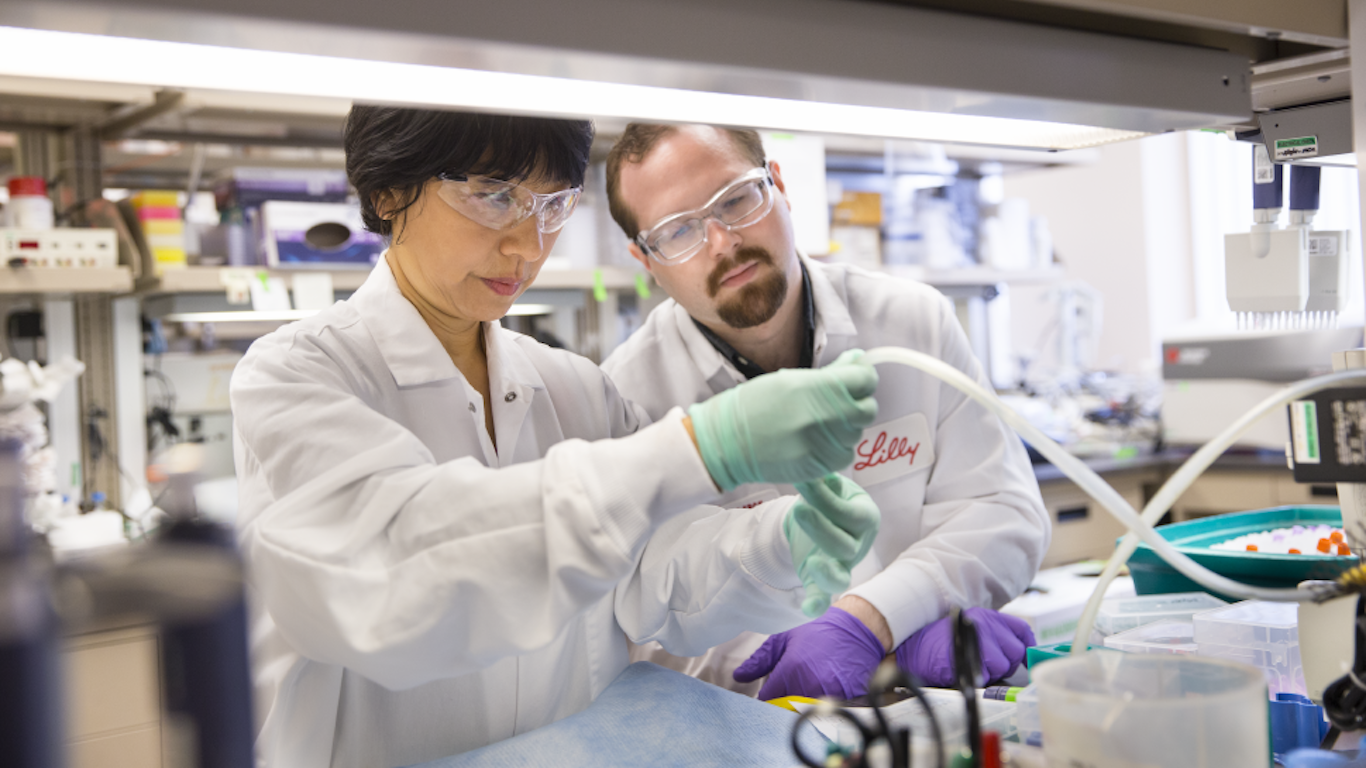
Eli Lilly (NYSE:LLY) is the company actually manufacturing Swanson’s forecast. Mounjaro and Zepbound are the prescription pads driving the appetite suppression that creates the demand BellRing is feeding. And in May, the FDA approved Foundayo (orforglipron), the only approved GLP-1 pill that can be taken any time of day, without food and water restrictions, which is the bridge from injection-only to statin-style scale.
Q1 FY2026 was the kind of quarter that justifies a near-trillion-dollar market cap. Mounjaro revenue hit $8.66 billion, up 125% YoY. Zepbound U.S. revenue grew 80% to $4.16 billion. Total company revenue jumped 55.5% and management raised the full-year revenue outlook to $82.0 to $85.0 billion. CEO David Ricks said “Foundayo will meaningfully expand the number of people who can benefit from GLP-1s.” That’s a CEO telling you the prescription pool is about to balloon.
The stock is up 30% over the past month and 54% over the past year, trading at a P/E of 39. Buy Lilly IF you believe the pill version pulls GLP-1 use toward Swanson’s 90-million ceiling. The inverse: if oral compliance disappoints, the multiple compresses. There is, however, a second drug company that could collect a check on the same megatrend.
3. Novo Nordisk: The Co-Heavyweight With the Oral Wedge
Novo Nordisk (NYSE:NVO ADR) is the other half of the duopoly. Ozempic, Wegovy, Rybelsus, and as of January 2026 the Wegovy oral pill, plus Wegovy HD launched April 7 with nearly 21% weight loss in trials. NVO has lagged hard, but on a prescription-volume thesis, ignoring it is a mistake.
Q1 FY2026 shows why the stock has stayed in the doghouse and why the demand is still real. Wegovy total franchise hit $18.24 billion, up 12%, while Ozempic fell 8% to $27.83 billion on pricing. The Wegovy oral pill posted $2.26 billion in Q1 sales with over 2 million prescriptions since launch. The wrinkle: a Most-Favored-Nation pricing agreement forces Wegovy and Ozempic U.S. list-price cuts of 50% and 35% in January 2027.
Shares are down 31% over the last year but up 13% over the past month, trading at a P/E of 11 with analyst targets averaging $46.90. Cheap optionality on the same 90-million-prescription wave. Which is also where the food half of the table starts to matter, because every one of those scripts puts pressure on the same dinner plate.
4. Tyson Foods: The Beef-to-Chicken Trade-Down Trade
Swanson explicitly named the protein rotation: consumers trading down from beef to chicken and pork, with Texas brisket prices up 28% over the past year. Tyson Foods (NYSE:TSN) is the single largest publicly traded pure-play on that rotation. Their chicken and prepared foods segments are exactly where a GLP-1 patient who used to splurge on ribeye now lands.
Q2 FY2026 confirms which engine is pulling the train. The Chicken segment delivered $4.286 billion in revenue at a 12.2% adjusted operating margin, and the segment has now posted five consecutive quarters of YoY volume growth. Beef, meanwhile, lost $202 million, and management guides FY2026 Chicken income to $1.9 to $2.05 billion. CEO Donnie King said “protein demand continues to increase, our consistent share gains demonstrate we are well-positioned to capture this momentum.”
USDA projects FY2026 chicken production up about 2%, beef down about 2%, pork up about 2%. Tyson is overweight the protein the consumer is rotating into and the protein the supply chain is producing more of. The stock is up 5% YTD. Decent, but the cleanest punchline on this list is still ahead.
5. Hormel: The Punchline Hiding on the Center Aisle
Here’s the payoff. Hormel Foods (NYSE:HRL) owns Spam, Skippy, Jennie-O turkey, Applegate, Hormel Black Label bacon, Columbus deli, and Planters. Every brand on that list is shelf-stable, protein-dense, and labeled with a grams-of-protein callout. The protein-labeling shift Swanson described as “food packaging across every category prominently featuring protein content” is happening on shelves Hormel already owns. The market is treating this like a tired dividend stock. It’s actually the most accidentally well-positioned brand house in U.S. packaged food.
Q2 FY2026 made the case quietly. Foodservice revenue grew 6.4%, marking the 11th consecutive quarter of organic net sales growth, with adjusted EPS of $0.40 beating $0.3544 consensus and adjusted operating margin expanding to 9.9% from 9.1%. Management is actively pruning low-margin volume, having divested the whole-bird turkey business and sold 51% of Justin’s to concentrate on value-added protein. On March 31, five directors bought stock on the same day at $22.65/share, including the Chairman.
The stock is up 11% over the past month, 9% over the past week, and the company has now strung together 60 consecutive years of dividend increases. Boring is the feature.
The Thread
Lilly and Novo write the prescriptions. BellRing fills the shake. Tyson fills the plate. Hormel fills the pantry. If Swanson’s call holds and GLP-1 use scales toward statin-level volumes, every link in that chain reprices off the same demand curve, and four of these five names still trade like the market hasn’t connected them. The headline industry of 2026 was always going to be AI. The quieter one, the one with 90 million customers walking into the pharmacy with a printed script, is already restructuring the food aisle while nobody is looking.
Contact [email protected] for any questions or corrections.
I've been writing about stocks and personal finance for 20+ years. I believe all great companies are tech companies in the long run, and I invest accordingly.