If You Own SCHD for a 10-Year Hold, This Dividend Growth ETF Deserves a Look
SCHD has been the go-to dividend ETF for income investors, but a decade of side-by-side data against its closest rival reveals a gap that could reshape how you think about building a retirement portfolio.

This post may contain links from our sponsors and affiliates, and Flywheel Publishing may receive compensation for actions taken through them.
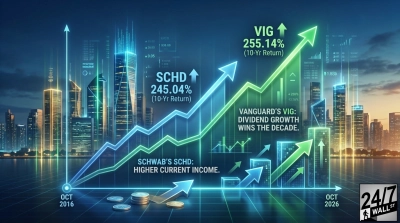
The Schwab U.S. Dividend Equity ETF (NYSEARCA:SCHD) has become a default holding for retail income investors. People buy SCHD because it leans toward higher current income from established dividend payers, and that gives them cash flow they can count on. Over a full decade, though, SCHD has trailed the Vanguard Dividend Appreciation ETF (NYSEARCA:VIG), which puts dividend growth ahead of current income. Vanguard holds the edge over the full period. That said, the Schwab fund has outperformed over the past year.
Starting from the same date, October 14, 2016, VIG returned 255.14%, and SCHD returned 245.04% through October 15, 2026. That puts Vanguard ahead by 10.1 points. A $100,000 position grew to $355,140 in VIG and $345,040 in SCHD. Since the periods begin on the same day, this is a like-for-like comparison.
Every Figure Here Assumes Reinvested Dividends
Each return in this article assumes that every distribution went back into the fund. These results don’t apply to anyone who took dividends as cash and spent them. That includes many SCHD holders, who own the fund for exactly that cash. If you spend your distributions, read these figures as a measure of how each fund compounds with full reinvestment. Your own path likely looked different.
Five-Year Results Point the Same Direction
The more recent half of the decade backs up the ten-year result. Since October 15, 2021, VIG has returned 65.61%, and SCHD has returned 58.98%, a gap of 6.63 points in Vanguard’s favor. VIG’s edge therefore held through both the early years of the window and the last five years.
SCHD Has Dominated the Past 12 Months
The past year changes the picture, and the reversal is significant. Over one year, SCHD returned 31.42%, and VIG returned 13.83%. Schwab led by 17.59 points. The year-to-date results look much the same: SCHD is up 27.45% against VIG’s 11.57%, a lead of 15.88 points.
SCHD’s one-year lead of 17.59 points is larger than VIG’s ten-year lead of 10.1 points. Anyone who bought SCHD a year ago has done far better than someone who bought VIG on the same day. Why this happened, and whether the trend will continue or reverse, remains unclear. Anyone thinking about a switch should treat both questions as unresolved.
Past Month Tilted Back Toward Vanguard
Over the past month, VIG returned 1.94%, and SCHD returned 0.15%. One month is too short to show a trend, so it should carry little weight in a long-term decision. Delayed quotes from October 15, 2026 showed SCHD at $34.12 and VIG at $242.26. The gap in share prices has no impact on returns. Fractional shares and dollar-based orders let you buy either fund in any amount.
Income Today or a Larger Balance Later
These funds aim at different things. VIG focuses on companies that grow their dividends, which usually means taking a lower payout today in exchange for growth. SCHD tends toward higher current income. A retiree who pays bills from distributions and a 35-year-old who reinvests every dollar want different things, and the ten-year result doesn’t decide the right fund for either of them.
How you switch matters as much as whether you switch. In an IRA or 401(k), selling SCHD and buying VIG doesn’t trigger a tax bill. With a taxable account, selling SCHD for more than you paid creates capital gains, and that tax can wipe out a 10-point edge built up over ten years. Taxable investors can avoid that by keeping their existing SCHD shares and sending new contributions and reinvested dividends to VIG. This changes the mix over time without selling anything.
Who Gains From the Swap and Who Doesn’t
For investors with a horizon of ten years or more, who reinvest everything (especially in accounts that shelter them from taxes), VIG has the better long-run record. It has led over both ten and five years, though its recent 12 months have been weaker. For investors who rely on distributions for spending now, or who would owe large capital gains taxes to sell, SCHD’s focus on current income lines up more closely with those goals. The past year shows how far it can pull ahead when conditions favor it. A change in the five-year gap or in your own need for income is the signal to revisit the choice.
Contact [email protected] for any questions or corrections.
Ryne Mauck is an investment writer covering exchange-traded funds, retirement planning, and portfolio strategy. Through his work at 24/7 Wall St. and other investment platforms, including Seeking Alpha, he aims to provide clear, research-driven insights that help investors make more informed decisions while maintaining a long-term approach to investing.
Ryne holds a B.Sc. in Finance and an M.A. in Political Science. He is a formerly registered Municipal Advisor Representative and has passed the Series 50, Series 63, and Series 65 exams. His articles are not intended to be, nor should they be interpreted as, financial advice.