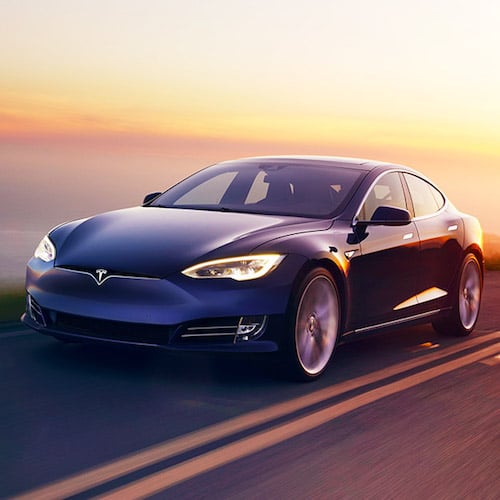
Tesla Batters Rivian in Self-Driving Test
A major TV network put Tesla's FSD head-to-head against Rivian's new Autonomy+ system on real roads, and the gap between them revealed something unsettling about where the entire self-driving industry actually stands.


CNBC matched Tesla’s (NASDAQ: TSLA | TSLA Price Prediction) FSD (Supervised) against Rivian’s (NASDAQ: RIVN) Autonomy+. The analysis also measured other “AI” self-driving systems. The Tesla product bested these. But the primary head-to-head comparison was between Tesla and Rivian.
Rivian has counted on Autonomy+ to boost sales in a very difficult US EV market.
Rivian offers its system for a free trial, after which owners can then pay $49.99 a month or “own” it for $2,500. It drives hands-free if there are painted or dotted lines on the road. That alone is a major drawback. To change lanes, the driver has to turn on the blinker. According to the Rivian website, two important features are available now. These are automatic parking and an “on-ramp to off-ramp” service. (I own a Subaru; the balance of the features are about the same as what I have.)
Looking over all the Rivian features, CNBC wrote, “But it’s still playing catch-up to Tesla’s FSD when it comes to non-highway driving and point-to-point driving, where a vehicle is designed to navigate itself from start to finish.” Tesla’s product costs $99 a month.
Tesla leads for several reasons, but most importantly, it operates well in the dark and on unmarked roads. (One of my sons has the latest features on his Tesla, and the operation is seamless on the 50 miles of back roads between his house and mine.) The CNBC reviewer wrote, “During my drives in the Model Y, the vehicle was essentially controlling itself for multiple hours and dozens of miles without intervention on highway and non-highway roads.”
What do the test results mean? While Tesla leads the industry, none of these products has been approved for driving without drivers paying attention. This may mean full approval will take years. That means no matter how good the Tesla is, the driver does not have true independence. Teslas have been involved in several visible accidents that have been widely covered in the press. This has hurt its image and reminded people that supervision is still needed.
Some evidence suggests that the only vehicles that have made the full self-driving transition are in China. Tesla, Rivian, and the other companies that sell cars in the US are lucky. Those Chinese cars are kept out of the US because of tariffs.
Contact [email protected] for any questions or corrections.
Douglas A. McIntyre is the co-founder, chief executive officer and editor in chief of 24/7 Wall St. and 24/7 Tempo. He has held these jobs since 2006.
McIntyre has written thousands of articles for 24/7 Wall St. He is an expert on corporate finance, the automotive industry, media companies and international finance. He has edited articles on national demographics, sports, personal income and travel.
His work has been quoted or mentioned in The New York Times, The Wall Street Journal, Los Angeles Times, The Washington Post, NBC News, Time, The New Yorker, HuffPost USA Today, Business Insider, Yahoo, AOL, MarketWatch, The Atlantic, Bloomberg, New York Post, Chicago Tribune, Forbes, The Guardian and many other major publications. McIntyre has been a guest on CNBC, the BBC and television and radio stations across the country.
A magna cum laude graduate of Harvard College, McIntyre also was president of The Harvard Advocate. Founded in 1866, the Advocate is the oldest college publication in the United States.
TheStreet.com, Comps.com and Edgar Online are some of the public companies for which McIntyre served on the board of directors. He was a Vicinity Corporation board member when the company was sold to Microsoft in 2002. He served on the audit committees of some of these companies.
McIntyre has been the CEO of FutureSource, a provider of trading terminals and news to commodities and futures traders. He was president of Switchboard, the online phone directory company. He served as chairman and CEO of On2 Technologies, the video compression company that provided video compression software for Adobe’s Flash. Google bought On2 in 2009.