Chevron vs. Exxon Mobil: The Better Energy Stock for the Next 5 Years
Exxon and Chevron just reported the same quarter with two completely different bets on where energy profits come from next. One is selling electrons to Microsoft for the next 20 years while the other doubles down on molecules, and only…

Exxon Mobil (NYSE:XOM | XOM Price Prediction) and Chevron (NYSE:CVX) both reported second quarter results on July 31, 2026, and the two supermajors are steering through the same tight oil market with very different playbooks.
Exxon leaned on Guyana, the Permian, and integrated refining. Chevron leaned on a freshly digested Hess deal and a new bet on powering AI data centers.
Guyana Cash Machine Meets a Hess-Powered Chevron
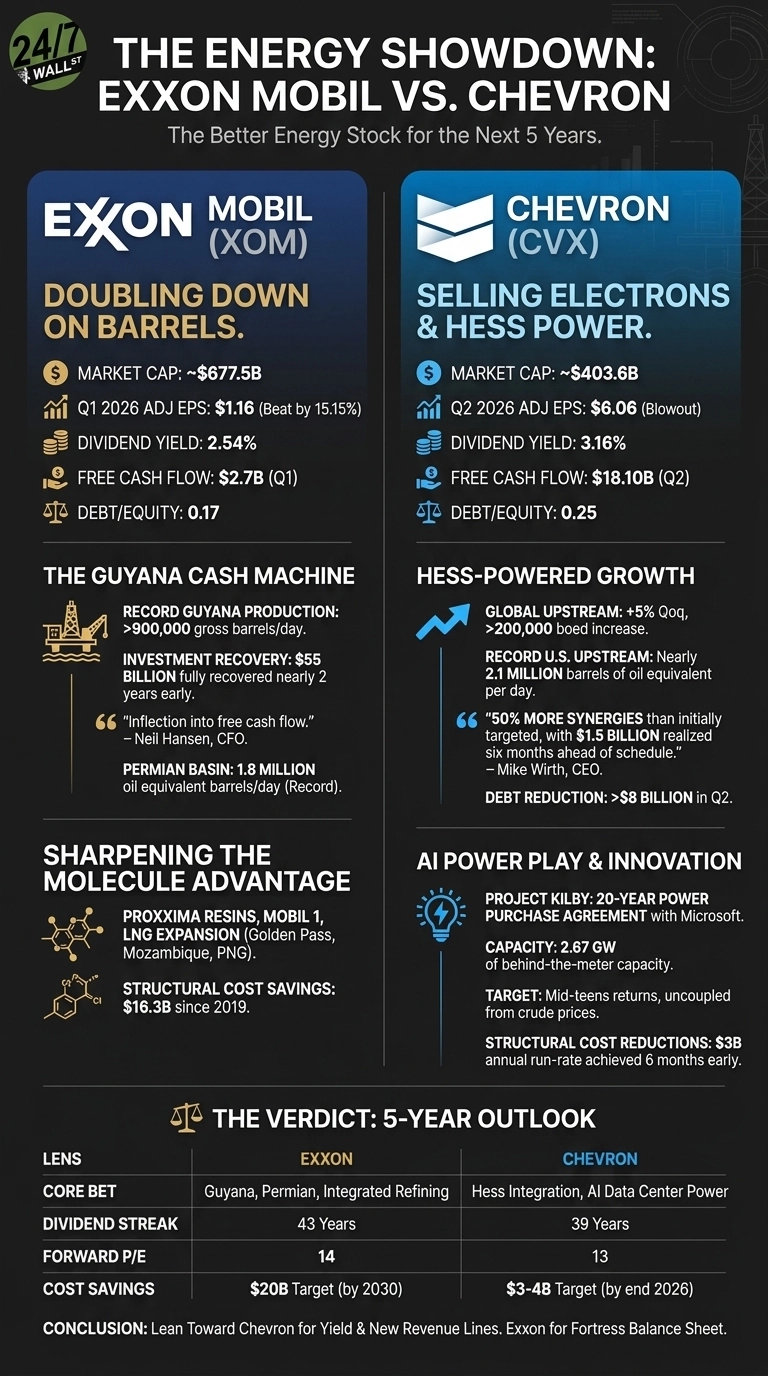
Exxon delivered $14.5 billion in quarterly earnings and $23.6 billion in operating cash flow even after losing roughly 10% of upstream production to disruptions.
Guyana hit 900,000 gross barrels per day, and the company said it has fully recovered its $55 billion of investment there, tipping the asset into what CFO Neil Hansen called an “inflection into free cash flow.” The Permian set another record at 1.8 million oil equivalent barrels per day, powered by 83 four-mile wells drilled year to date.

Chevron told a different story: scale bought and quickly monetized. Global upstream grew more than 5% quarter over quarter, U.S. upstream hit a record nearly 2.1 million barrels of oil equivalent per day, and adjusted free cash flow reached $15.4 billion.
CEO Mike Wirth said the Hess integration captured “50% more synergies than initially targeted, with $1.5 billion realized six months ahead of schedule.” Debt fell by more than $8 billion in the quarter.

One Doubles Down on Barrels. One Sells Electrons.
| Lens | Exxon | Chevron |
| Core bet | Guyana, Permian, LNG, chemicals | Hess integration, AI data center power |
| Cost program | $16.3B saved since 2019 | $3B run-rate, hit six months early |
| Dividend yield | 2.53% | 3.44% |
| Forward P/E | 14 | 13 |
Chevron’s most eye-catching move is Project Kilby, a 20-year take-or-pay power purchase agreement with Microsoft (NASDAQ:MSFT) for 2.67 gigawatts of behind-the-meter capacity, targeting mid-teens returns uncoupled from crude prices. It is a reminder that the AI buildout runs on power as much as silicon, and we pulled together seven non-chipmaker suppliers riding that same wave in a free report here.

Exxon is going the opposite direction, sharpening its molecule advantage through Proxxima resins, Mobil 1, and expanded LNG at Golden Pass, Mozambique, and Papua New Guinea.

Next Test: Guyana Cash and Kilby Returns
I will be watching whether Exxon’s Guyana free cash flow really doubles by 2030 versus 2025, as management promised. That is the linchpin of the buyback story behind the $20 billion repurchase plan.
For Chevron, the tell will be Project Kilby’s final investment decision later this year and whether Iraq’s West Qurna II converts into competitive terms. CPC pipeline exposure and OPEC+ discipline sit uncomfortably in the background of both stories.
Why I Lean Toward Chevron for the Next Five Years
Both stocks have run hard. XOM is up 57.79% over the past year; CVX is up 40.68%. If you want the fortress balance sheet, a 43-year dividend streak, and the deepest well of long-cycle projects, Exxon is the cleaner choice. Its integrated chemical and specialty margins give it ballast that Chevron simply cannot match today.

Personally, I lean toward Chevron for the next five years. The Hess synergies are landing faster than promised, the Microsoft power deal opens a genuinely new revenue line, and the 3.44% yield pays me to wait.
My view flips if Brent collapses back below $70 and Kilby slips, because Chevron carries higher post-Hess leverage. CVX fits a yield-focused profile; XOM fits investors prioritizing the sturdier compounder.

Contact [email protected] for any questions or corrections.
Vandita Jadeja is a financial publisher with over a decade of experience writing about financial topics, including investment, savings, retirement, insurance and banking. Vandita is a Chartered Accountant who loves to debunk financial concepts for readers.
Her work has appeared on sites that include The Motley Fool, InvestorPlace, and Benzinga. She covers investing and focuses on stock picks and price prediction for 24/7 Wall St.
When not looking for the next stock investment opportunity, she can be found traveling, reading, chasing sunsets and enjoying her iced latte.