AI Is Now Attacking at Machine Speed, and This CEO Says That Changes the Case for Cybersecurity Stocks
A top global tech CEO just declared that machine-speed attacks have made human-speed defense obsolete, and that single claim reshuffles which cybersecurity vendors survive the AI era and which ones quietly become irrelevant.


The most useful thing said about cybersecurity this week came from Abhijit Dubey, the global CEO of NTT DATA, who told CNBC that “the frontier AI effectively has changed the cybersecurity equation” because attacks are now exponentially more sophisticated, the surface area has grown, and everything is happening at machine speed. His conclusion follows directly: “when you have attacks that are operating on machine speed, you cannot have defense. That is human speed.”
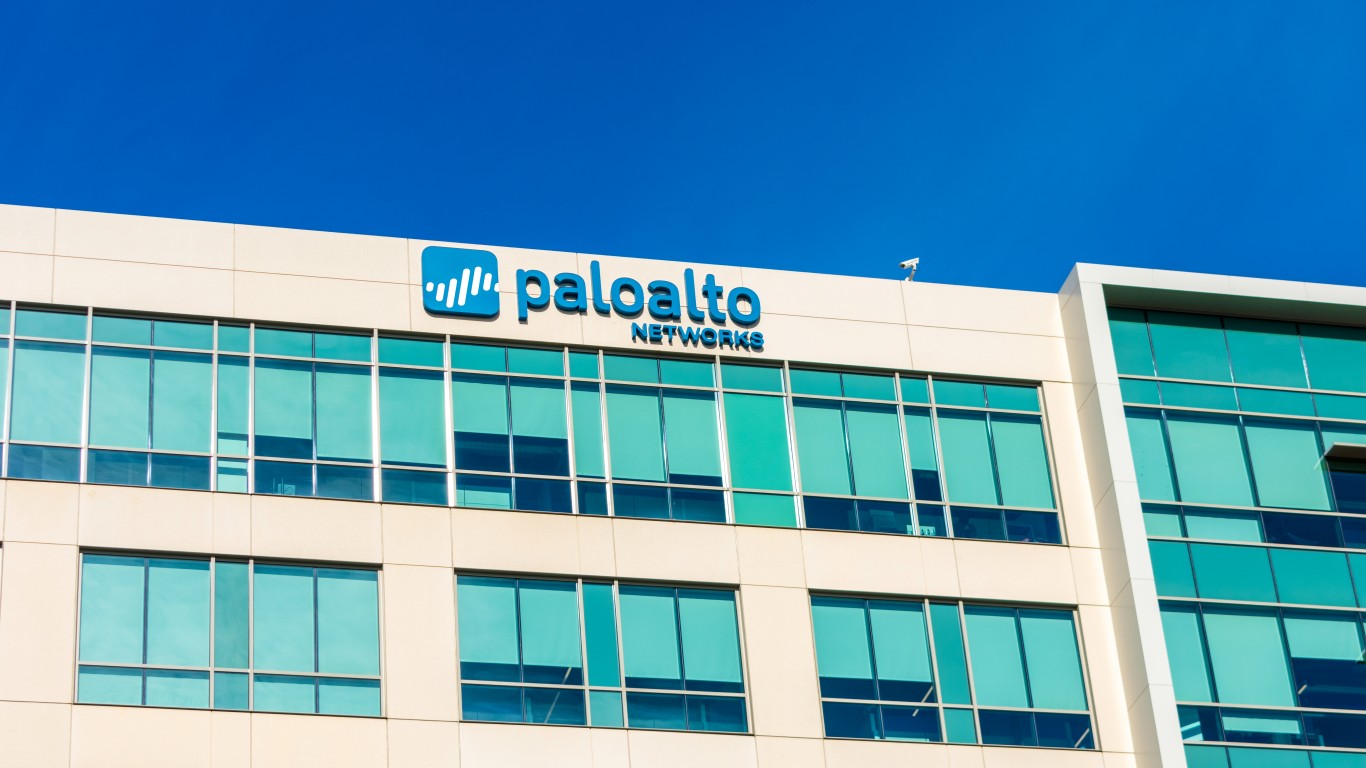
Dubey announced an expanded partnership with Palo Alto Networks (NASDAQ:PANW | PANW Price Prediction) covering both AI for security and security for AI.
The interesting question for investors is which US-listed vendors are positioned for the shift he describes. The money is quietly moving toward whoever can govern autonomous agents, and away from whoever built a business selling vulnerability detection and patching. That reframes the sector from a cost center to a prerequisite for AI adoption.
Why Detection And Patching Is the Losing Side
Dubey put the legacy problem this way: “Most cybersecurity postures and enterprises effectively are vulnerability detection oriented” at a moment when attackers are exploitation-driven. Nikesh Arora made the same point on PANW’s June earnings call, saying that frontier models can weaponize a vulnerability “in mere minutes,” whereas it used to take months.
Jay Chaudhry at Zscaler told investors that “you will never be done patching” and that hiding applications and eliminating lateral movement matters more than trying to close every hole. That is the same argument, phrased architecturally.
Vendors whose growth came from selling scanners, dashboards, and remediation queues find themselves in an awkward spot. Their pitch assumes a human has time to look at the alert. The vendors positioned for what comes next sell in-line enforcement, identity, and platform-level context.
Palo Alto Networks Is the Named Partner for a Reason
PANW’s most recent quarter had revenue of $3 billion, up 31% year over year, and Next-Generation Security ARR reaching $8.13 billion, up 60%, disclosed in the company’s Q3 FY26 8-K. Arora described a Prisma AIRS deal with a global consulting customer running more than 2 trillion tokens per month on the platform.
PANW trades at a forward P/E of 91x with the stock up 89.77% year to date through August 20. That is not a cheap valuation, and platformization stories have disappointed on margin before.
What PANW has that most rivals do not is IDERA, its identity platform stitched together with the CyberArk acquisition, aimed at what Arora called the “primary attack vector of the future”: agentic identities. That is the layer Dubey said matters.
The risk is straightforward. Stock-based compensation was 17% of revenue in the quarter, and integrating CyberArk without hurting growth remains a priority.
Identity Is What the Market Has Not Priced
Todd McKinnon at Okta framed the customer problem cleanly in May, saying “91% of enterprises deploy AI agents, but only 22% have a way to identify them.” That gap is the entire investable idea.
Okta (NASDAQ:OKTA) trades at a forward P/E of 38x, a meaningful discount to PANW because growth is slower, with FY27 revenue guided to 9-10%. McKinnon said Okta’s pipeline for AI agent products was “bigger than anything we’ve ever seen”, and neutrality across hyperscalers is real leverage for a customer choosing an identity control plane.
CrowdStrike (NASDAQ:CRWD) has taken the endpoint franchise into agent governance through AIDR, with ARR reportedly growing “more than 250% sequentially” off a small base. George Kurtz argued that AIDR could exceed EDR in size because every agent needs a host and an identity. The identity layer has a shorter path to becoming non-optional than the platform layer, because agent identity is essential to governance.
Caveats Worth Weighing
Zscaler (NASDAQ:ZS) is the interesting counter-case, down 22.22% year to date despite ARR reaching $3.5 billion. Its Symmetry Systems acquisition bets on the access-graph problem rather than issuing agent identity itself, which is defensible.
Fortinet (NASDAQ:FTNT) benefits from a firewall refresh cycle with product revenue up 52% last quarter. That is a real cash-generating business, but closer to infrastructure than to agent governance.
Platform consolidation has been sold to investors before, and margin expansion has been uneven. This cycle differs because Dubey’s framing removes the buyer’s option to wait. His line makes the point: “You have to do it securely from the beginning.” A customer who wants the AI cannot defer the security purchase, which is the first time in a while that has been true.
Contact [email protected] for any questions or corrections.
Omor Ibne Ehsan is a writer at 24/7 Wall St. He is a self-taught investor with a focus on growth, cyclical, and dividend equities that have strong fundamentals, value, and long-term potential. He also has an interest in high-risk, high-reward investments such as penny stocks.