Oracle Sits Far Below Wall Street’s Target. Here’s What Gets It There.
Oracle trades nearly $100 below Wall Street's consensus target, yet the forces that crushed the stock over the past year have not touched its hyperscaler peers. Whether that gap is a value opportunity or a value trap hinges on a…

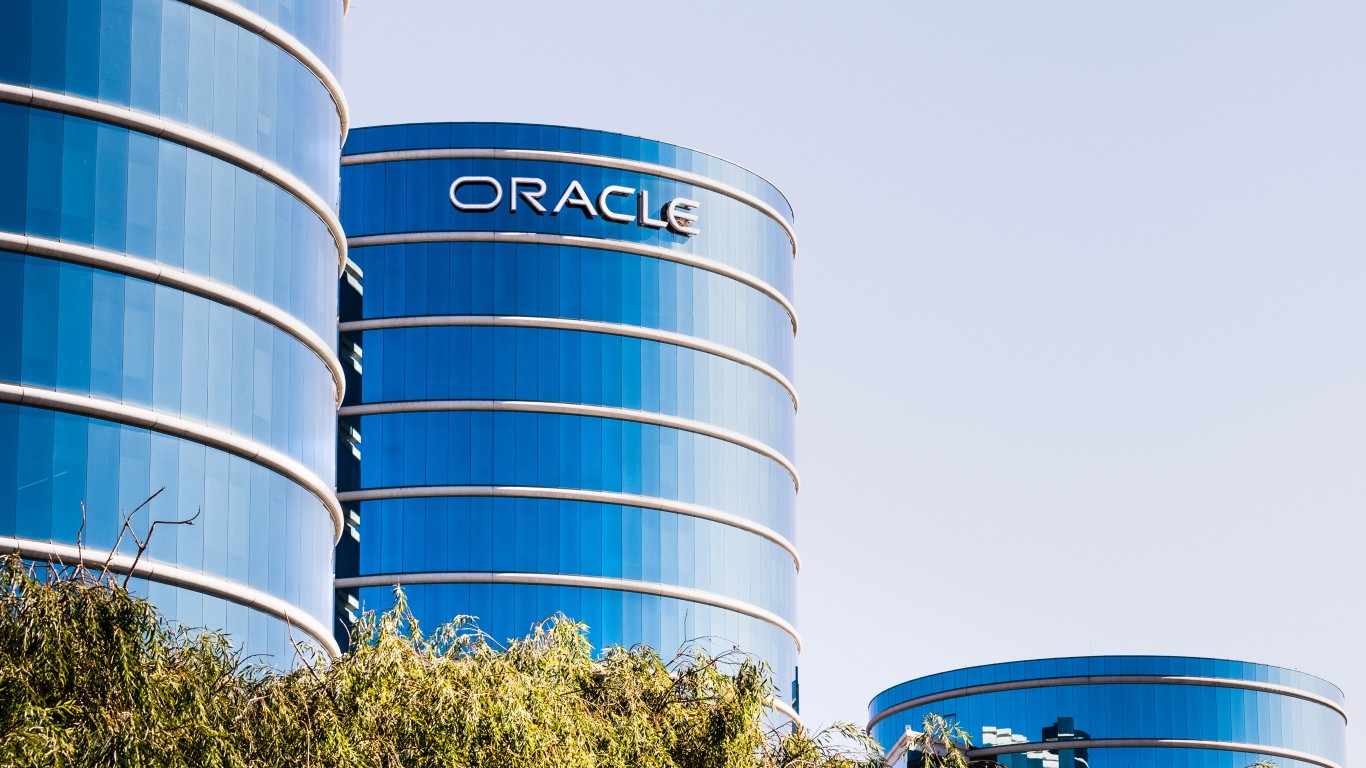
Oracle (NYSE:ORCL | ORCL Price Prediction) currently trades at $142.07, while the Wall Street consensus target is $246.43. That is a wide dislocation for a company with a market cap north of $409 billion, and it did not happen by accident.
Oracle has spent two years converting itself from a legacy database vendor into a hyperscale AI infrastructure operator. Cloud now accounts for 52% of quarterly sales, and cloud infrastructure alone grew 93% in the most recent quarter. Wall Street still likes the pivot. The market is less sure.
Cash Burn and a Customer Rumor Blew a Hole in the Stock
Oracle is down 39.6% over the trailing year and 27.1% year to date, crossing the 30% threshold that typically separates a correction from a repricing.
Two forces did the damage. Free cash flow was −$23.686 billion for FY2026, driven by $55.663 billion of capital expenditures. Oracle plans to raise approximately $40 billion in FY2027, including through a $20 billion at-the-market equity program. The AI capex debate has intensified, and Oracle occupies the extreme end of the curve.
Customer concentration is the second worry. A large share of the backlog belongs to a small set of hyperscale AI customers, and recent reporting has questioned whether one of the largest commitments holds at its original scale. The market has priced in some probability that Oracle’s biggest AI contracts get renegotiated or stretched.
Analysts See a Backlog Nobody Else Has
The bull case rests on remaining performance obligations of $638 billion, up 363% year over year. Management called it an “unprecedented level of RPO,” providing multi-year visibility, with 12% converting in the next twelve months and 34% across the following two years.

Analyst sentiment is bullish. FY2027 guidance calls for revenue of $90 billion and non-GAAP EPS of $8.05, with a reconfirmed 31% revenue CAGR through fiscal 2030. Recent revisions have skewed toward reiterations.
Analysts are watching four checkpoints:
- RPO conversion pace
- OCI margins (management guides 30% to 40% with steady-state ROIC in the “high 20s”)
- Gigawatt delivery from Abilene and the newer Texas, New Mexico, Michigan, and Wisconsin sites
- The next earnings report, expected around September 14 after the close and not yet confirmed by the company
The path from here to $246 depends on those catalysts materializing in sequence.
Oracle Fell Alone Among Hyperscalers
The peer group did not reprice with Oracle. Microsoft, Amazon, and Alphabet have held up materially better over the same window, and their capital plans do not rely on Oracle’s debt-funded financing profile. Enterprise software peers such as Salesforce and IBM lag far behind Oracle’s growth curve and trade closer to their own consensus targets. Across that competitive set, the largest analyst-implied upside belongs to Oracle. The market has punished a specific balance sheet while leaving the broader AI cloud thesis intact.
Two Targets, One Stock
As mentioned, Oracle shares are down 27.1% year to date. The stock rallied 17.1% over the past month, despite giving back 9.1% over the past week. The share price remains well below the $246.43 consensus target.
Our valuation model carries a base case of $207.58 at high confidence, a bear case of $176.22, and a bull case of $349.21. The model runs meaningfully below Wall Street consensus, as analysts weigh the backlog more heavily than a P/E-blended framework does.

Retail sentiment tilts bullish on the week at a score of 72, while the trailing month reads neutral at 41.3.
The Verdict
The bull thesis holds if RPO converts on schedule, OCI margins settle inside the guided band, and no headline AI customer walks back its commitment before revenue gets recognized. The path back to a $200 handle runs through the next earnings call. Watch the RPO figure, the cloud infrastructure growth rate relative to the 58% to 64% Q1 FY27 cloud revenue guidance range, and management commentary on customer concentration.
The bear case strengthens if free cash flow does not inflect in FY2027, if the $40 billion capital raise gets absorbed at unfavorable terms, or if reporting on Oracle’s largest AI cloud commitments continues to erode. Total liabilities of $218.703 billion and rising interest expense leave no room for a soft landing on the AI capex bet.
Investors can be cautiously positive. The backlog is documented, and the demand is verifiable. Balance sheets are where value traps hide, though, and Oracle is building the biggest AI-financed one in enterprise software. The next earnings call is the checkpoint that will validate or invalidate the thesis.
Contact [email protected] for any questions or corrections.
Trey has been an editor and author at 24/7 Wall St. for more than a decade, where he has published thousands of articles analyzing corporate earnings, dividend stocks, short interest, insider buying, private equity, and market trends. His comprehensive coverage spans the full spectrum of financial markets, from blue-chip stalwarts to emerging growth companies.
Beyond 24/7 Wall St., Trey has created and edited financial content for Benzinga and AOL's BloggingStocks, contributing additional hundreds of articles to the investment community.
Trey's editorial expertise extends across multiple publishing environments. He served as production editor at Dearborn Financial Publishing and development editor at Kaplan, where he helped shape financial education materials. Earlier in his career, he worked as a writer-producer at SVE. His freelance editing portfolio includes work for prestigious clients such as Sage Publications, Rand McNally, the Institute for Supply Management, the American Library Association, Eggplant Literary Productions, and Spiegel.
Outside of financial journalism, Trey writes fiction and has been an active member of the writing community for years, moderating workshop sessions at regional conventions.